




Best Power Bank for Travel and Daily Use: What to Buy and Fly With in 2026
Power bank labels are confusing, and airline rules changed in 2026. This guide explains watt-hours, compares three trusted models for daily carry, trips, and heavy use, and shows how to check the...
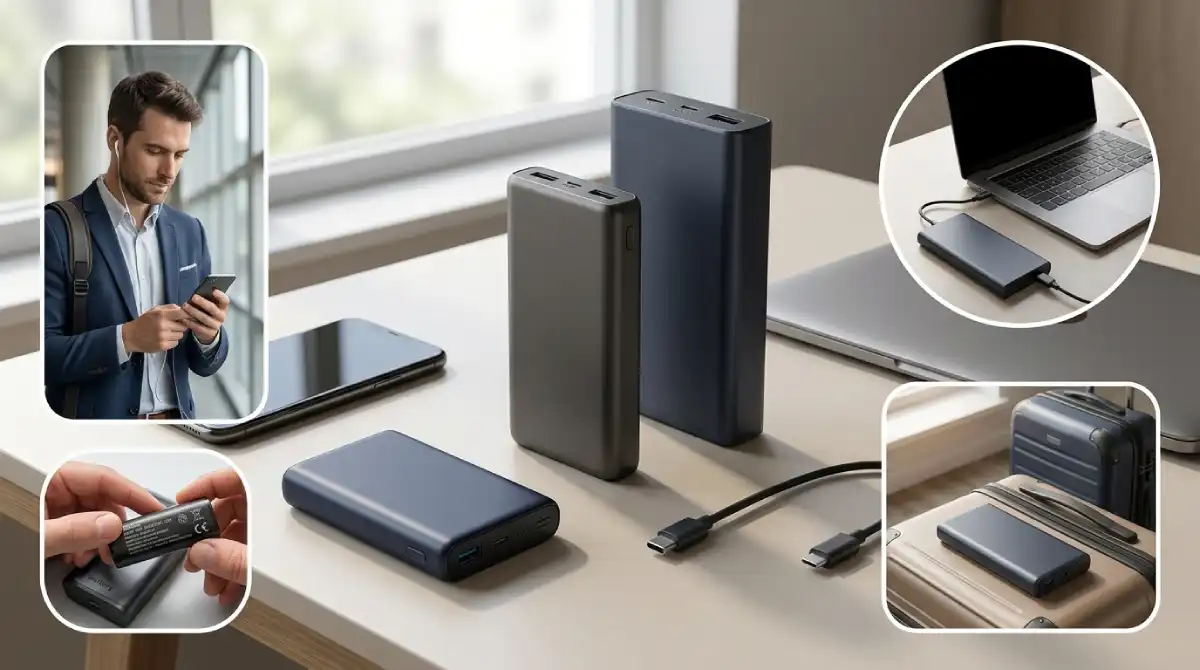
The best power bank is the one you will carry every day without thinking about it. That sounds simple, but the label on the box makes it hard. Numbers like 25,000mAh and 250W look impressive, yet they say little about weight or airline rules. Let’s sort out what really matters before you spend money.
Table Of Content
- How to Choose the Best Power Bank: Start With Watt-Hours
- Quick Picks at a Glance
- Anker Nano 10,000mAh: Small Enough for Every Day
- UGREEN Nexode 25,000mAh 145W: Built for Trips and Laptops
- Anker Prime 27,650mAh 250W: Maximum Power Under the Airline Line
- How Much Capacity Do You Need?
- Flying With a Power Bank in 2026: What Changed
- Check Your Model Against the Anker Recall
- Habits That Keep Any Power Bank Safer
- Which Power Bank Fits Your Bag? A Quick Match Guide
- FAQs About Power Banks
You’ll learn how to read watt-hours and which three models fit different routines. I also cover what changed for flyers in 2026. Each pick lists its rated numbers, so you can compare them side by side. The Anker recall gets its own section, since a safe battery beats a fast one.
How to Choose the Best Power Bank: Start With Watt-Hours

Milliamp-hours, or mAh, tell you how much charge the cells hold. Watt-hours, or Wh, tell you how much energy that really is. The FAA’s tip is to multiply the battery voltage by the amp hours. So 25,000mAh at 3.6 volts works out to 90 Wh.
That math matches the ratings on the models in this guide. UGREEN lists its 25,000mAh Nexode at 90 Wh. Anker lists its 27,650mAh Prime at 99.54 Wh. Both land just under the 100 Wh line that airlines care about.
Rated capacity is also not what reaches your phone. Anker’s page for the Prime says its real capacity runs 17,970 to 19,300 mAh. That’s roughly 65 to 70 percent of the rating. Voltage conversion and heat likely explain much of the gap.
Here’s a simple way to plan. Say your phone battery holds about 4,000 mAh. At 65 percent, a 10,000mAh bank gives about one and a half full charges. A 25,000mAh bank gives about four, though these are estimates, not promises.
Quick Picks at a Glance
These three models cover the best power bank choices for most routines. Output figures come from each maker’s own listings, so confirm them before you buy. Prices vary by retailer and change often, so check them yourself.
| Model | Rated capacity | Max output | Best for |
|---|---|---|---|
| Anker Nano 10,000mAh | 10,000mAh | 30W | Daily carry |
| UGREEN Nexode 25,000mAh | 25,000mAh (90 Wh) | 145W total | Trips and laptops |
| Anker Prime 27,650mAh | 27,650mAh (99.54 Wh) | 250W total | Heavy users |
Anker Nano 10,000mAh: Small Enough for Every Day
For many people, the best power bank for daily carry is a slim one. The Nano is a 10,000mAh bank with a 30W output and a built-in USB-C cable. Retail listings give its size as about 4.1 by 2.1 by 1 inch. They list the weight at 7.58 ounces.
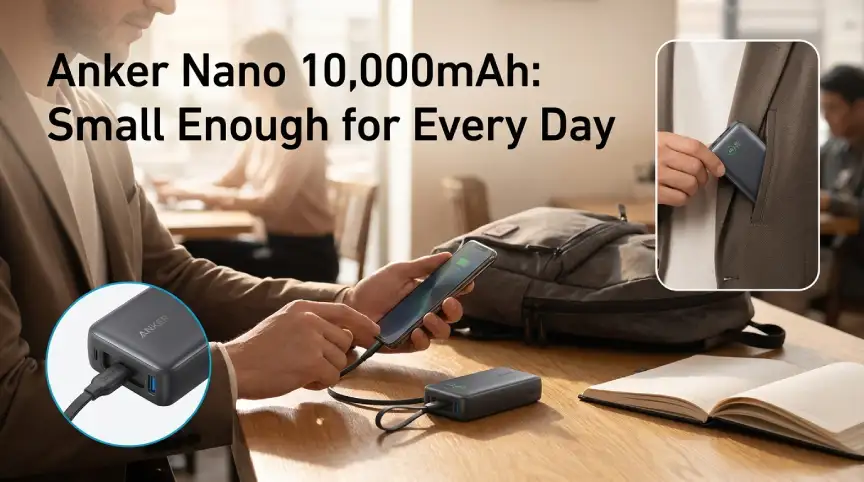
The cable does two jobs. It charges your devices, and it also recharges the bank itself. That means one less cord to remember on a busy morning.
If you commute by bus and your phone fades by mid-afternoon, this size makes sense. It slips into a jacket pocket or a small bag. By the math above, it covers a long day, not a long weekend. A 30W output is also light for most laptops.
If the cells run at 3.6 volts, the battery works out to about 36 Wh. That’s my math, not an Anker rating, so read the label on your own unit. The model number on the back should not match any number on the recall list below.
UGREEN Nexode 25,000mAh 145W: Built for Trips and Laptops
For longer trips, the best power bank gives you room to charge several things. UGREEN lists the Nexode at 25,000mAh and 90 Wh. Its listing splits the output as 100W plus 45W across two USB-C ports. The same listing says one port can reach 140W.
UGREEN says a 65W adapter refills the bank in about two hours. Its German page also says it can charge three devices at once. Those are the maker’s claims, so treat them as ratings.
Take a three-day work trip with a phone, tablet, and thin laptop. A bank this size handles all three. You charge everything from one block instead of hunting for outlets. The 100 Wh airline limit leaves you a comfortable margin at 90 Wh.
The trade-off is weight. UGREEN’s EU listing gives 513 grams, which is about 1.1 pounds. You’ll notice that in a small bag. If you only charge a phone, a lighter bank is the better call.
Anker Prime 27,650mAh 250W: Maximum Power Under the Airline Line
The Prime is for people who run a laptop, a phone, and another gadget at once. Anker lists two USB-C ports and one USB-A port. Total output is 250W. The user guide gives its size as 57 by 49.7 by 161.7 millimeters.
Anker’s Singapore page lists the capacity at 99.54 Wh. That sits just under the 100 Wh limit, which is a thin margin. Confirm the printed rating on your own unit before you head to the airport.
The same page includes a compatibility warning. It says the bank may have issues with ASUS laptops. It also says the ROG Ally handheld charges at 30W at most. Handheld owners can compare devices in our Steam Deck OLED vs ROG Ally X guide.
A retail listing shows a 24-month warranty. Most people never need 250W, so this one suits a narrow group. If you charge only a phone and earbuds, a smaller bank costs less and weighs less. Save the Prime for real laptop work.
How Much Capacity Do You Need?
For most people, a 10,000mAh bank is enough for daily use. Trips and laptop work call for 20,000mAh or more. The best power bank for you depends on what you charge and how far you travel.
For daily phone top-ups, 10,000mAh gives about one and a half charges by our planning math. That covers a workday plus a late evening. If your phone already lasts all day, a smaller bank may be plenty. Stopping background apps on Android can also cut how often you top up.
Weekend trips call for 20,000mAh or more. You get several phone charges, plus a tablet refill or two. Earbuds and a smartwatch sip little power and barely dent the total.
Laptops need more than capacity, because wattage matters just as much. Check the rating on your laptop’s own charger. A bank near that number works best, while a weaker one charges slowly. Some thin laptops want 65W, and larger ones ask for more.
Flying With a Power Bank in 2026: What Changed
The FAA says spare lithium batteries, power banks included, belong in carry-on baggage only. If a carry-on gets checked at the gate, take the power bank out first. The FAA also asks you to protect the terminals from short circuits. Tape, a case, or a snug pouch all work.
On size, the FAA allows rechargeable batteries up to 100 Wh without special approval. With airline approval, you may carry up to two spares from 101 to 160 Wh. You can read the full rule on the FAA’s PackSafe lithium battery page.
On 27 March 2026, ICAO limited passengers to two power banks each. It also banned recharging them during flights. Crew can still carry and use them as aircraft operations require. You can read the announcement on ICAO’s news page.
The FAA page still says most batteries have no quantity limit. It also warns that airlines may set stricter caps. Rules differ by country and carrier, so pack two or fewer and read your airline’s page.
Some airlines go further than the global rule. Emirates says passengers may carry one power bank under 100 Wh. Using it onboard is banned, and it can’t sit in the overhead bin. If you fly that route, charge your devices before boarding.
Before any flight, read the Wh rating and keep the bank where you can reach it. If it gets hot, swells, or smokes, tell the crew right away. That advice comes straight from the FAA.
Check Your Model Against the Anker Recall
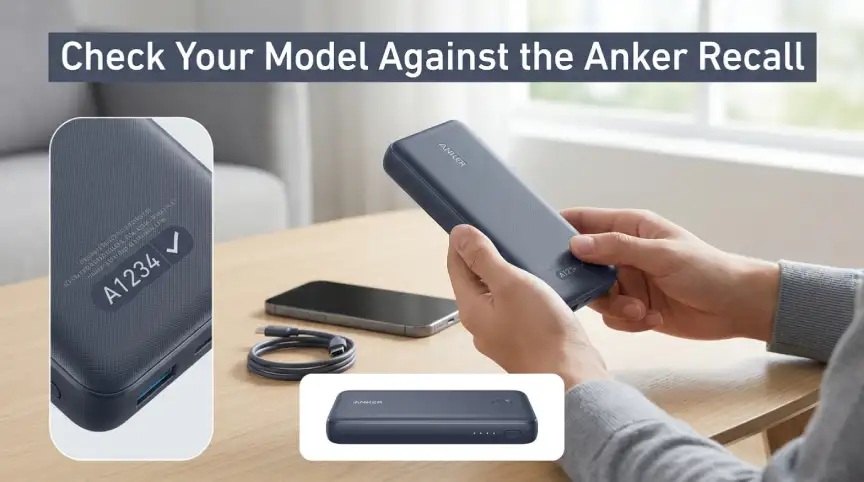
In September 2025, the U.S. Consumer Product Safety Commission announced a recall of about 481,000 Anker power banks. The models are A1647, A1652, A1257, A1681, and A1689. The commission cited 33 reports of overheating incidents.
These banks sold between August 2023 and June 2025 for roughly $30 to $50. Anker offers a cash refund or a gift card. The commission tells owners to stop using a recalled bank and register on Anker’s recall page. Anker says it will share return or disposal steps, so don’t toss it in the trash.
The model number is engraved or printed on the back or side. Check it against the list, then search it on cpsc.gov to confirm. The FAA adds that damaged or recalled batteries can’t fly unless removed or made safe.
A recall for one brand doesn’t make every other brand safe. It does show why a printed Wh rating, a known maker, and a working warranty matter. Treat the model number as the first thing you check on any bank you already own.
Habits That Keep Any Power Bank Safer
The FAA says lithium-ion batteries can overheat without warning. It lists damage, heat, water, overcharging, and poor packing as triggers. Manufacturing defects can cause it too.
So keep a bank out of a hot car or a wet bag. Stop using one that has been dropped hard, dented, or swollen. Unplug it once your device is full, and don’t leave it charging under a pillow.
Which Power Bank Fits Your Bag? A Quick Match Guide
The best power bank for you matches your routine and passes the airline test. The Nano suits daily phone top-ups. The UGREEN Nexode fits trips with a tablet or thin laptop. The Prime serves people who run several gadgets from one bag.
Whichever you choose, check the printed Wh rating and the model number before you leave home. Keep it in your carry-on, and expect airlines to allow no more than two. Compare current prices and read your airline’s own page, since both change often.
FAQs About Power Banks
What is the best power bank for flying?
Any bank rated 100 Wh or less that you keep in your carry-on. That includes the Nano at 10,000mAh and the Nexode at 90 Wh. Always check your airline’s own limits too.
Can I put a power bank in checked luggage?
No. The FAA says spare lithium batteries, including power banks, must travel in carry-on baggage only. If your carry-on is checked at the gate, remove the bank first.
Can I use a power bank on a plane?
It depends on the airline. ICAO bans recharging the bank during flights, and Emirates bans using one at all. Check your carrier’s page before you fly.
How do I find my power bank’s Wh rating?
Look for the Wh figure printed on the unit. If it isn’t there, multiply the voltage by the amp hours, as the FAA suggests. For 10,000mAh at 3.6 volts, that’s 36 Wh.
Is a higher wattage power bank better?
Not always. Match the output to your device. A 30W bank suits a phone or tablet. A laptop needs a bank close to its charger’s rating.




No Comment! Be the first one.