




Museums of the Future: Flexible Raised Floors for Evolving Exhibitions and Immersive Experiences
Discover how the Gridd Adaptive Cabling Distribution System gives museums and galleries the ultimate flexibility to reconfigure exhibits, lighting, and immersive tech in hours—all without invasive...
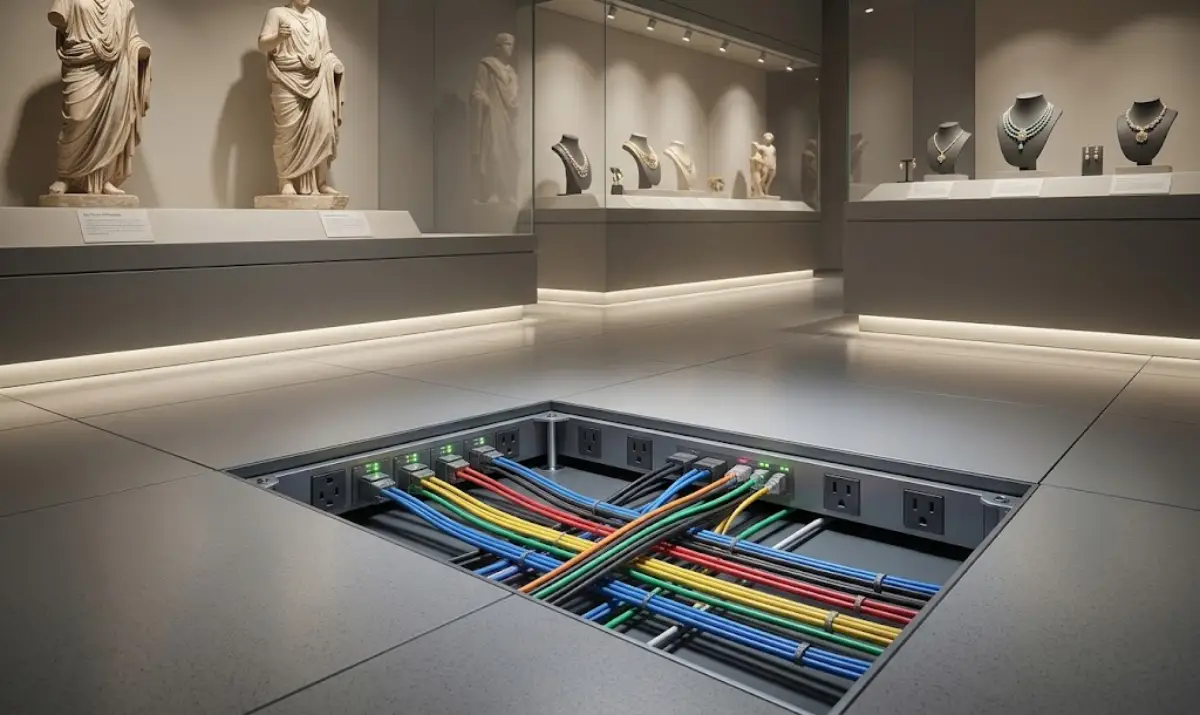
Museum and gallery exhibits rarely stay still. New artifacts arrive, interactive installations rotate in and out, and immersive tech experiences replace last season’s displays, often on a tight timeline. For curators and facility staff, that constant turnover creates a real balancing act: keeping visitors immersed, supporting frequent exhibit changes, and integrating modern technology like lighting, sensors, and screens, all without disrupting the aesthetics or flow that make a gallery feel intentional.
Table Of Content
Traditional cabling methods make that balancing act harder than it needs to be. Running power and data through walls or ceilings, or trenching them into the floor, creates visible clutter and disrupts operations whenever an exhibit changes. Saw-cutting and trenching mean dust, noise, and inconvenience for patrons, the opposite of the calm, curated experience a museum aims to create. Reconfiguring a gallery the traditional way often means closing a wing for days, scheduling contractors around visitor hours, and living with whatever cable runs were decided on during the last renovation, even if they no longer serve the current show. For historic buildings, the stakes are even higher, since invasive construction can threaten the very structures museums are meant to preserve.
The Gridd® Adaptive Cabling Distribution System® offers a different path. By delivering data and power through a low-profile raised floor rather than walls, ceilings, or slabs, Gridd gives museums and galleries the flexibility to build engaging, future-ready spaces without the disruption of traditional infrastructure demands.
Why Museums and Galleries Need Adaptive Flooring Solutions
Museum environments carry a distinct set of demands that most commercial cabling solutions were never designed to address:
- Frequent exhibit changes and rotations, often on compressed timelines between shows.
- Growing use of interactive displays, digital kiosks, AV projections, and smart lighting throughout gallery spaces.
- A need to preserve historic structures, which rules out invasive trenching or ceiling alterations in many buildings.
- High foot traffic, which puts a premium on safety, quiet operation, and an uncluttered aesthetic.
Gridd’s all-steel, modular design addresses each of these challenges directly. It installs without tools, provides cable pathways at roughly 19.7-inch intervals on both axes for high capacity, and installs at about 1,000 square feet per installer per day. Because the system isn’t fixed to the subfloor, it’s compatible with a range of modular floor coverings, including carpet tile, luxury vinyl tile, and carpet. Gridd can match the aesthetic of nearly any gallery space while staying hidden, minimally disruptive, and sustainable.
Key Benefits for Museums of the Future
As museums increasingly experiment with AI-driven interactives and virtual reality storytelling, the underlying infrastructure must keep pace, or it becomes the limiting factor on what curators can actually build.
Unparalleled flexibility for exhibits. Gridd allows for rapid setup, teardown, and reconfiguration of displays, lighting, and technology without downtime or major construction. Facility teams can set up for an evening event and have the room returned to the original setup by morning. Power and data are accessible virtually anywhere on the floor plan, which is especially valuable for temporary or traveling exhibits that need to be installed and struck quickly.
Gridd Power, the system’s integrated 50-amp modular bus, delivers power to tap-off points every 12 inches so electrical service can move with the exhibit rather than dictating where it goes.
Once the floor is installed, Gridd Mobile gives facility and AV staff an augmented-reality view of exactly where every cable runs beneath the floor, right from a phone or tablet, so future changes can be planned quickly and without guesswork.
Seamless technology integration. Because cabling remains concealed beneath the floor, galleries maintain a clean aesthetic, with no visible cables or trip hazards competing for attention with the art and artifacts themselves.
- Lighting and interactive elements: Concealed power supports spotlights, LED displays, sensors, and touchscreens without a single visible cord.
- AV and multimedia: Projectors, sound systems, video walls, and AR/VR stations can be placed wherever the storytelling calls for them, not wherever the nearest outlet is.
- Digital and smart features: The same underfloor infrastructure supports kiosks, wayfinding systems, climate-controlled display cases, and broader data networks.
Operational and visitor advantages. Gridd is engineered to stay quiet, stable, and bump-free underfoot, with no creaking associated with older raised-floor systems. Its ultra-low profile preserves ceiling height, which matters for both historic buildings and the dramatic lighting and spacious feel many galleries rely on. ADA-compliant ramps and slopes integrate cleanly with the system for enhanced accessibility, and because reconfiguration doesn’t require a contractor, maintenance costs stay lower, and turnaround between shows moves faster. For institutions juggling a packed calendar of rotating exhibitions, that faster turnaround can be the difference between opening on schedule and pushing back a launch date.
Cost, Sustainability, and Future-Proofing
The case for adaptive flooring extends well beyond the exhibit floor itself.
Efficiency and ROI. Fast installation at roughly 1,000 square feet per installer per day keeps labor costs down and delivers immediate savings on retrofits compared to trenching or ceiling work. Because Gridd isn’t attached to the building, it depreciates as equipment rather than as permanent construction.
Sustainability. Gridd is reusable, recyclable, and BuildingGreen-approved and GreenSpec-listed, supporting circular-economy principles and minimizing waste each time an exhibit is turned over.
Preservation and compliance. For historic museum buildings, Gridd’s minimal structural impact enables modernization of the technology infrastructure while aligning with green building standards and preservation requirements.
Future-readiness. As exhibits increasingly lean on higher bandwidth and more interactive elements, a scalable cabling foundation means the floor won’t be the constraint the next time curatorial ambitions outpace the current setup.
Real-World Examples and Testimonials
Gridd’s flexibility has already found a home in gallery and museum settings that demand both technical performance and visual restraint. Lisson Gallery in New York City and the Museum of the Bible in Washington, D.C. have both installed the Gridd system to support their exhibit spaces.
Clients across industries consistently point to the same advantages: fast, tool-free installation and the ability to reconfigure a space in hours rather than weeks. One facilities manager noted that without a system like Gridd, a comparable project would have required removing the concrete flooring altogether to run power and data conduit, an approach that simply isn’t compatible with an active gallery calendar.
Another described relocating eight floor boxes in under two hours, work that would traditionally have meant a multi-day construction disruption in the middle of an exhibit season. For museum and gallery managers weighing the cost of a raised-floor system against the cost of repeated renovations, that kind of turnaround time tends to settle the question quickly.
In an era of dynamic, tech-enhanced storytelling, adaptive flooring has become a key ingredient in creating museum experiences that feel both timeless and endlessly renewable. Gridd empowers museums and galleries to focus on curation and visitor engagement by providing a flexible foundation that keeps pace with technology and change.
Please contact a Gridd Advisor for samples, BIM/CAD resources, or a consultation to design the next museum of the future.

No Comment! Be the first one.