





Steam Deck OLED vs ROG Ally X in 2026: Which Handheld Gaming PC Should You Actually Buy?
Two of the most powerful handheld gaming PCs go head to head in 2026. The Steam Deck OLED vs ROG Ally X battle comes down to more than specs. Find out which one truly wins for you.

The Steam Deck OLED vs ROG Ally X debate is the hottest topic in handheld gaming right now. Both devices are powerful, both are impressive, and both have passionate fans defending their choice online. But they are fundamentally different machines built for different types of players. If you want a clear, honest answer based on real benchmarks and 2026 pricing, you are in exactly the right place.
Table Of Content
- Why This Comparison Matters More Than Ever in 2026
- Full Specs Comparison: Steam Deck OLED vs ROG Ally X
- Performance: Who Wins the Benchmark Battle?
- Display: OLED Beauty vs Sharp Clarity
- Battery Life: The Most Important Spec You Are Ignoring
- Operating System: SteamOS vs Windows 11
- Price and Value: Where Does Your Money Go Further?
- Game Library and Compatibility
- Who Should Buy the Steam Deck OLED?
- Who Should Buy the ROG Ally X?
- Final Verdict: Steam Deck OLED vs ROG Ally X
- FAQ: Steam Deck OLED vs ROG Ally X in 2026
This guide breaks down every key difference. By the end, you will know exactly which device fits your gaming lifestyle.
Why This Comparison Matters More Than Ever in 2026
The handheld gaming PC market has transformed dramatically since 2022. The handheld gaming PC market has exploded since Valve launched the original Steam Deck in 2022, and ASUS answered with the ROG Ally lineup shortly after. In April 2026, the two leading options are the Steam Deck OLED starting at $549 and the ROG Ally X starting at $799.
Prices have shifted. Performance gaps have widened. And the choice between these two devices is now more consequential than ever. Getting this decision wrong means spending hundreds of dollars on a device that does not match your actual needs.
The honest answer depends on what you play, where you play, and whether you care about anything outside your Steam library. Let us find that answer together.
Full Specs Comparison: Steam Deck OLED vs ROG Ally X
Before we dig into real-world performance, here is a full side-by-side specification breakdown.
| Feature | Steam Deck OLED | ROG Ally X |
|---|---|---|
| Processor | AMD Zen 2 (4C/8T) | AMD Zen 4 (8C/16T) |
| RAM | 16GB LPDDR5 | 24GB LPDDR5X |
| Storage | 512GB or 1TB SSD | 1TB SSD |
| Display | 7.4″ OLED 1280×800 90Hz HDR | 7″ IPS 1920×1080 120Hz VRR |
| Battery | 50Whr | 80Whr |
| Weight | 640g | 715g |
| Operating System | SteamOS | Windows 11 |
| Starting Price (2026) | $549 to $790 | $799 to $1000 |
| Game Pass Support | Limited | Full native support |
| Upgradeable Storage | microSD | M.2 SSD slot |
Screen specs differ meaningfully: the Steam Deck OLED offers a 7.4-inch 1280×800 OLED at 90Hz HDR, while the ROG Ally provides a 7-inch 1920×1080 IPS at 120Hz VRR. The processor jump from Zen 2 to Zen 4 represents a significant generational performance leap.
Performance: Who Wins the Benchmark Battle?
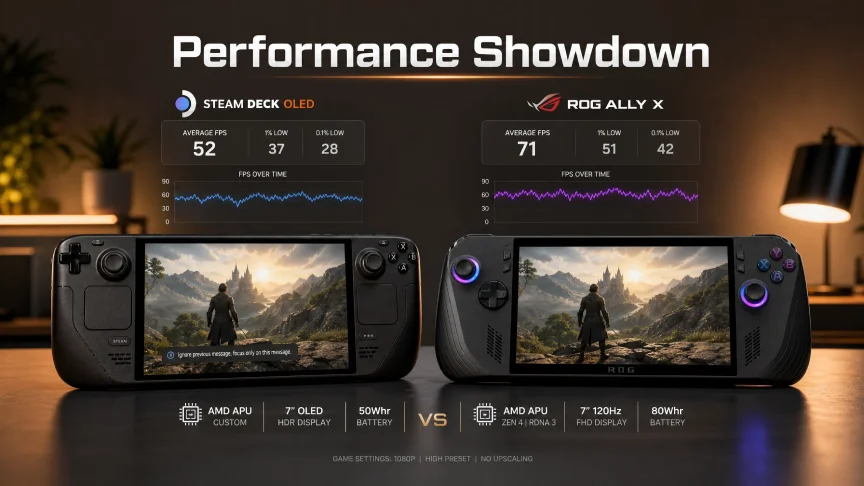
Raw performance is where the ROG Ally X pulls clearly ahead of the Steam Deck OLED.
The ROG Ally X delivers up to 50% higher FPS in AAA titles thanks to its Zen 4 architecture and RDNA 3 graphics.
At balanced 15W profiles, Steam Deck OLED typically runs modern titles at 35 to 42 FPS using FSR, while the ROG Ally X pushes 42 to 50 FPS under similar settings. The Ally X improves thermals and maintains higher sustained performance.
However, raw numbers only tell part of the story. The Steam Deck’s operating system is purpose-built for gaming, which means it squeezes more performance per watt than Windows 11 can deliver.
SteamOS is an operating system purpose-built for gaming that outperforms Windows at low power draws by a factor of 2x.
For most games running at 30 to 45 FPS, both devices deliver smooth, enjoyable experiences. The performance gap matters most when you push demanding AAA titles at high settings. If you are playing indie games, older titles, or anything from the mid-range library, the difference is barely noticeable.
Display: OLED Beauty vs Sharp Clarity
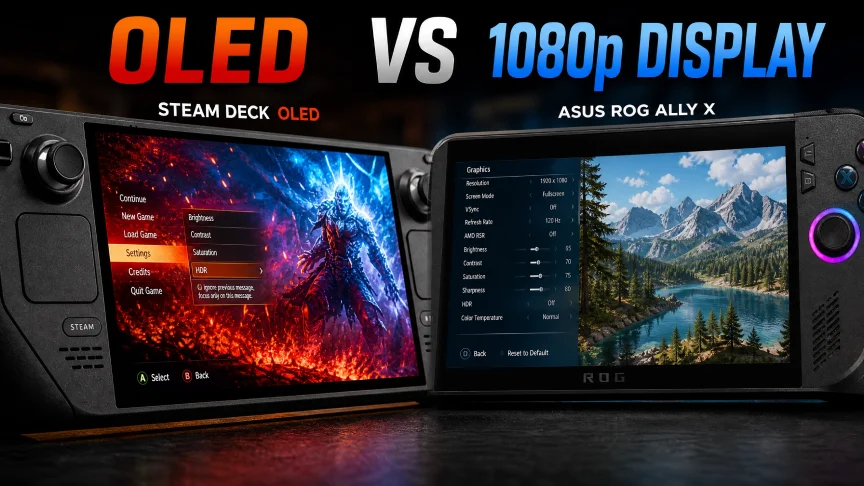
This is the section where personal preference matters enormously. Both displays are excellent for different reasons.
The Steam Deck OLED’s 7.4-inch HDR OLED delivers deeper blacks and vibrant colors for immersive single-player games, while the ROG Ally’s 1080p 120Hz IPS offers sharper resolution for competitive play.
The Steam Deck OLED wins on color depth, contrast ratio, and visual warmth. Games like Cyberpunk 2077 and Elden Ring look genuinely stunning on that screen. The HDR support makes dark scenes dramatically more atmospheric.
The ROG Ally X wins on sharpness and motion clarity. Its 1080p native resolution is noticeably crisper than the Steam Deck’s lower-resolution panel. For fast-paced games and competitive shooters, the 120Hz IPS screen feels snappier.
Games like Elden Ring and Baldur’s Gate 3 benefit greatly from the OLED’s superior contrast and detail, while Cyberpunk 2077 makes full use of the updated version with Ray Tracing mode.
For most single-player gaming in 2026, the OLED screen is the more pleasurable everyday experience.
Battery Life: The Most Important Spec You Are Ignoring
Battery life is where the Steam Deck OLED has long held an advantage. The ROG Ally X has significantly closed this gap with its 80Whr battery.
Battery efficiency strongly favors the Steam Deck OLED in unplugged use. Indie and older titles often run for 6 to 10 hours on the Steam Deck OLED, while demanding AAA games average 2 to 3 hours without aggressive tuning.
The ROG Ally X offers up to 3 to 4 hours in optimized gaming scenarios, a meaningful improvement over the base Ally model’s 1 to 3 hours.
The ROG Ally X showed impressive battery performance in testing, completing a full benchmark suite on a single charge, which had never happened before on any handheld. It was also able to play Halo 2 Anniversary on Performance mode for an hour while only losing 30% of battery.
The practical takeaway is straightforward. For long commutes, flights, or sessions away from a power outlet, the Steam Deck OLED is still the safer choice. For gaming mostly at home or near a charger, the ROG Ally X’s battery limitation matters far less.
Operating System: SteamOS vs Windows 11
This is arguably the most important difference between these two devices. The operating system shapes your entire daily experience.
The Steam Deck OLED is the more suitable choice for the majority of people. It provides a smoother overall experience, a much better screen, longer battery life, and a reasonable price. It feels more like a handheld game console rather than a small PC that you have to constantly adjust and manage.
SteamOS is clean, fast, and built entirely around gaming. You turn it on, and you are playing in seconds. There is no Windows bloat, no update prompts interrupting your session, and no confusing desktop mode to navigate for basic tasks.
Windows 11 on the ROG Ally X is more powerful but also more demanding of your patience. You get full access to Xbox Game Pass, the Epic Games Store, and every PC launcher imaginable. You can use it as a real productivity PC. But it requires more setup and occasional maintenance.
The Xbox Ally X is a sensible choice if your primary desire is to get the highest possible performance, you need Windows-only game support, or you are fine with dealing with the setup and maintenance that comes with owning a PC.
For players who just want to pick up and play without thinking about software, SteamOS wins without question.
Price and Value: Where Does Your Money Go Further?
The $250 price gap between the Steam Deck OLED at $549 and the ROG Ally X at $799 tells you which device most players should buy.
However, pricing in 2026 has gotten complicated. Valve’s website no longer has the Steam Deck OLED in stock, and the only place to find it is from third party sellers who usually charge more. The 512GB OLED version is now going for about $800, which is the best price currently available.
This pricing change dramatically affects the value equation. When both devices cost around $800, the ROG Ally X becomes a much more compelling choice simply because it offers significantly more performance for the same money.
For 7 out of 10 handheld gaming buyers, the Steam Deck OLED is the better investment when purchased at its original price. Its combination of display quality, battery efficiency, SteamOS polish, and a $250 lower price makes it the handheld to beat in 2026.
The bottom line on pricing: if you can find the Steam Deck OLED at its original price range, it wins the value argument clearly. At current inflated third party prices, the ROG Ally X becomes much harder to dismiss.
Game Library and Compatibility
Both devices can play an enormous range of games, but they access those libraries differently.
SteamOS ensures seamless access to over 14,000 verified or playable titles, minimizing setup friction. Trackpads, gyro aiming, and extensive community tools enhance the experience for players who enjoy customization and emulation.
Windows 11 on the ROG Ally X provides native support for Xbox Game Pass, Epic Games Store, mods, and productivity apps, making it a true portable PC.
If your library lives mostly on Steam, the Steam Deck OLED is the obvious fit. If you rely on Game Pass or regularly use other launchers, the ROG Ally X makes your gaming life significantly easier.
Who Should Buy the Steam Deck OLED?
The Steam Deck OLED is the right choice for a specific type of gamer.
You should buy the Steam Deck OLED if you want a device that feels like a proper handheld console rather than a portable PC. You should choose it if you have a large Steam library you want to enjoy on the go. You should pick it if you prioritize battery life, display quality, and ease of use over raw frame rates. And you should consider it if budget is a genuine concern.
For a first-time handheld PC buyer, the Steam Deck OLED is the better starting point. The lower price, longer battery life, and console-like SteamOS experience make it the more accessible entry.
Who Should Buy the ROG Ally X?
The ROG Ally X exists for a different kind of player entirely.
You should buy the ROG Ally X if you want the highest possible frame rates in demanding AAA games. Choose it if you use Xbox Game Pass frequently or rely on Windows-only game launchers. Pick it if you want a device that can double as a portable productivity PC. And choose it if you want full hardware upgrade flexibility through M.2 storage expansion and higher RAM.
The ROG Ally X earns its recommendation for gamers who prioritize raw FPS above all else, need native Windows 11 compatibility for Game Pass or non-Steam launchers, or want a device that doubles as a portable Windows PC. It’s 40 to 60% performance advantage in AAA titles is real and meaningful when plugged in.
Final Verdict: Steam Deck OLED vs ROG Ally X
The ROG Ally X is the better machine on paper, but the Steam Deck OLED is the better handheld. In a device category defined by portability, that distinction matters deeply.
For most players in 2026, the Steam Deck OLED still earns the recommendation when found at reasonable prices. Its OLED display, SteamOS simplicity, and battery life make daily handheld gaming genuinely enjoyable.
For power users, Game Pass subscribers, and anyone who values maximum performance over everything else, the ROG Ally X is worth every extra dollar. It is not a perfect device, but it is the most capable handheld gaming PC you can buy today.
The best handheld gaming PC in 2026 depends on playstyle, not just price. Value emerges when hardware, software, and usage habits align, making an informed choice more important than chasing specs.
Neither device will disappoint a serious gamer. The right one is simply the one that matches your real-life gaming habits.
FAQ: Steam Deck OLED vs ROG Ally X in 2026
Is the Steam Deck OLED or ROG Ally X better for AAA gaming?
The ROG Ally X is better for AAA gaming performance. It delivers up to 50% higher FPS in demanding titles thanks to its AMD Zen 4 architecture and RDNA 3 graphics compared to the Steam Deck OLED’s older Zen 2 chip.
Which has better battery life: Steam Deck OLED or ROG Ally X?
The Steam Deck OLED typically offers better battery life for everyday gaming. It delivers 6 to 10 hours for indie titles and 2 to 3 hours for demanding games. The ROG Ally X offers 3 to 4 hours under optimized conditions thanks to its larger 80Whr battery.
Which display is better: Steam Deck OLED or ROG Ally X?
It depends on what you value. The Steam Deck OLED has a superior OLED panel with deeper blacks, better HDR, and vibrant colors. The ROG Ally X has a sharper 1080p IPS display with 120Hz VRR for smoother motion in fast games.
Is the ROG Ally X worth the extra cost over the Steam Deck OLED?
For most players, no. The Steam Deck OLED offers a better value at its original price point. However, with Steam Deck OLED prices rising in 2026, the ROG Ally X becomes much more competitive when both devices cost around the same amount.
Which is easier to use for beginners: Steam Deck or ROG Ally X?
The Steam Deck OLED is significantly easier to use for beginners. SteamOS is designed purely for gaming and requires almost no setup. The ROG Ally X runs Windows 11, which offers more power but also more complexity and occasional maintenance.
Can the ROG Ally X play Steam games?
Yes, the ROG Ally X can play Steam games. It runs Windows 11, so you can install the Steam app directly. However, it does not have SteamOS, which means some community optimizations and features are exclusive to the Steam Deck.
Subscribe to the TechAndTrends newsletter and never miss the latest updates in AI, gaming, cybersecurity, smart technology, software, and emerging tech. Get expert guides, honest product comparisons, practical tips, and breaking technology news delivered straight to your inbox. Join thousands of readers who stay informed, make smarter tech decisions, and keep up with the trends shaping the future.






No Comment! Be the first one.