





Panther Lake Performance Laptops: Everything You Need to Know in 2026
If you’ve been waiting for a laptop that actually feels like a leap forward — Panther Lake performance laptops are finally here. Intel’s Core Ultra Series 3, built on the brand-new 18A...
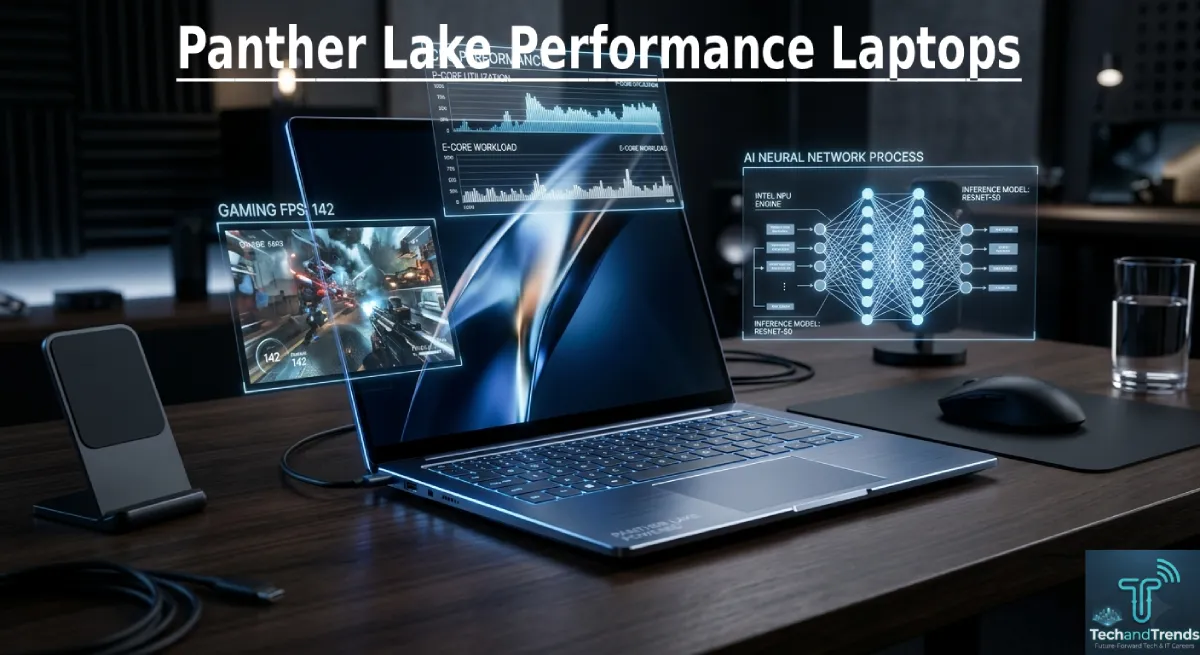
If you’ve been waiting for a laptop that actually feels like a leap forward — Panther Lake performance laptops are finally here. Intel’s Core Ultra Series 3, built on the brand-new 18A process node, delivers desktop-rivaling CPU scores, gaming-capable integrated graphics, and a 180 TOPS AI engine, all packed into thin-and-light chassis that last all day on a single charge. This guide breaks down exactly what makes these chips special and which laptops are worth buying right now.
Table Of Content
- What Are Panther Lake Performance Laptops?
- Core Architecture: What’s New Inside Panther Lake
- Panther Lake Performance Laptops vs. the Competition
- Best Panther Lake Laptops to Buy in 2026
- Battery Life and Power Efficiency: Intel’s Big Return
- Who Should Buy a Panther Lake Performance Laptop?
- What About Wildcat Lake? The Value Option Explained
- Final Verdict: Is Panther Lake Worth It?
| Specification | Value |
|---|---|
| Total AI TOPS | 180 |
| Multi-thread gain over Arrow Lake | 24% |
| Max CPU cores | 16 (4P + 8E + 4LPE) |
| Max LPDDR5X RAM support | 96 GB |
What Are Panther Lake Performance Laptops?
Panther Lake is Intel’s internal codename for its Core Ultra Series 3 family of processors, officially launched at CES 2026. These chips represent the most significant architecture shift Intel has made in a decade, being the first consumer processors to ship on Intel’s in-house 18A (1.8nm-class) manufacturing process.
Unlike previous generations that relied heavily on TSMC fabs, the Panther Lake compute tiles — containing the powerful Cougar Cove P-cores and Darkmont E-cores — are manufactured at Intel’s own Fab 52 facility in Chandler, Arizona. This is Intel taking back control of its manufacturing destiny, and the results speak for themselves.
The lineup is broad and covers multiple user segments:
- Core Ultra X9 388H / Ultra X7 300H — High-performance ultraportable; targets content creators and power users who skip the discrete GPU
- Core Ultra 9 386H / Ultra 7 356H — Mainstream performance notebooks, often paired with an NVIDIA RTX 5000 discrete GPU
- Core Ultra 7 365 / Ultra 5 325 — Thin-and-light efficiency models; direct successors to Lunar Lake, ideal for everyday productivity and travel
Core Architecture: What’s New Inside Panther Lake
Understanding what makes Panther Lake tick is essential before choosing a laptop. The chip is built on a multi-tile architecture, meaning different parts of the chip are manufactured on different processes and assembled together — similar to building with Lego bricks, as Intel engineers actually demonstrated at launch using a physical Lego kit.
CPU Cores: Cougar Cove + Darkmont
The flagship Core Ultra X9 388H features a 4P + 8E + 4LPE core configuration — four high-performance Cougar Cove cores for demanding single-threaded tasks, eight Darkmont efficiency cores for balanced workloads, and four low-power efficiency cores for background tasks and deep sleep states. This hybrid design achieves an impressive Cinebench 2024 single-core score of 131, outpacing even overclocked desktop chips like the Core i7-14700K running at 5.6GHz.
Xe3 “Celestial” Integrated Graphics
The GPU tile is where Panther Lake genuinely surprises. The Arc B390 integrated graphics features 12 Xe3 cores, 96 execution units, and 1,536 ALUs. In gaming benchmarks, PCWorld found that titles like Shadow of the Tomb Raider reach fully playable frame rates at settings previously reserved for laptops with discrete NVIDIA GPUs. Intel claims Panther Lake’s gaming performance matches a laptop equipped with an NVIDIA GeForce RTX 4050 — a bold claim that early real-world testing largely supports.
NPU 5: The On-Device AI Engine
Panther Lake ships with Intel’s newest NPU 5, delivering 50 TOPS of dedicated AI processing power — meeting Microsoft’s Copilot+ PC certification requirements. When combined with the GPU’s 122 TOPS of AI compute, the total platform AI performance reaches an eye-opening 180 TOPS. Intel also claims its NPU can perform LLM inference 4.3× faster than AMD’s XDNA2 NPU found in the Ryzen AI 9 HX 370.
💡 Real-World AI Speed: Running Llama 3.1 (8B) on the NPU produces around 20 tokens per second — fast enough for a comfortable reading experience. Switch to the GPU, and that jumps to 25 tokens per second. Local AI that genuinely works without burning through your battery.
Panther Lake Performance Laptops vs. the Competition
The laptop market in 2026 is more competitive than ever. Here’s how Panther Lake performance laptops stack up against the top rivals from AMD and Qualcomm.
| Feature | Intel Panther Lake (Core Ultra X9 388H) | AMD Ryzen AI 9 HX 370 | Qualcomm Snapdragon X Elite |
|---|---|---|---|
| Process Node | Intel 18A (compute tiles) | TSMC 4nm | TSMC 4nm |
| Total AI TOPS | 172–180 TOPS | ~80 TOPS | ~75 TOPS |
| NPU TOPS | 50 TOPS (NPU 5) | 50 TOPS (XDNA2) | 45 TOPS |
| iGPU | Arc B390 (Xe3, 12 cores) | Radeon 890M (RDNA 3.5) | Adreno X1 |
| Max RAM | 96 GB LPDDR5X @ 9600 MT/s | 64 GB LPDDR5X | 64 GB LPDDR5X |
| x86 App Compatibility | Native ✅ | Native ✅ | Emulation ⚠️ |
| Copilot+ PC Ready | Yes ✅ | Yes ✅ | Yes ✅ |
Intel’s biggest advantage over AMD is its dramatically higher GPU-side AI compute (122 GPU TOPS vs. roughly 30 GPU TOPS on the Radeon 890M). Against Qualcomm, the key win is native x86 compatibility — no app emulation penalties, no software quirks, full access to every Windows application built in the last 30 years.
AMD still holds an edge in some multi-core workloads, particularly video rendering with DaVinci Resolve (which is heavily optimized for AMD hardware), and photo editing performance remains virtually identical between the two platforms.
Best Panther Lake Laptops to Buy in 2026
OEMs wasted no time building premium devices around the new Core Ultra Series 3 chips. Here are the standout options across different categories:
🏆 Best Overall: Asus ROG Zephyrus G16
- Core Ultra 9 386H paired with NVIDIA RTX 5000 series discrete GPU
- 16-inch OLED display with high refresh rate, stunning color accuracy
- Higher-power GPU configuration that outpaces most competitors
- Best choice for creative professionals who need both CPU and GPU headroom
🎒 Best Ultraportable: Dell XPS 13 (2026)
- Weighs under 2.6 lbs, making it one of the lightest 18A-powered laptops available
- Panther Lake’s thermal efficiency finally solves XPS 13’s historically warm keyboard deck
- NPU 5 handles on-device AI noise cancellation during video calls without impacting battery
- Best for business travelers and students who prioritize portability above all
📱 Best MacBook Alternative: Samsung Galaxy Book6 Ultra
- Updated Dynamic AMOLED 3X display, 20% brighter than the previous generation
- Deep AI integration with Samsung Galaxy phones for a seamless cross-device workflow
- Strong Panther Lake H-series chip with impressive multi-threaded performance
- Best for Android ecosystem users looking for a premium Windows alternative to Apple Silicon
💼 Best for Business: Lenovo Yoga Pro 9i
- Panther Lake + dGPU combo with enterprise security features built in
- Excellent keyboard and large haptic touchpad ideal for all-day productivity
- Supports up to 64 GB RAM, great for power users running VMs or data analysis
- Outstanding battery life — a defining strength of the 18A process node
Battery Life and Power Efficiency: Intel’s Big Return
One of the most celebrated aspects of Panther Lake is what reviewers have called a “return to form” for Intel when it comes to power efficiency. The 18A process node delivers up to 15% better performance per watt compared to previous Intel chip generations, and up to 40% lower package power consumption versus Meteor Lake.
In practical terms, this means fanless premium designs are now possible. Several OEMs are shipping Panther Lake ultrabooks without active cooling fans at all — a milestone that was unthinkable for Intel-powered laptops just two years ago.
Intel also claims 50% better power efficiency than AMD’s Ryzen AI 300 series under matched workloads. While independent testers haven’t fully validated this exact number yet, battery life results from early Panther Lake ultrabooks consistently exceed 12–16 hours in real-world mixed usage — matching or exceeding even ARM-based Snapdragon X machines.
Who Should Buy a Panther Lake Performance Laptop?
Panther Lake isn’t the right upgrade for everyone. Here’s a quick breakdown to help you decide:
✅ Buy Now If You:
- Are using a 12th Gen Intel (Alder Lake) or older laptop — the performance jump is massive
- Rely on AI tools and want to run local LLMs without a cloud subscription
- Want gaming-capable performance without carrying around a heavy gaming laptop
- Need all-day battery life combined with serious processing power
- Work in video editing, 3D design, or creative content production
⏳ Consider Waiting If You:
- Already own a Core Ultra Series 2 (Lunar Lake) machine — efficiency gains are incremental for light tasks
- Are on a tight budget — premium Panther Lake systems currently start around $1,200+
- Need the absolute best multi-core performance — some AMD desktop-class Ryzen mobile chips still lead in specific rendering workloads
What About Wildcat Lake? The Value Option Explained
In April 2026, Intel launched Wildcat Lake, a simplified, lower-cost derivative of Panther Lake. These chips drop the “Ultra” branding and are sold simply as Intel Core Series 3 (not Core Ultra). Wildcat Lake targets budget laptops, commercial deployments, and edge devices where cost, power consumption, and thermal simplicity matter more than peak performance.
Wildcat Lake supports up to 64 GB of RAM in single channel mode (LPDDR5X 7467 MHz or DDR5 6400 MHz). If you need a laptop for basic productivity tasks, light web browsing, and office software, a Wildcat Lake system will offer excellent efficiency at a more affordable price point. Just don’t expect the Xe3 gaming performance or the high-TOPS AI capabilities of the full Panther Lake lineup.
Final Verdict: Is Panther Lake Worth It?
Panther Lake performance laptops represent the most exciting Intel launch in years — and arguably one of the most significant moments for the laptop industry as a whole. The combination of the 18A process node, Cougar Cove/Darkmont hybrid cores, Xe3 Celestial integrated graphics, and the NPU 5 AI engine creates a platform that genuinely delivers on promises that previous generations could only hint at.
For the first time, you can buy a thin ultrabook and get gaming performance that would have required a dedicated graphics card just 18 months ago. You can run local AI models smoothly. You can work unplugged all day. And you can do all of this with full, native compatibility with every Windows application ever written — something Qualcomm’s ARM-based chips still can’t fully claim.
Intel has closed the efficiency gap with ARM, restored competitive CPU performance, and added a world-class GPU to the mix. Panther Lake isn’t just a good Intel chip — it’s a landmark moment for the PC industry.
Ready to Choose Your Panther Lake Laptop?
Compare models from Asus, Dell, Lenovo, and Samsung — all powered by Intel Core Ultra Series 3 — and find the perfect fit for your workflow and budget in 2026.






No Comment! Be the first one.