


Smart Office Lighting in 2026: How to Cut Costs, Boost Productivity, and Future-Proof Your Workplace
Smart office lighting is no longer optional. Businesses using AI-powered, sensor-driven systems are slashing energy costs and boosting employee performance. Here is everything you need to know in...
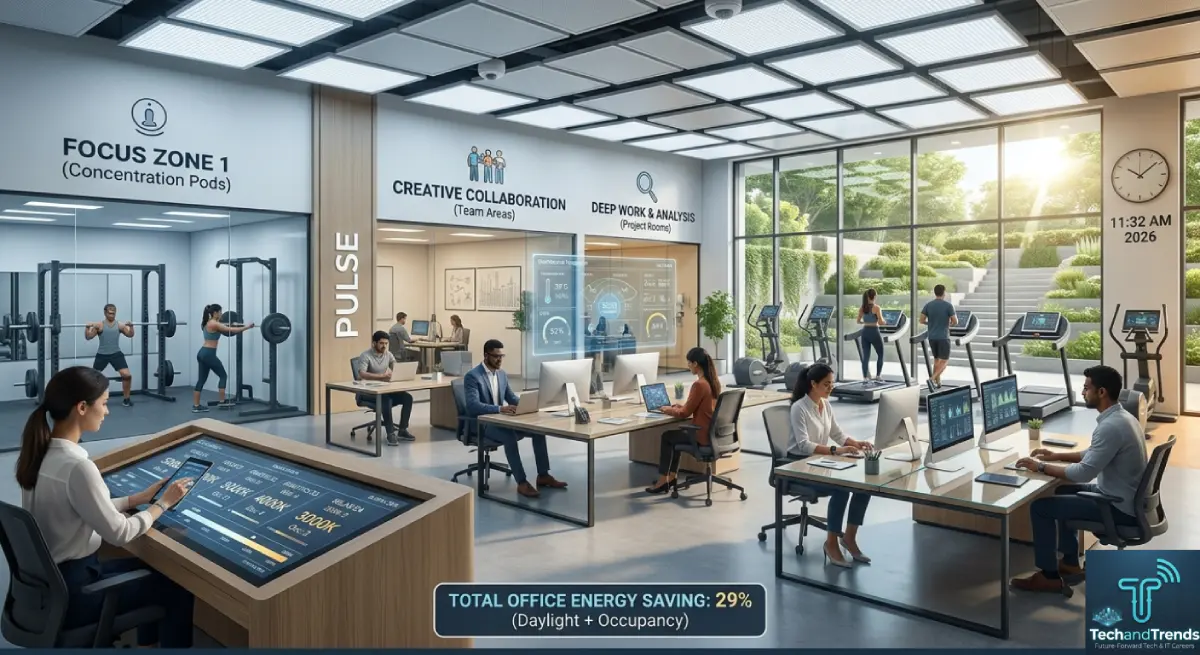
Your office lighting is costing you more than you think. Every hour lights run in empty conference rooms, that is wasted money. Every day employees work under harsh fluorescent glare, that is lost productivity. Smart office lighting solves both problems at the same time.
Table Of Content
- What Is Smart Office Lighting?
- Why Smart Office Lighting Is No Longer Optional in 2026
- Human-Centric Lighting: The 2026 Game Changer
- Smart Office Lighting vs Traditional Office Lighting: Side-by-Side Comparison
- Key Features to Look for in a Smart Office Lighting System
- Real-World Applications: Where Smart Office Lighting Delivers Most
- ROI and Cost Breakdown: What to Expect
- Smart Office Lighting and ESG Compliance
- Top Smart Office Lighting Brands and Platforms in 2026
- Installation: What the Setup Process Actually Looks Like
- FAQ: Smart Office Lighting
- The Future of Smart Office Lighting: What Comes Next
- Conclusion: The Smartest Thing You Can Do for Your Office in 2026
The Smart Offices Market is valued at USD 55 billion in 2026, expected to reach USD 125 billion by 2033. Lighting is the single biggest technology upgrade driving that growth. Businesses that make the switch are seeing faster returns than almost any other workplace investment.
This guide breaks down everything from core technology to real cost savings. By the end, you will know exactly how smart office lighting works, what it costs, and why 2026 is the best time to upgrade.
What Is Smart Office Lighting?
Smart office lighting goes far beyond switching bulbs. It is an intelligent, connected system that automatically adjusts brightness, color temperature, and timing based on real conditions inside your workplace.
These systems use sensors and AI to automatically adjust lighting based on occupancy, daylight levels, and user preferences. The result is a workspace that always has the right light at the right time, without anyone touching a switch.
The three core components of every smart lighting system are:
Sensors detect motion, occupancy, and natural daylight. They feed live data into the control system continuously.
Controllers and software process that data and make adjustments. Modern platforms use AI to learn usage patterns over weeks and optimize automatically.
Connected fixtures receive commands through Wi-Fi, Zigbee, or the emerging Matter protocol. They dim, brighten, or shift color within milliseconds.
Office LED lights are now connected to centralized systems that track occupancy, natural light levels, and employee preferences. Employees can also personalize lighting at their own workstations through smartphone apps or voice assistants.
Why Smart Office Lighting Is No Longer Optional in 2026
The numbers make a powerful case on their own. Up to 40% of a commercial building’s energy usage can be attributed to lighting. That is your single biggest controllable energy expense.
Offices typically shave 25 to 40% of electricity costs through automated dimming. Combine that with occupancy sensing, and the savings compound fast. An office that used to run lights all day in half-empty rooms can now eliminate that waste entirely.
Beyond cost, there is a talent angle most businesses underestimate. Over 80% of office workers are more likely to choose employers who prioritize environmentally friendly practices. A smart lighting system is visible, measurable proof that your company takes sustainability seriously.
Regulatory pressure is also building fast. California’s 2022 code already requires advanced lighting controls in all new commercial builds. Similar mandates are rolling out across the UK and EU in 2026. Acting now keeps you ahead of compliance deadlines.
Human-Centric Lighting: The 2026 Game Changer
This is the trend that separates good smart lighting from truly transformational smart lighting. One of the most defining trends in commercial lighting design for 2026 is the widespread adoption of human-centric lighting.
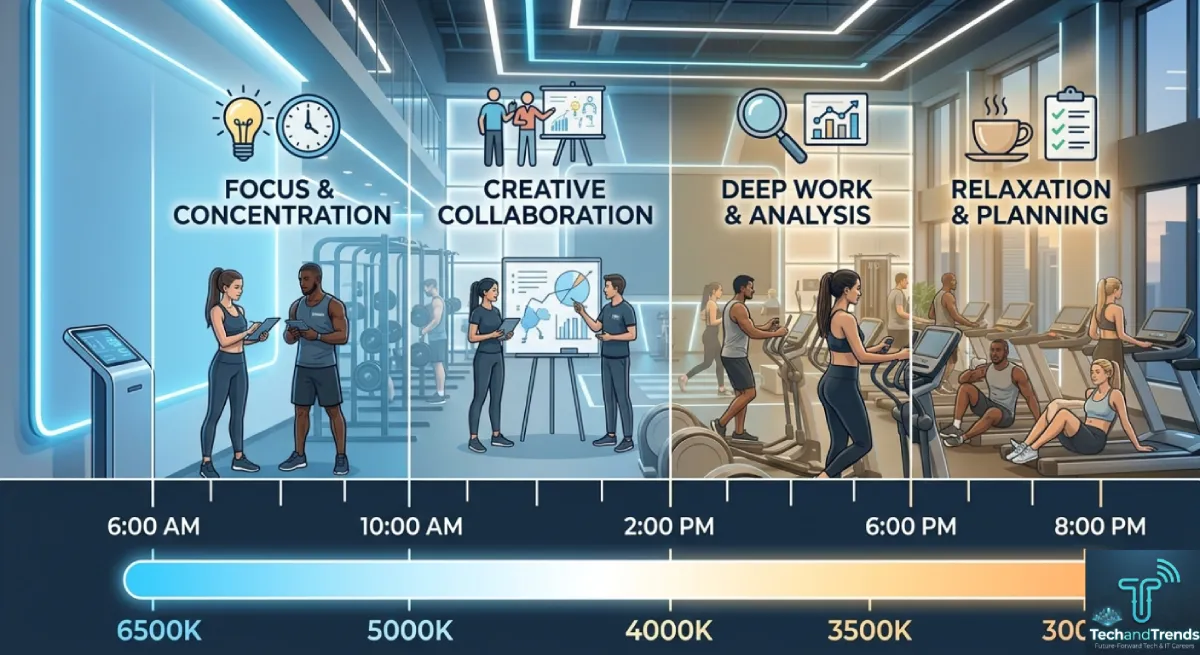
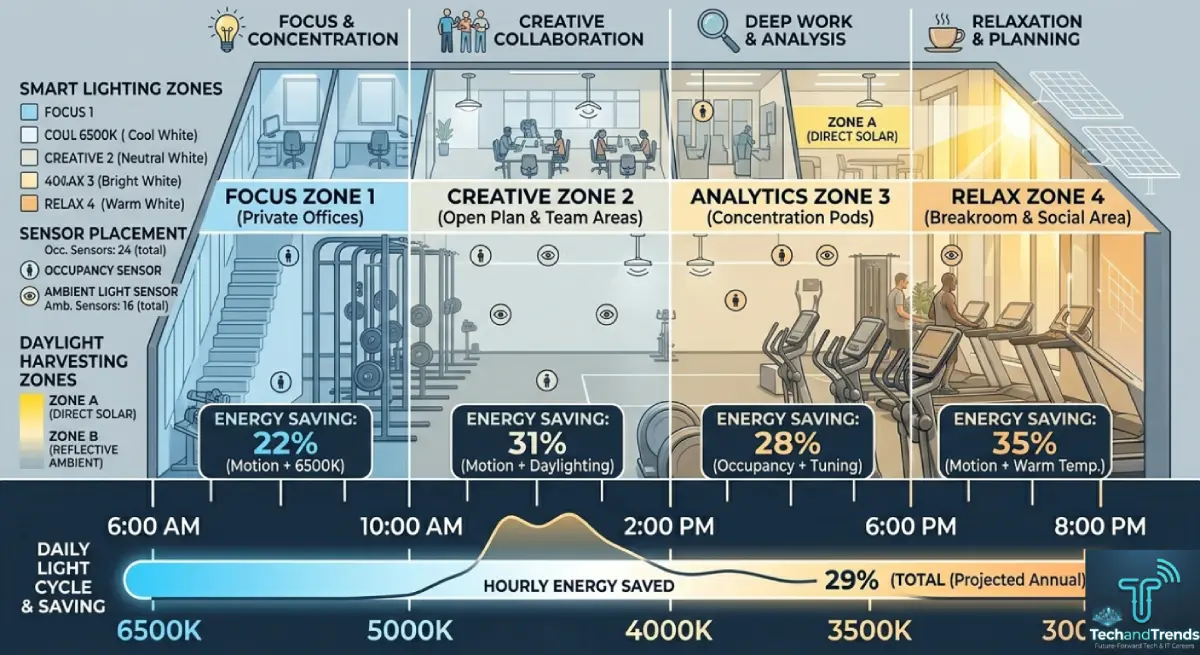
The concept is simple. Human biology responds powerfully to light. Tunable white LEDs shift throughout the day, providing cooler, higher-intensity light in the morning to support alertness and focus, and warmer tones in the afternoon and evening to reduce eye strain and mental fatigue.
Think of it as giving your employees a natural outdoor light experience inside a controlled workspace. Morning sessions feel crisp and energizing. Afternoon deep-work hours feel calm and focused. End-of-day light gently signals the body to wind down.
Growing evidence confirms that light quality directly affects cognitive performance, mood, and overall well-being. Offices, healthcare facilities, and educational buildings are adopting circadian-based lighting schedules to reduce headaches, improve sleep quality, and create more comfortable environments.
Smart Office Lighting vs Traditional Office Lighting: Side-by-Side Comparison
| Feature | Traditional Lighting | Smart Office Lighting |
|---|---|---|
| Energy consumption | High, always-on | 25 to 80% lower with automation |
| Control method | Manual wall switch | App, voice, sensor, schedule |
| Occupancy response | None | Automatic dimming or shutoff |
| Color temperature | Fixed | Adjustable throughout day |
| Maintenance alerts | Manual inspection | Predictive AI notifications |
| Integration | Standalone | Connects to HVAC, BMS, IoT |
| Employee wellness | Not considered | Circadian rhythm optimization |
| ESG reporting | No data | Real-time energy dashboards |
| Upfront cost | Low | Moderate to high |
| ROI timeline | None specific | 12 to 36 months typical |
This comparison shows why businesses switching in 2026 are gaining competitive advantages. Traditional lighting is simply not a fair fight.
Key Features to Look for in a Smart Office Lighting System
Not all smart lighting systems deliver equal value. Here are the features that actually matter in 2026.
Occupancy and Vacancy Sensors
These are the foundation of any energy-saving system. Passive infrared and ultrasonic sensors detect whether a room is occupied. Lights dim or turn off within minutes of a space becoming empty. This single feature alone drives most of the measurable energy savings.
Daylight Harvesting
Energy management is a significant trend, as these systems enable businesses to monitor and reduce energy consumption. Daylight harvesting takes this further by measuring natural light through photosensors and dimming artificial lights proportionally. Conference rooms near windows can run at 20 to 30% brightness on sunny days.
Tunable White Technology
This is the hardware backbone of human-centric lighting. Fixtures with tunable white LEDs can shift between cool daylight white and warm amber tones. Systems cycle automatically through pre-set schedules without any employee input required.
Wireless Protocol and Interoperability
Wi-Fi accounted for 37.8% of connectivity revenue in 2024, reflecting existing LAN infrastructure. Zigbee and the Matter protocol are gaining fast, offering better mesh reliability and energy efficiency for large office deployments.
Central Dashboard and Analytics
Enterprise-grade systems provide room-level energy consumption data. Facilities managers can identify waste patterns, optimize schedules, and generate reports for ESG compliance. This data becomes increasingly valuable as sustainability reporting requirements tighten.
Emergency and Fail-Safe Modes
Any commercial system must include code-compliant emergency lighting. Smart systems go further by integrating emergency modes into the same app interface, with battery backup and automatic activation on power failure.
Real-World Applications: Where Smart Office Lighting Delivers Most
Open Plan Workspaces
Large open offices with flexible seating benefit enormously from zoned lighting. Different task zones get different light levels. Collaboration areas can be brighter. Focus pods can dim to 60 to 70% for deep work.
Conference Rooms and Meeting Spaces
Meeting rooms are frequently empty for most of the workday. Occupancy-based shutoff eliminates 100% of wasted energy in unused rooms. Systems also integrate with calendar software to pre-set lighting scenes before meetings begin automatically.
Reception and Lobby Areas
First impressions matter. Smart lighting lets reception areas run dramatic, brand-aligned lighting scenes during business hours while automatically switching to low-power mode evenings and weekends.
Server Rooms and Utility Spaces
Motion-activated lighting in utility areas is low-cost and delivers immediate savings. These spaces are often lit continuously despite very low human traffic.
ROI and Cost Breakdown: What to Expect
Smart office lighting is an investment, not an expense. Here is a realistic look at what businesses actually pay and save.
Upfront Investment: A mid-size office of 5,000 square feet typically spends between $15,000 and $40,000 on a full smart lighting retrofit including hardware, installation, and commissioning.
Annual Energy Savings: At $0.12 per kWh average commercial rate, a 40% energy reduction in lighting can save $8,000 to $18,000 annually depending on building size and prior baseline.
Payback Period: Most commercial smart lighting projects achieve full payback within 18 to 36 months. Utility rebate programs in many regions shorten this significantly.
The Australian Taxation Office cut lighting costs by 94% via a retrofit. That is an exceptional case, but it illustrates the ceiling of what is possible with a well-executed upgrade.
Maintenance Savings: The average LED lamp can last up to 100,000 hours. That means dramatically fewer replacement cycles compared to traditional commercial fluorescents, reducing both labor and materials costs.
Smart Office Lighting and ESG Compliance
Sustainability reporting is no longer a nice-to-have. Major corporations, government contractors, and listed companies face increasing pressure to document and reduce Scope 2 emissions. Lighting is one of the easiest wins.
LED lighting plays a critical role in helping organizations meet their environmental targets in 2026. LEDs consume up to 80% less energy than traditional bulbs, directly reducing carbon footprints.
Smart lighting platforms generate the data that ESG reports need. Real-time dashboards show kilowatt-hours consumed per zone, reduction percentages versus baseline, and carbon equivalent calculations. These numbers feed directly into annual sustainability reports without requiring manual audits.
For companies pursuing LEED, BREEAM, or WELL building certifications, smart lighting controls are often a prerequisite for earning credits. Installing a certified system now positions your building for higher certification tiers as standards evolve.
Top Smart Office Lighting Brands and Platforms in 2026
The market has several strong players, each with distinct strengths.
Signify (Philips Hue for Business) offers deep integration with third-party building management systems and strong circadian lighting capabilities. Their Interact Office platform is a popular enterprise choice.
Lutron Electronics is known for best-in-class dimming precision and reliability. Their GRAFIK Eye and Quantum systems are trusted in premium commercial deployments worldwide.
Siemens and Schneider Electric provide end-to-end smart building ecosystems where lighting integrates seamlessly with HVAC and energy management. Ideal for large enterprise campuses.
Crestron Electronics specializes in unified building automation. Their lighting solutions are typically paired with AV control and room booking systems for a fully integrated experience.
Major players in the smart office space include ABB, Cisco, Crestron, Honeywell, Johnson Controls, Lutron, Philips, Siemens, and Schneider Electric.
Installation: What the Setup Process Actually Looks Like
Many businesses delay smart lighting because they assume the installation is disruptive. In most cases, a retrofit takes one to three days for a typical floor.
Step 1: Audit and Design. A lighting consultant maps existing fixtures, measures daylight zones, and identifies sensor placement. This creates the system design and zone plan.
Step 2: Hardware Installation. LED drivers, smart switches, sensors, and controllers are installed. In most retrofits, existing wiring is reused to minimize cost.
Step 3: Commissioning. The system is programmed with schedules, occupancy thresholds, and daylight harvesting targets. This is where most of the intelligence is configured.
Step 4: Staff Training. Employees learn app controls and how to override settings at their workstations. Most platforms are intuitive within minutes.
Step 5: Optimization. After two to four weeks of real usage, the facility manager reviews energy data and refines schedules. AI-driven systems begin learning automatically during this period.
FAQ: Smart Office Lighting
What is smart office lighting?
Smart office lighting is an automated, sensor-connected lighting system that adjusts brightness and color temperature based on occupancy, daylight, and preset schedules. It reduces energy consumption while improving employee comfort and productivity.
How much energy does smart office lighting save?
Offices typically save between 25 and 40% on electricity through automated dimming alone. Combined with occupancy sensing and daylight harvesting, total lighting energy reductions of 50 to 80% are achievable.
Does smart lighting improve employee productivity?
Modern LED systems are becoming smarter, more adaptive, and more integrated with office wellness goals. Circadian-aligned lighting reduces headaches, improves focus, and supports better sleep quality for employees working long hours.
What protocol is best for smart office lighting?
Wi-Fi works well for smaller deployments. Zigbee and the Matter protocol offer better scalability and reliability for larger commercial spaces. Your choice should align with your building management system.
How long does a smart lighting retrofit take?
Most offices complete a retrofit within one to three working days per floor. Work is typically done outside business hours to minimize disruption.
Is smart office lighting worth the investment?
Yes. Most businesses achieve full ROI within 18 to 36 months through energy savings alone. Employee wellness benefits and maintenance cost reductions add further long-term value.
Can smart lighting integrate with other building systems?
Yes. Enterprise platforms connect smart lighting with HVAC, security, access control, and building management systems. Integration enables broader automation and more accurate ESG reporting.
The Future of Smart Office Lighting: What Comes Next
Industrial facilities are the fastest-growing adopter group at 20.7% CAGR, deploying sensors for asset tracking and Li-Fi to exchange data with robotic tools. Li-Fi, which uses light waves to transmit data, is beginning to appear in commercial office environments as an alternative to Wi-Fi in secure or high-density areas.
AI will play a bigger role over the next three years. Systems will predict occupancy patterns from calendar data, automatically pre-cool or pre-warm light scenes before employees arrive, and flag fixture failures before they cause outages.
Biometric integration is also emerging. Some platforms are beginning to experiment with personal light profiles that adjust based on individual preferences saved to employee access cards or smartphones.
The global smart lighting market is expected to reach $45.64 billion by 2029, growing at 20.8% annually. The companies investing in smart office lighting now are building infrastructure that will serve them well through the next decade of workplace evolution.
Conclusion: The Smartest Thing You Can Do for Your Office in 2026
Smart office lighting is not a luxury upgrade. It is a practical, measurable, and rapidly returning investment that touches every part of your business. Energy bills shrink. Employees perform better. Your ESG credentials strengthen. Your building becomes future-ready.
The technology is mature, the suppliers are proven, and the financial case is clear. The only question is how long your business can afford to wait.
Start with an energy audit of your current lighting. Map your occupancy patterns. Then request quotes from two or three certified lighting integrators. The data will make the decision for you.

No Comment! Be the first one.