





The Sentient Support System: How AI Wellness Companions Are Rewriting Mental Healthcare 2026
AI Wellness in 2026: Bridging the 2 a.m. gap with biometric sensing and empathetic algorithms for proactive, personalized, and 24/7 mental support.
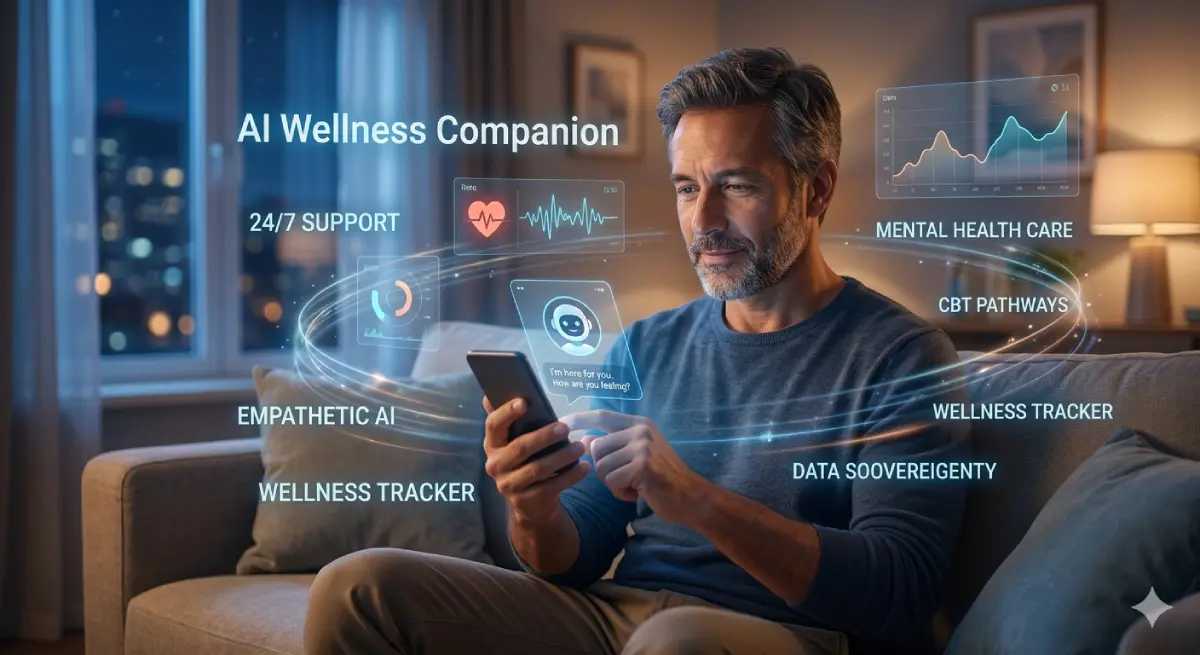
It is 2:17 in the morning. You have been lying awake for ninety minutes, chest tight, thoughts spiraling. Your therapist’s next available appointment is Thursday. The crisis hotline feels like too much — this isn’t a crisis, exactly. It’s just the particular darkness that arrives when the world is asleep and you are not. You reach for your phone, not to scroll, but to talk.
Table Of Content
- The Paradigm Shift: From React-and-Rescue to Proactive Care
- The Core Technology: How AI Actually “Feels” You
- The Top Five AI Wellness Companion Apps of 2026
- Why Users Are Converting: The Three Irreplaceable Benefits
- The Ethical Architecture: Questions We Cannot Ignore
- Conclusion: Your Mental Health, Upgraded
This is the moment AI wellness companions were built for. And in 2026, they are finally ready to deliver on their decade-old promise: not as clumsy chatbots dispensing generic affirmations, but as sophisticated, empathetic, multimodal systems that read your voice, your heart rate, your sleep patterns, and your history — and respond with something that feels, unsettlingly, like genuine understanding.
The Paradigm Shift: From React-and-Rescue to Proactive Care
For most of modern history, mental healthcare has operated on a “react-and-rescue” model. You deteriorate, you recognize the deterioration (if you are lucky), you seek help, you wait. The average delay between the onset of a mental health condition and receiving treatment remains stubbornly long — often measured in years, not weeks. In the United States alone, the shortage of licensed therapists means that roughly one in three people who need mental health support cannot access it in any meaningful timeframe.
The 2026 mental health landscape looks meaningfully different. The convergence of large language models, affective computing, wearable biosensors, and clinical research has given rise to a new category: the AI Wellness Companion. These are not replacements for human therapists. They are something new — proactive digital allies that monitor, intervene, and support across the full arc of your daily life, not just in fifty-minute weekly sessions.
The Core Technology: How AI Actually “Feels” You
The question people most often ask about AI wellness companions is a deceptively simple one: how does it know? How does an algorithm detect that you are struggling before you have said a single word about it?
The answer lies in what researchers call passive sensing — the continuous, unobtrusive collection of physiological and behavioral data that reveals emotional state without requiring conscious input from the user. Integrated with 2026’s medical-grade wearables, these apps now leverage bio-impedance sensors and non-invasive cortisol tracking to distinguish between physical fatigue and acute emotional distress with unprecedented accuracy. A sudden dip in HRV at 11 p.m., combined with disrupted sleep onset and increased screen time, can trigger a gentle check-in well before the user themselves has named what they are feeling.
Layered on top of biometric feedback loops is affective computing — the analysis of voice tonality, speech cadence, and, where users opt in, facial micro-expressions via front-facing cameras. These systems are trained to detect the specific acoustic signatures of low mood: slower speech, reduced prosodic variation, longer pauses. In clinical trials, voice-based distress detection has reached accuracy rates that rival clinical intake assessments for mild-to-moderate anxiety.
The intelligence layer that synthesizes all of this data is, of course, the large language model — specifically, fine-tuned variants trained on vast corpora of clinical transcripts, cognitive behavioral therapy (CBT) protocols, and positive psychology research. These generative AI therapy models create dialogue that is contextually aware, non-judgmental, and personalized to the user’s own language patterns and history. Unlike scripted chatbot trees, they can hold a genuine conversation: remembering that you mentioned your mother last Tuesday, noticing that you seem less guarded than you were a month ago, and adjusting their tone accordingly.
The Top Five AI Wellness Companion Apps of 2026
The market has matured considerably. Dozens of apps compete for users’ trust, but five have separated themselves through clinical rigor, technological sophistication, and genuine user outcomes.
I. Flourish
Best for Holistic Wellbeing
Flourish distinguishes itself through evidence: its AI coach has been validated in multiple randomized controlled trials, making it one of the few wellness apps with the kind of empirical backing typically reserved for pharmaceutical interventions. Rather than framing mental health around symptom reduction, Flourish orients its entire architecture around the concept of “flourishing” — drawing on Martin Seligman’s PERMA model to build strength, meaning, and positive relationships alongside managing distress. Users who engage with its structured programs for ninety days report measurable improvements in life satisfaction scores that hold at six-month follow-up.
II. Wysa
Best for Clinical-Grade CBT
Wysa has long been the gold standard for anxiety support in the digital mental health space, and its 2026 iteration cements that position. With FDA breakthrough device designation for its clinical CBT modules and a seamless, dignified hand-off pathway to licensed human therapists, Wysa navigates the hybrid future more elegantly than any competitor. The platform’s “pocket coaching” approach — brief, high-frequency CBT-based check-ins throughout the day — is grounded in the well-established principle that small, consistent behavioral activations outperform intensive but infrequent sessions.
III. Headspace with Ebb
Best for Mindfulness & Sleep
Headspace’s integration of its AI companion “Ebb” into its world-class content library represents the most polished user experience in the category. Where earlier versions of the app offered static meditation courses, Ebb now generates personalized mindfulness journeys that adapt in real time to biometric data and self-reported mood. Its sleep architecture is particularly impressive: combining predictive mood analytics from wearables with generative audio environments and a conversational check-in before bed, Ebb has helped thousands of users break cycles of anxiety-driven insomnia that had persisted for years.
IV. Ash by SlingshotAI
Best for Deep AI Conversations
Ash is the most therapeutically ambitious entry on this list — and the most discussed. Voice-first and conversational in a way that feels qualitatively different from text-based alternatives, Ash maintains long-term emotional memory across months of interaction. It remembers the name of your sister, the promotion you did not get in February, the specific phrasing you used when you described feeling invisible at work. This continuity — the closest any app has come to replicating the depth of a human therapeutic relationship — is both Ash’s greatest strength and its most potent ethical flashpoint.
V. Neurofit
Best for Nervous System Regulation
Neurofit takes a deliberately physiological approach to mental health — what clinicians call the “bottom-up” model, working through the body to regulate the mind rather than the other way around. Using real-time HRV monitoring as its primary feedback mechanism, Neurofit prescribes short physical exercises — specific breathing patterns, cold exposure timing, gentle movement sequences — calibrated to your nervous system’s current state. For users whose mental health struggles manifest primarily as somatic symptoms (chronic tension, fatigue, gut dysregulation), Neurofit addresses a dimension that pure conversational AI cannot reach.
Why Users Are Converting: The Three Irreplaceable Benefits
The case for AI wellness companions rests on three advantages that human therapy, structurally, cannot match.
The first is the elimination of stigma. Research consistently shows that people disclose more honestly to an AI than to a human clinician — not because the AI is more trustworthy, but because the asymmetry of judgment is removed. You cannot disappoint an algorithm. You cannot sense its fatigue, its subtle reactions, its perception of you shifting. The judgment-free zone created by the non-human nature of these companions is not a limitation; it is a feature, and for many users it is the reason they engage at all.
The second is cost. At $150 or more per session, traditional therapy is functionally inaccessible for the majority of the global population. AI wellness companions range from free to approximately $15 per month — making evidence-based, personalized mental health support available at a scale that was unimaginable a decade ago.
The third is the 2 a.m. factor. Mental distress does not observe business hours. The dark hours — late nights and early mornings when rumination peaks and support systems are offline — are precisely when many people are most vulnerable and least resourced. Twenty-four-hour emotional support AI fills a gap that the human mental health system was never designed to cover.
The Ethical Architecture: Questions We Cannot Ignore
The power of these systems is inseparable from their risks. The same emotional memory that makes Ash feel like a genuine companion also creates a detailed psychological profile that would be extraordinarily sensitive in the wrong hands. Questions of data sovereignty — who owns your distress data, who can access it, under what legal frameworks — are not theoretical. Several major platforms have faced scrutiny over data-sharing provisions buried in terms of service, and HIPAA compliance in the era of generative AI remains a genuinely unsettled legal question.
Data Sovereignty
HIPAA and GDPR compliance in the age of LLM-based therapy is legally unsettled. Demand transparency on data retention and sharing policies.
The Empathy Question
Can an algorithm truly care? The “uncanny valley” of AI empathy — warm language without interiority — raises genuine questions about the nature of therapeutic relationships.
Dependency Risk
Long-term emotional memory and availability by design risk fostering attachment that substitutes for, rather than scaffolds, human connection.
The Hybrid Imperative
The clinical consensus is clear: AI should augment human care, not replace it. The best platforms build in escalation pathways and actively encourage human connection.
Then there is the deeper, more philosophical question: can an algorithm truly care? The language these systems generate is warm, attuned, and contextually intelligent. But warmth generated by a statistical model is not the same as warmth generated by a being with genuine interiority. The “uncanny valley” of AI empathy is real — many users describe moments of profound connection followed by an unsettling awareness of the void behind the words. This is not an argument against AI companions; it is an argument for honesty about what they are and what they are not.
The clinical consensus is unambiguous: AI wellness companions should augment human care, not replace it. The platforms doing this responsibly build in explicit escalation pathways — recognizing when a user’s presentation exceeds the scope of digital intervention and facilitating warm, dignified hand-offs to licensed clinicians. The ones that do not are playing a dangerous game with the most vulnerable people who need them most.
Conclusion: Your Mental Health, Upgraded
The convergence of neuroscience, data science, and generative AI has produced something genuinely new: a mental health support system that is always on, always learning, and increasingly capable of meeting you where you are.
The right tool depends on your specific psychological profile and needs. If clinical rigor and evidence matter most to you, Flourish and Wysa represent the state of the art. If you need the felt sense of a relationship — something that knows your history and speaks to you as a continuous self — Ash offers an experience unlike anything else in the category. If your stress lives in your body, Neurofit may reach you in ways that conversation alone cannot.
What all of them share is a commitment to the radical proposition that no one should face the dark hours alone — and that the technology to deliver on that promise, at last, exists. Use it as a bridge, not a destination. Use it alongside human connection, not instead of it. And if it gets you through the night, through to Thursday’s appointment, through to the moment when you can name what you are feeling — then it has done something real.
To stay ahead of the curve in the rapidly evolving digital landscape, techandtrends is your essential guide. The platform delivers sharp insights into emerging tech, from groundbreaking AI innovations to the latest in digital wellness. Whether you are a tech enthusiast or a professional, following this site ensures you never miss a beat in the world of tomorrow.




No Comment! Be the first one.