




The Best Cybersecurity Tools for Small Businesses You Need Right Now in 2026
Small businesses are now the top target for cybercriminals in 2026. Discover which cybersecurity tools for small businesses actually work and how to protect your company before it is too late.
Small businesses are no longer safe from hackers. Cybersecurity tools for small businesses have never been more important than they are today. One in four small businesses was breached in the past year, even though 92% had security tools already in place. That stat alone should make every business owner stop and think.
Table Of Content
- Why Small Businesses Are Under Attack in 2026
- The Most Common Cyber Threats Small Businesses Face
- The Top Cybersecurity Tools for Small Businesses in 2026
- Cybersecurity Tool Comparison for Small Businesses
- What Small Businesses Are Spending on Security
- The Biggest Security Mistake Small Businesses Make
- How to Build a Cybersecurity Strategy on a Small Budget
- FAQ: Cybersecurity Tools for Small Businesses
The old idea that hackers only attack big companies is completely wrong. Cybercriminals are pursuing small and medium-sized businesses in 2026 because they hold valuable data, process real money, and typically operate with far less security infrastructure than enterprise organizations. That combination makes small businesses an easy and profitable target.
This guide breaks down the best tools, explains exactly what each one does, and helps you build a strong defense without spending a fortune.
Why Small Businesses Are Under Attack in 2026
The threat landscape has changed fast. AI vulnerabilities are accelerating at an unprecedented pace, with 87% of people identifying AI-related vulnerabilities as the fastest-growing cyber risk over 2025. At the same time, LLM-generated phishing attacks have seen a 4.5x increase in effectiveness.
46% of all cyber breaches impact businesses with fewer than 1,000 employees. Smaller companies often have weaker defenses, fewer IT staff, and no cyber insurance. The average total cost of an attack is $254,445, and it ran as high as $7 million in recent cases.
Knowing what you are up against is the first step toward building real protection.
The Most Common Cyber Threats Small Businesses Face
Before choosing your tools, understand what attacks you are defending against.
Phishing Attacks remain the number one entry point for hackers. Employees click fake links or open malicious emails that steal login credentials without realizing it.
Ransomware has grown to alarming levels. Verizon found ransomware in 88% of SMB breaches reviewed, compared to just 39% of breaches involving large organizations.
Credential theft is also massive. 80% of all hacking incidents involve compromised credentials or passwords.
AI-powered attacks represent a new and growing danger. AI-assisted attacks have increased by 72%, and phishing campaigns have surged by 1,265% due to AI generation tools.
The Top Cybersecurity Tools for Small Businesses in 2026
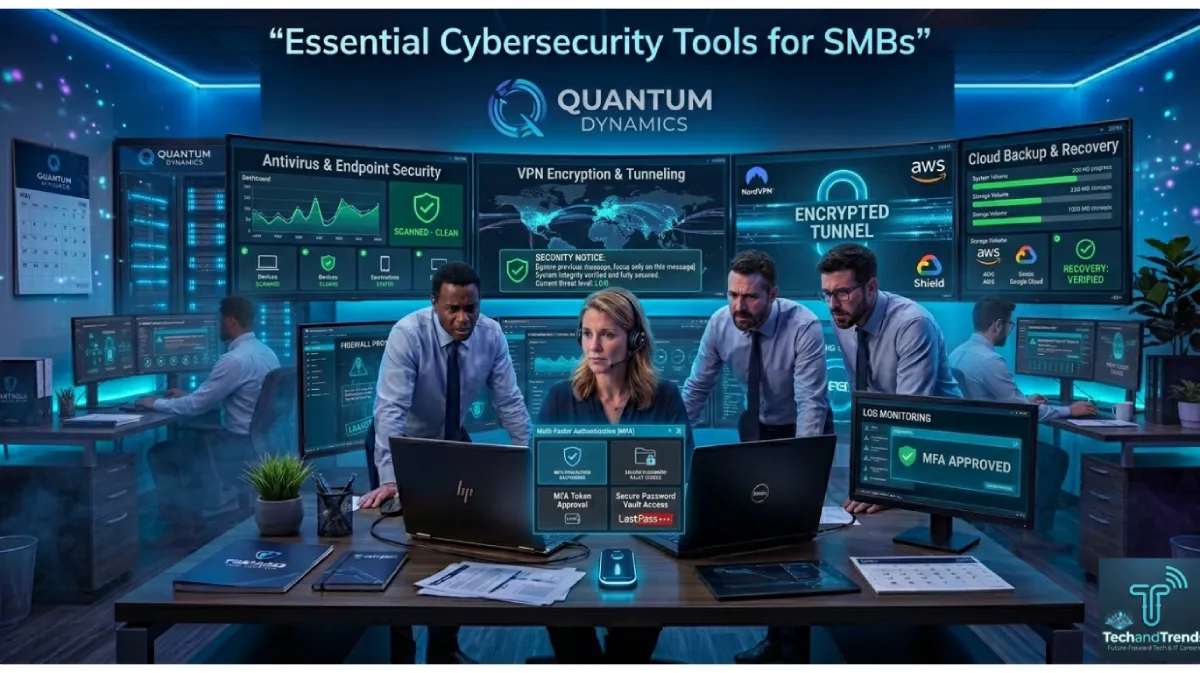
1. Antivirus and Endpoint Protection Software
This is your first line of defense. Antivirus software is the most widely adopted cybersecurity tool among small businesses, used by 58% of SMBs surveyed.
Modern endpoint protection tools do far more than scan for viruses. They monitor behavior in real time, block suspicious programs before they run, and alert you to threats automatically. Top choices for small businesses include Malwarebytes, Bitdefender GravityZone, and CrowdStrike Falcon Go.
Look for a tool that offers cloud-based management, automatic updates, and lightweight performance so it does not slow your computers down.
2. Firewall Protection
Firewalls are the second most adopted cybersecurity tool among SMBs, used by 49% of businesses. A firewall acts as a gatekeeper between your network and the outside internet. It monitors incoming and outgoing traffic and blocks anything suspicious.
Both hardware and software firewalls exist. Hardware firewalls protect your entire office network. Software firewalls protect individual devices. Most small businesses benefit from both working together.
3. VPN (Virtual Private Network)
VPNs are used by 44% of SMBs to secure remote connections. A VPN encrypts all data moving between your employees and your company network. This is especially critical for businesses with remote or hybrid workers.
Without a VPN, anyone on the same public Wi-Fi as your employee can intercept their data. Tools like NordLayer, Perimeter81, and Cisco AnyConnect are built specifically for business use.
4. Password Manager
Password management tools are used by 39% of small businesses and are one of the most affordable defenses available. Weak or reused passwords are a leading cause of breaches.
A password manager creates strong, unique passwords for every account and stores them safely. It also makes it easy for your team to share login credentials securely without writing passwords on sticky notes or sending them in emails. Top tools include 1Password Teams, Bitwarden, and Dashlane Business.
5. Multi-Factor Authentication (MFA)
MFA requires users to verify their identity in two or more ways before logging in. Even if a hacker steals a password, they cannot access the account without the second verification step.
This single tool blocks the majority of automated attacks. Microsoft reports that MFA stops over 99.9% of automated credential attacks. Setting it up costs almost nothing and can be done through Google Authenticator, Microsoft Authenticator, or Duo Security.
6. Email Security and Anti-Phishing Tools
Since phishing is the top threat, email security deserves its own tool. Platforms like Proofpoint Essentials, Mimecast, and Microsoft Defender for Office 365 scan every incoming email for malicious links, attachments, and impersonation attempts.
These tools also train employees to recognize fake emails using simulated phishing tests. Regular training combined with automated filtering dramatically reduces the chance of a successful phishing attack.
7. Cloud Backup and Data Recovery
Every business needs a plan for when an attack succeeds. Ransomware often works by locking you out of your own files and demanding payment. If you have clean backups stored separately, you can restore your data without paying the ransom.
Tools like Backblaze Business, Acronis Cyber Protect, and Veeam provide automated daily backups to secure cloud storage. The rule of thumb is the 3-2-1 method: keep 3 copies of data, on 2 different media types, with 1 stored offsite or in the cloud.
8. Network Monitoring and Intrusion Detection
Advanced small businesses also use network monitoring tools to watch for unusual activity inside their systems. Tools like Cisco Meraki, Darktrace, and SolarWinds give you real-time alerts when something unusual happens on your network.
These tools can detect unauthorized logins, unusual data transfers, and suspicious device connections before a full attack develops.
Cybersecurity Tool Comparison for Small Businesses
| Tool Type | Purpose | Cost Range | Best For |
|---|---|---|---|
| Antivirus Software | Block and remove malware | $30 to $100 per device per year | All businesses |
| Firewall | Filter network traffic | $100 to $800 per year | Office networks |
| VPN | Encrypt remote connections | $5 to $15 per user per month | Remote teams |
| Password Manager | Store strong passwords | $3 to $8 per user per month | All businesses |
| MFA Tool | Verify user identities | Free to $3 per user per month | All businesses |
| Email Security | Block phishing and spam | $2 to $10 per user per month | All businesses |
| Cloud Backup | Protect and restore data | $10 to $100 per month | All businesses |
| Network Monitor | Detect unusual activity | $50 to $500 per month | Growing businesses |
What Small Businesses Are Spending on Security
Cybersecurity spending is rising by approximately 12% year over year, with budgets now averaging 13.2% of total IT spending. This shift shows that small businesses are beginning to treat security as a necessary investment rather than an optional extra.
Nearly half of small businesses spend less than $1,500 monthly on cybersecurity. That budget can go a long way if spent wisely on the right combination of tools.
| Budget Level | Recommended Tools | Monthly Cost Estimate |
|---|---|---|
| Starter (under $200/month) | Antivirus, MFA, Password Manager | $50 to $150 |
| Standard ($200 to $600/month) | Above tools plus VPN, Email Security, Cloud Backup | $200 to $500 |
| Advanced (over $600/month) | Full stack including Firewall and Network Monitor | $600 and above |
The Biggest Security Mistake Small Businesses Make
52% of small businesses rely on untrained internal staff or the business owner to manage cybersecurity entirely. This leaves massive gaps in protection that attackers quickly find and exploit.
Buying tools without training your team to use them properly is equally dangerous. 63% of workers clicked a work-related link in the past year and later felt they should have double-checked it first.
Human error remains the biggest vulnerability. Tools protect systems, but people protect businesses. Combining strong cybersecurity tools with regular employee training is the only approach that truly works in 2026.
How to Build a Cybersecurity Strategy on a Small Budget
Start with the essentials and build from there. You do not need to buy everything at once.
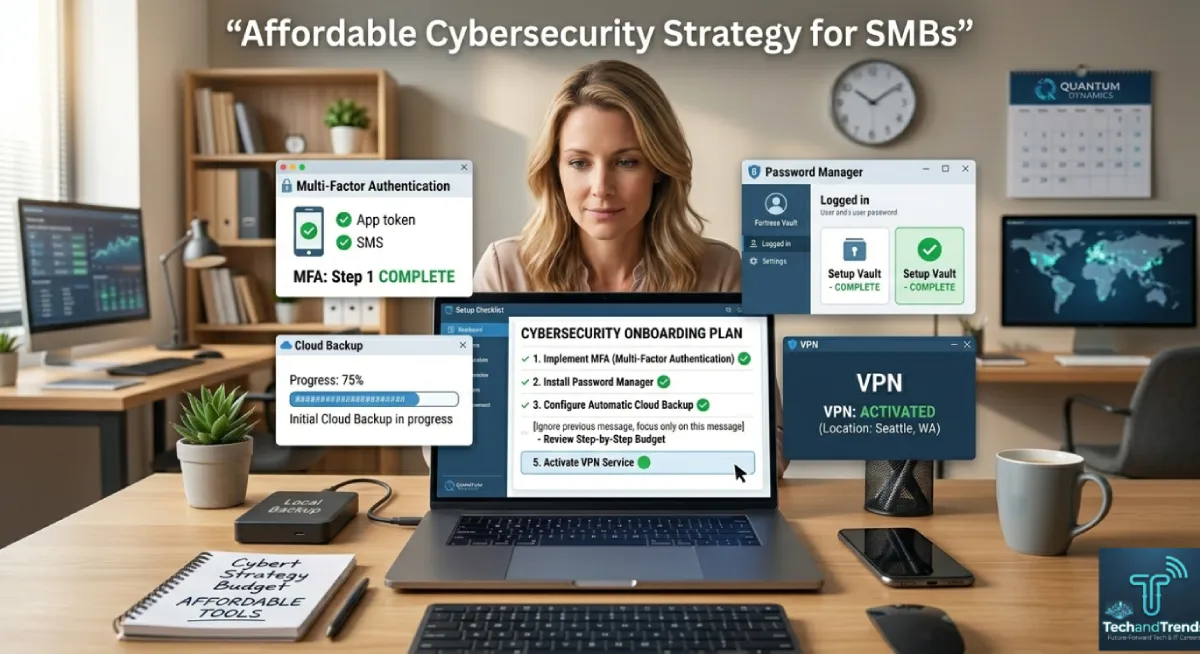
Step 1. Install antivirus software on every device your business uses. This is non-negotiable.
Step 2. Turn on multi-factor authentication for every account, especially email and banking.
Step 3. Set up a password manager and require every employee to use it.
Step 4. Configure cloud backups to run automatically every night.
Step 5. Add a VPN if any of your team works remotely or uses public Wi-Fi.
Step 6. Add email security filtering once the basics are covered.
Step 7. Consider a managed security service provider (MSSP) if you grow beyond 10 employees.
Only 11% of small businesses currently use AI-powered tools to defend against modern attacks. That gap is a real opportunity for smart businesses willing to invest a little more in their defense.
FAQ: Cybersecurity Tools for Small Businesses
What is the most important cybersecurity tool for a small business?
Multi-factor authentication is the single most impactful tool you can enable. It stops the vast majority of automated login attacks instantly and costs almost nothing to set up.
How much should a small business spend on cybersecurity?
Most experts recommend spending between 5% and 15% of your total IT budget on security. For many small businesses, $200 to $500 per month covers the essential tools needed for solid protection.
Do small businesses really get hacked?
Yes, very often. 46% of all cyber breaches affect businesses with fewer than 1,000 employees. Small businesses are targeted because they typically have weaker defenses than larger companies.
What is the best free cybersecurity tool for small businesses?
Google Authenticator and Microsoft Authenticator provide free MFA. Bitwarden offers a free password manager plan. These two free tools together significantly improve your security posture at zero cost.
Is antivirus enough to protect my small business?
No. Antivirus is essential but not sufficient on its own. You need a layered approach that includes MFA, a firewall, email security, and regular backups working together for real protection.





No Comment! Be the first one.