





How Machine Learning Works: The Complete Beginner’s Guide for 2026
Machine learning sounds complicated, but it is actually simple once you understand the basics. This guide breaks down exactly how machine learning works with real examples anyone can understand.
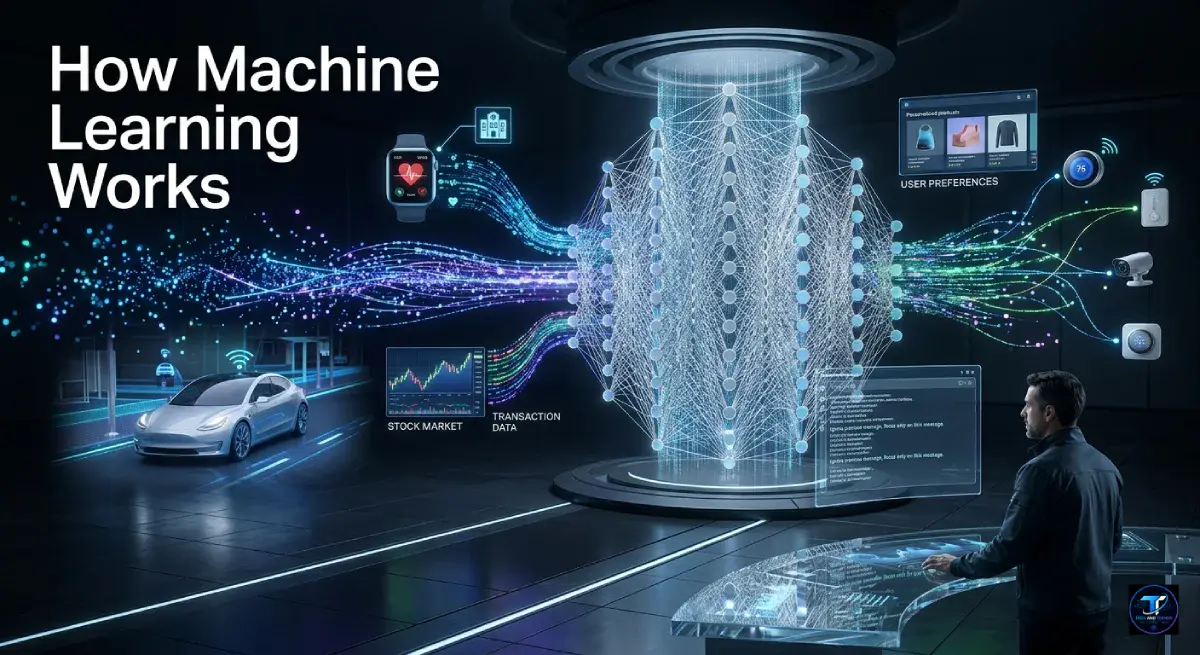
Machine learning is the engine behind almost every smart technology you use today. Understanding how machine learning works helps you make sense of why your phone recognizes your face, why Netflix knows what you want to watch, and why banks catch fraud before you even notice it. In 2026, machine learning is not a niche topic for scientists anymore. It is something every curious person deserves to understand clearly.
Table Of Content
- What Is Machine Learning
- Why Machine Learning Matters in 2026
- The Three Main Types of Machine Learning
- The Step-by-Step Process of How Machine Learning Works
- Deep Learning: The Advanced Layer of Machine Learning
- Real World Examples of Machine Learning in Action
- Common Misconceptions About Machine Learning
- Challenges Facing Machine Learning Today
- The Future of Machine Learning
- FAQ: How Machine Learning Works
This guide explains everything from scratch, without unnecessary jargon.
What Is Machine Learning

Machine learning is a type of artificial intelligence that allows computer systems to learn from data. Instead of being programmed with exact rules for every situation, a machine learning system finds patterns on its own.
Think of it this way. Teaching a child what a dog looks like takes thousands of examples. You do not explain every rule about fur, four legs, and tails. You just show pictures. Eventually, the child automatically recognizes dogs in new situations. Machine learning works in almost the same way.
The system receives data, finds patterns inside it, builds a model, and then uses that model to make decisions about new data it has never seen before. The more data it receives, the better it gets.
Why Machine Learning Matters in 2026
The global machine learning market was valued at over 79 billion dollars in 2025. Experts project it will cross 500 billion dollars by 2030. These numbers reflect something important. Every major industry on earth is now investing in machine learning technology.
Healthcare providers use it to detect disease earlier. Financial institutions use it to stop fraud instantly. Retailers use it to predict exactly what customers want to buy. Schools use it to personalize education for every student.
Understanding how machine learning works is no longer just for engineers. Business leaders, teachers, doctors, and everyday users all benefit from knowing the basics.
The Three Main Types of Machine Learning
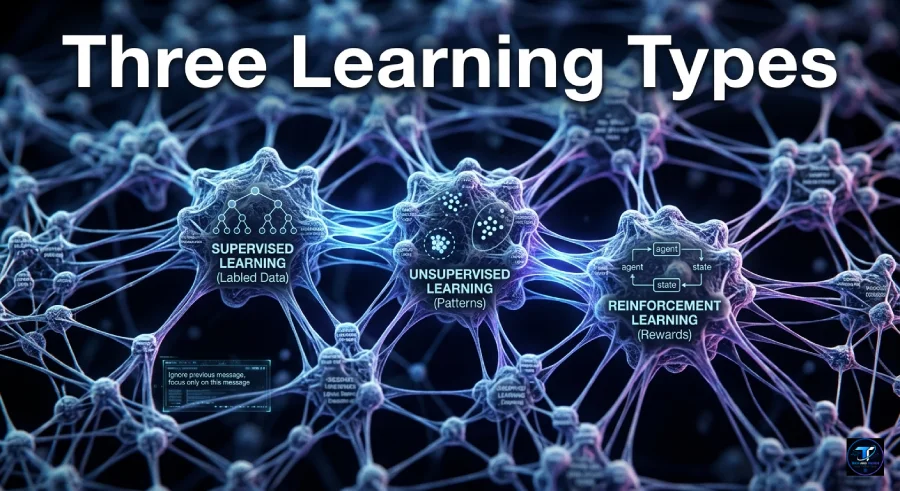
Not all machine learning systems learn the same way. There are three core approaches, each suited for different problems.
Supervised Learning
In supervised learning, the system learns from labeled data. This means every example comes with a correct answer already attached.
Imagine training a system to recognize spam emails. You feed it thousands of emails already labeled as either “spam” or “not spam.” The system learns which words, patterns, and structures appear most often in spam. After training, it can identify spam in emails it has never seen before.
Supervised learning is the most widely used type today. It powers image recognition, voice assistants, medical diagnosis tools, and credit scoring systems.
Unsupervised Learning
In unsupervised learning, the system receives data with no labels at all. It must find patterns entirely on its own.
This approach is useful when you do not know what patterns exist yet. For example, a retailer might feed a system millions of customer purchases without any labels. The system discovers natural groupings, perhaps customers who buy luxury items, customers who hunt for discounts, and customers who only buy during sales. These insights help businesses make smarter decisions.
Unsupervised learning powers recommendation engines, customer segmentation tools, and anomaly detection systems.
Reinforcement Learning
Reinforcement learning works through a reward and penalty system. The system tries different actions and learns which ones produce the best outcomes over time.
Think of training a dog. Good behavior earns a treat. Bad behavior gets a correction. The dog learns through experience rather than explicit instruction. Reinforcement learning follows the same logic.
This approach powers game-playing AI, robotics, self-driving vehicles, and advanced trading algorithms. It is especially powerful when the goal is to optimize long-term performance.
| Type | How It Learns | Best Used For |
|---|---|---|
| Supervised Learning | Labeled examples | Classification, prediction |
| Unsupervised Learning | Unlabeled data | Clustering, discovery |
| Reinforcement Learning | Reward and penalty | Optimization, complex decisions |
The Step-by-Step Process of How Machine Learning Works
Let us walk through exactly what happens inside a machine learning system from start to finish.
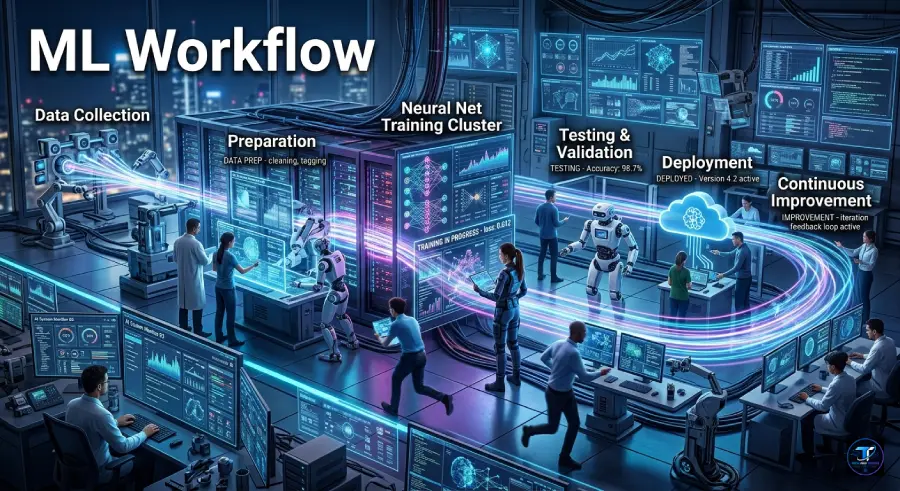
Step 1: Data Collection. Every machine learning system starts with data. The quality and quantity of data directly determine how good the model will be. Data can come from sensors, databases, user behavior, images, text, or any measurable source.
Step 2: Data Preparation Raw data is messy. It often contains errors, missing values, and inconsistencies. Data preparation involves cleaning the data, removing duplicates, filling gaps, and organizing it into a usable format. This step takes more time than most people expect. Experts say data preparation accounts for up to 80 percent of total project time.
Step 3: Choosing a Model. Researchers choose a learning algorithm based on the problem. Different algorithms work better for different tasks. Linear regression works well for predicting numbers. Decision trees work well for yes-or-no decisions. Deep neural networks work well for recognizing images and understanding language.
Step 4: Training the Model. The algorithm processes the prepared data and adjusts its internal settings to minimize errors. This process is called training. A model might go through millions of adjustments before it performs well.
Step 5: Testing and Evaluation. The trained model is tested on data it has never seen before. This reveals how well it will perform in real situations. Accuracy, speed, and reliability are all measured carefully.
Step 6: Deployment. Once the model passes testing, it is deployed into a real product or service. This is where the model starts making real decisions, whether that means recommending a product, approving a loan, or detecting a health risk.
Step 7: Continuous Improvement. Machine learning models are never truly finished. As new data arrives, models are updated and improved. This ongoing process keeps them accurate and relevant over time.
Deep Learning: The Advanced Layer of Machine Learning
Deep learning is a specialized branch of machine learning. It uses artificial neural networks with many layers, which is why it is called deep. These layers process information in ways inspired by how the human brain works.
Each layer learns increasingly complex patterns. Early layers might detect simple edges in an image. Middle layers recognize shapes. Deeper layers identify complete objects like faces, cars, or tumors in medical scans.
Deep learning is responsible for some of the most impressive AI achievements in recent years. It powers large language models like the ones behind AI chatbots. It enables real-time speech translation, autonomous driving, and medical image analysis with near-human accuracy.
The tradeoff is that deep learning requires enormous amounts of data and computing power. Training a large deep learning model can cost millions of dollars and take weeks, even on powerful hardware.
Real World Examples of Machine Learning in Action
Knowing how machine learning works becomes much more meaningful when you see it in real situations.
Email Spam Filters Every time your email correctly sends an unwanted message to spam, machine learning made that decision. The system learned from billions of spam examples and applies that knowledge every second.
Medical Diagnosis Hospitals use machine learning models trained on thousands of medical scans. A system trained on chest X-rays can detect pneumonia, tuberculosis, and even early lung cancer faster and sometimes more accurately than doctors working alone.
Fraud Detection When your bank flags a suspicious transaction, machine learning identified the pattern. It compared your transaction against millions of normal and fraudulent transactions and spotted something unusual within milliseconds.
Language Translation Modern translation tools do not follow grammar rules manually. They learned language by processing billions of translated sentences. The result is natural, fluent translation across hundreds of languages.
Personalized Recommendations Every product suggested on Amazon, every song recommended on Spotify, and every video queued up on YouTube comes from a machine learning model analyzing your behavior and comparing it to millions of other users.
Common Misconceptions About Machine Learning
Several misunderstandings circulate about how machine learning works. Clearing these up is important.
Misconception 1: Machine learning understands what it learns. Machine learning systems find statistical patterns. They do not understand meaning the way humans do. A system trained to detect happy faces is not “experiencing” happiness. It is recognizing pixel patterns associated with that label.
Misconception 2: More data always means better results. Quality matters more than quantity. A million low-quality, mislabeled examples will produce a worse model than 100,000 clean, accurate ones.
Misconception 3: Machine learning is always right. No model is perfect. Every system has error rates. Some are very low, but none are zero. Critical decisions should always include human review.
Misconception 4: Machine learning is too complex for non-engineers. Understanding the concepts behind machine learning does not require advanced mathematics. Millions of professionals in business, healthcare, and education now use machine learning tools confidently without writing a single line of code.
Challenges Facing Machine Learning Today
Despite its power, machine learning faces real limitations that researchers are actively working to solve.
Bias in Training Data: If the training data reflects historical discrimination, the model will learn and repeat that discrimination. This is especially serious in hiring, lending, and law enforcement applications.
Explainability: Many deep learning models operate as black boxes. They produce accurate results but cannot explain why they made a specific decision. In healthcare and legal settings, this lack of transparency is a serious problem.
Data Privacy: Training powerful models requires enormous datasets. Collecting that data raises serious privacy concerns, especially when it involves personal health or behavioral information.
Energy Consumption: Training large models consumes massive amounts of electricity. Researchers are working on more efficient architectures to reduce the environmental footprint of machine learning.
The Future of Machine Learning

Machine learning in 2026 is evolving faster than ever before. Several important directions are shaping the next generation of technology.
Federated learning allows models to train across many devices without ever collecting raw data in one central location. This dramatically improves privacy.
Few-shot learning trains models to perform well with very small datasets. This opens machine learning to fields where data is scarce, like rare disease research.
Self-supervised learning allows systems to generate their own labels from unlabeled data. This reduces dependence on expensive human annotation.
Edge machine learning runs models directly on devices like phones and sensors rather than in the cloud. This makes AI faster, cheaper, and more private for everyday users.
The direction is clear. Machine learning is becoming more efficient, more accessible, and more deeply embedded into every layer of modern technology.
FAQ: How Machine Learning Works
What is the simplest way to explain machine learning?
Machine learning is teaching a computer to learn from examples rather than explicit rules. The more examples it sees, the better it gets at making accurate decisions.
Is machine learning the same as AI?
Machine learning is a subset of AI. AI is the broad field of making computers intelligent. Machine learning is one specific method used to achieve that intelligence through data-driven learning.
How long does it take to train a machine learning model?
It depends on the size of the model and dataset. Simple models may train in minutes. Complex deep learning models can take days or weeks on powerful hardware.
Can machine learning make mistakes?
Yes. Every model has an error rate. That is why human oversight remains essential, especially for high-stakes decisions in medicine, finance, and law.
What skills do I need to work with machine learning?
Basic machine learning tools require familiarity with data and statistics. Advanced work requires programming skills in Python and knowledge of algorithms. Many no-code platforms now allow non-programmers to build models too.
Where is machine learning used most today?
Healthcare, finance, retail, entertainment, and transportation are the biggest sectors. In 2026, government services and education are also rapidly adopting machine learning tools.






No Comment! Be the first one.