





What Is Cyber Insurance for Small Business and Do You Really Need It in 2026?
A single cyberattack can permanently close a small business. Find out how cyber insurance for small business works, what it covers, and what it actually costs in 2026.

Cyber insurance for small businesses has moved from an optional add-on to a critical survival tool. One cyberattack is all it takes to wipe out years of work. 60% of small businesses that suffer a cyberattack shut down within six months. Without financial protection in place, a single incident can end everything.
Table Of Content
- What Is Cyber Insurance?
- Two Types of Coverage Inside a Cyber Insurance Policy
- What Cyber Insurance Actually Covers in 2026
- What Cyber Insurance Does Not Cover
- How Much Does Cyber Insurance for Small Businesses Cost in 2026?
- What Happens Without Cyber Insurance?
- Who Actually Needs Cyber Insurance?
- What Insurers Require Before Giving You Coverage
- How to Choose the Right Cyber Insurance Policy
- FAQ: Cyber Insurance for Small Business
Most small business owners carry general liability insurance and never think twice about it. But general liability does not cover data breaches, ransomware payments, or the cost of notifying customers after a hack. That is exactly what cyber insurance is designed to do.
This guide explains what cyber insurance covers, what it costs in 2026, and how to decide if your business needs it.
What Is Cyber Insurance?
Cyber insurance is a policy that covers the financial losses your business suffers after a cyberattack or data breach. It also covers costs you did not expect, like legal fees, customer notification letters, forensic investigators, and regulatory fines.
Think of it as a financial safety net. Your security tools try to stop attacks from happening. Cyber insurance covers the cost when those tools are not enough.
Over 56% of cyber insurance claims come from small businesses with revenue under $25 million. This proves that cyber insurance is not just for large corporations. Small businesses file more claims than any other group.
Two Types of Coverage Inside a Cyber Insurance Policy
Every cyber insurance policy contains two layers of protection. Understanding both helps you choose the right policy.
First-Party Coverage This covers losses that hit your business directly. It includes ransomware payments, data restoration costs, business interruption losses while your systems are down, and the cost of hiring forensic IT experts to clean and rebuild your systems.
Third-Party Coverage This covers claims made against your business by others. It includes legal defense costs if a customer sues you after their data is stolen, regulatory fines for failing to protect personal data, and notification costs for contacting everyone affected by a breach.
Data breaches, incident response, and crisis management caused 73% of all cyber insurance claims. Both coverage types are essential to handle these costs.
What Cyber Insurance Actually Covers in 2026
A solid cyber insurance for small business policy in 2026 typically covers the following areas.
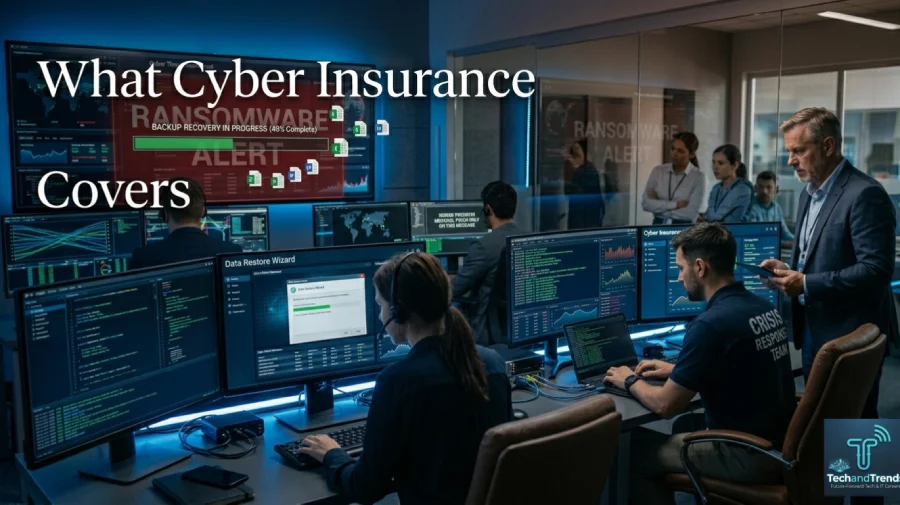
Ransomware and Extortion covers the ransom payment itself, extortion negotiators, and the cost of restoring encrypted files. Average ransomware payments in 2026 exceed $400,000, with total event costs often reaching $1 million or more for mid-size businesses.
Business Email Compromise covers financial losses when an employee is tricked into wiring money to a fake bank account. Average losses from business email compromise range from $50,000 to $300,000 per event.
Data Breach Notification Covers the cost of notifying customers, credit monitoring services, and public relations support after a data breach.
Legal and Regulatory Defense Covers attorney fees and regulatory fines if your business is investigated for failing to protect customer data properly.
System Restoration Covers IT labor costs to rebuild servers, reinstall software, and restore backups after an attack.
What Cyber Insurance Does Not Cover
Knowing what is excluded matters just as much as knowing what is included.
Most policies do not cover losses from prior incidents that happened before the policy started. They do not cover theft by your own employees in most standard policies. Intentional acts, fraudulent claims, and losses from using outdated software without patches are often excluded too.
Businesses that do not meet security control requirements face three potential outcomes: outright denial of coverage, exclusion of key incident types such as ransomware, or denial of claims after a breach.
This means your policy is only as good as your current security posture. Insurers check whether you have MFA, endpoint protection, and regular backups before they pay out.
How Much Does Cyber Insurance for Small Businesses Cost in 2026?
The cost varies based on your industry, revenue, data volumes, and existing security controls.

In 2026, the average cyber liability insurance cost for a small business ranges from $1,200 to $3,500 annually for a standard $1 million coverage limit. That breaks down to roughly $100 to $290 per month.
Small businesses pay $83 per month on average for cyber insurance with a $1 million aggregate annual limit.
| Business Revenue | Annual Premium Range | Monthly Estimate |
|---|---|---|
| Under $1 million | $1,200 to $2,400 | $100 to $200 |
| $1 million to $5 million | $2,500 to $5,000 | $208 to $416 |
| $5 million to $25 million | $5,000 to $15,000 | $416 to $1,250 |
| High-risk industries (healthcare, legal) | $2,500 to $5,000+ | $208 to $416+ |
A premium hike of 15% to 20% is expected for many cyber insurance policies in 2026 due to rising AI-powered attack volumes and higher claim payouts industry-wide.
What Happens Without Cyber Insurance?
The math is not kind to uninsured small businesses. The average cyber incident cost for an uninsured small business exceeds $79,000, which is a potentially terminal event for a business with tight margins.

The average cost of a data breach for a small business now exceeds $120,000, while most small businesses carry less than $10,000 in liquid reserves. That gap is where businesses close permanently.
The average insurance claim cost for a small or medium business is $345,000. Covering that from business cash flow is not realistic for most small operations. Insurance transforms a potentially fatal financial blow into a manageable recovery.
Who Actually Needs Cyber Insurance?
Not every business carries the same level of risk. These factors increase your need for coverage significantly.
Your business stores customer personal information, credit card numbers, or health records. You process payments online or accept card transactions in person. You rely on your systems staying online to generate revenue each day. You operate in a regulated industry like healthcare, finance, or legal services. You use cloud-based software or remote access tools regularly.
If even one of these applies to your business, cyber insurance for small business is not optional. It is a necessary financial protection.
In 2026, only 10% to 20% of small and medium enterprises have adequate cyber insurance coverage, leaving the majority financially exposed after an attack.
What Insurers Require Before Giving You Coverage
Insurers in 2026 are stricter than ever. They require evidence of real security controls before issuing a policy or paying a claim.
Most insurers require multi-factor authentication on all email and remote access accounts. They also check that you have endpoint protection software on all devices, automated backups stored separately from your main systems, a documented incident response plan, and employee security awareness training completed within the past year.
Do not apply for insurance until you have implemented these controls. If you apply with bad security, the rejection can stay on your record, making it harder to get coverage elsewhere.
Meeting these requirements before applying also lowers your premium significantly.
How to Choose the Right Cyber Insurance Policy
Choosing the wrong policy is almost as dangerous as having no policy at all. Follow these steps to find coverage that actually fits your business.
Step 1. List every type of data your business holds. Include customer names, payment details, health records, and employee information.
Step 2. Estimate your worst-case scenario cost. Think about what it would cost to be offline for two weeks, notify every customer, and rebuild your systems from scratch.
Step 3. Work with a broker who specializes in cyber risk, not a general insurance agent. Policy language in cyber coverage varies enormously between carriers.
Step 4. Read the exclusions carefully. Ask specifically whether ransomware is covered, whether social engineering losses are included, and what security controls are required to maintain coverage.
Step 5. Start with $1 million in coverage and adjust up based on your revenue, data volume, and risk level.
| Coverage Feature | What to Look For |
|---|---|
| Ransomware coverage | Confirm it covers both payment and recovery costs |
| Business interruption | Check the waiting period before payments begin |
| Social engineering | Verify that funds transfer fraud is included |
| Regulatory fines | Confirm coverage for GDPR and state privacy laws |
| Breach notification | Check whether credit monitoring is included |
FAQ: Cyber Insurance for Small Business
What does cyber insurance for small businesses actually cover?
It covers ransomware payments, data breach notification costs, business interruption losses, legal defense fees, regulatory fines, and IT recovery costs after a cyberattack.
How much does cyber insurance cost for a small business in 2026?
The average annual cost for $1 million in coverage ranges from $1,200 to $3,500 for most small businesses in 2026. High-risk industries like healthcare and legal services pay more.
Is cyber insurance worth it for a small business?
Howden’s 2025 analysis estimated a 19% return on investment on cyber insurance for businesses that experience a claim. Given that most small businesses cannot survive a six-figure loss, the answer is strongly yes.
What security controls do I need to get cyber insurance?
Most insurers require MFA, endpoint protection software, automated backups, a documented incident response plan, and proof of employee security training before offering coverage.
Will my general liability insurance cover a cyberattack?
No. General liability insurance does not cover digital losses, data breaches, ransomware, or business interruption caused by a cyberattack. You need a separate cyber insurance policy for those risks.






No Comment! Be the first one.