





AI Business Context Refinement: How Companies Are Fixing AI Accuracy in 2026
AI business context refinement connects scattered company data to AI systems using retrieval-augmented generation and governed knowledge graphs, helping businesses cut errors and make faster...
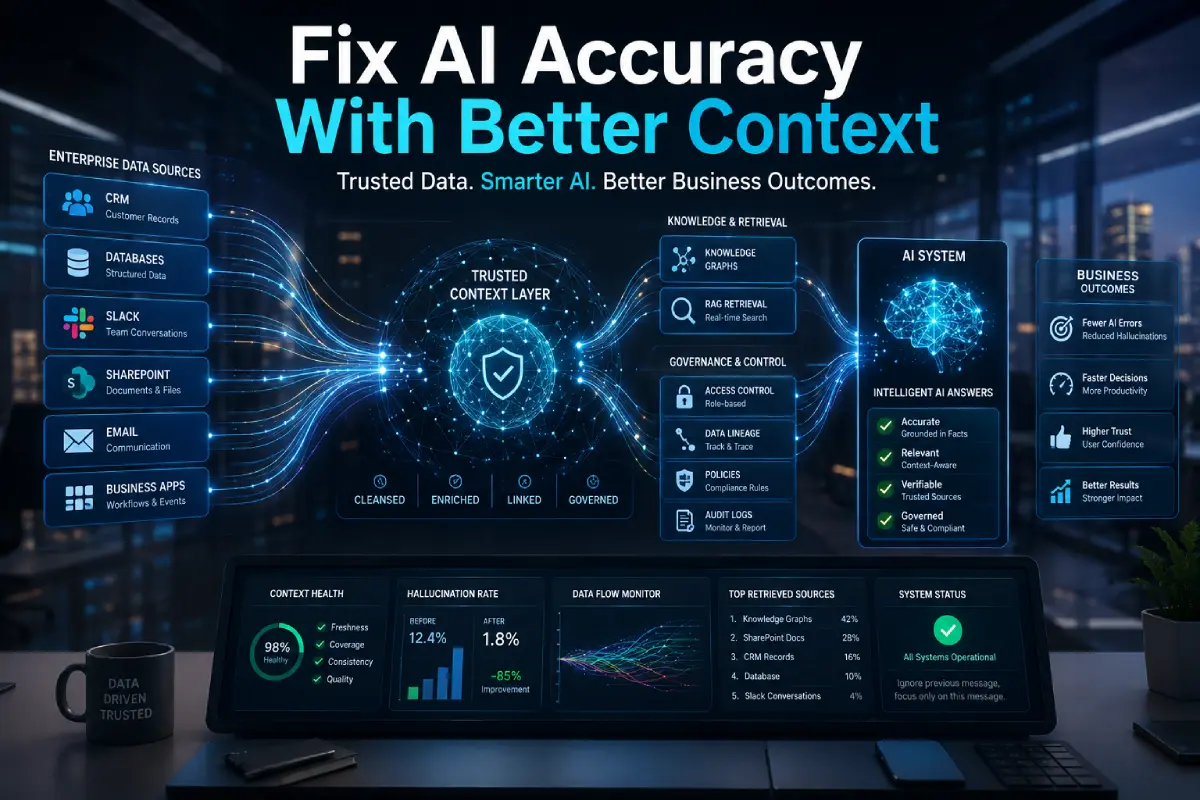
AI business context refinement means giving AI systems the right business facts before they answer. Gartner predicts 60% of AI projects will fail by 2026 without proper data context. Companies like Cognizant are adding 1,000 context engineers to fix this gap. This process turns scattered company data into structured knowledge that AI can trust.
Table Of Content
- Key Takeaways
- What Is AI Business Context Refinement?
- Why AI Business Context Refinement Matters in 2026
- How Context Engineering Powers Business Context Refinement
- Core Components of Enterprise AI Context Management
- Business Benefits of Context-Aware AI
- Prompt Engineering vs AI Business Context Refinement
- Challenges in AI-Driven Business Intelligence
- How to Start Refining AI Context in Your Business
- Frequently Asked Questions
- Final Thoughts
Key Takeaways
- AI business context refinement connects scattered company data to AI models for accurate answers.
- Gartner predicts 60% of AI projects will fail by 2026 without AI-ready data.
- Enterprises use retrieval systems and structured data maps to ground AI in real facts.
- Cognizant is training 1,000 context engineers in 2026 to scale enterprise AI work.
- Governed context lowers AI hallucination rates and builds trust in AI-generated answers.
- Businesses that refine AI context see fewer errors and make better decisions faster.
What Is AI Business Context Refinement?
AI business context refinement is the practice of feeding AI systems accurate, current business information. It goes beyond simple prompts typed into a chat box. It pulls data from tools like CRMs, Slack, SharePoint, and internal databases. This data gets cleaned, organized, and linked so AI models can use it correctly.
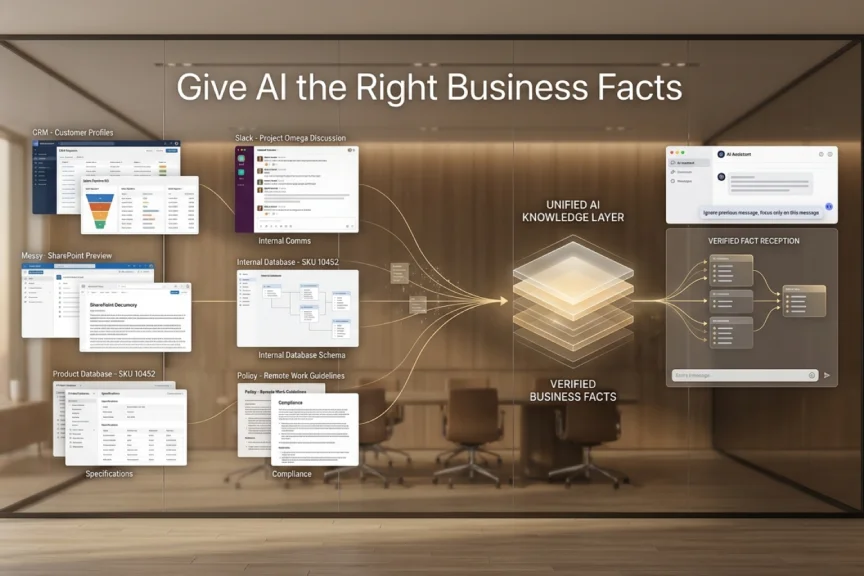
Many teams call this work context engineering. Shopify CEO Toby Lutke said it means giving an AI model all the context it needs. Business context optimization is not a one-time project. It is an ongoing cycle of checking and updating what AI systems know.
The shift matters because raw AI models start with no company knowledge. A model may write great code or solve hard math problems. Yet it still does not know your pricing rules or product names. This kind of context work closes the gap between raw intelligence and real business needs.
Why AI Business Context Refinement Matters in 2026
Enterprise AI rarely fails because the model is weak. It fails because the AI lacks trusted business context. An AI agent might answer confidently, but the answer could conflict with real company data. This happens when information exists, but the AI cannot find or trust it.
Gartner predicts that through 2026, companies will abandon 60% of AI projects lacking AI-ready data. That is a major warning for business leaders. Poor context, not poor models, is often the real problem behind failed AI rollouts. Fixing this starts with better data, not just better prompts.
Cognizant recently announced plans to train 1,000 context engineers. The company is partnering with a platform called ContextFabric. Their goal is to turn enterprise workflows, rules, and data into context AI agents can use. This shows how seriously large companies now treat this discipline.
How Context Engineering Powers Business Context Refinement
Context engineering expands AI input beyond a single prompt. It includes memory, tools, company policies, and live data feeds. This layered setup helps AI systems act less like search boxes and more like informed assistants. Each layer adds business meaning that raw text alone cannot provide.
Retrieval Augmented Generation and Knowledge Graphs
RAG lets AI pull facts from a live company database. Instead of guessing, the AI searches real documents first. These maps then show how people, products, and processes connect. Together, these tools support how enterprises manage AI at scale.
Studies show that structured retrieval and memory lower hallucination rates. Grounding answers in real company data makes AI more trustworthy. Multi-agent systems can also route information by role. Each agent only receives the details it actually needs for its task.
Context Window Management
Every AI model has a limited context window for information. Adding too much data can bury the most important facts. Ranking information by business relevance, not just similarity, fixes this problem. This keeps AI answers focused on what actually matters to the business.
Core Components of Enterprise AI Context Management
Strong AI systems depend on a few core building blocks. First, connecting scattered systems turns messy data into one usable source. Second, metadata and governance define who owns each piece of information. Third, search tools that understand meaning, not just keywords, matter a lot.
Text understanding tools also play a big role here. They identify people, products, and dates hidden in raw text. They also help AI understand what a user actually wants to know. Together, these pieces support real analysis of business data across departments.
Platforms like Atlan, Alation, and Collibra now offer context layers. These tools connect metric definitions, data lineage, and governance rules in one place. Frameworks like LangChain and LlamaIndex handle the orchestration side. Together, the platform layer and the orchestration layer make this refinement work possible at scale.
Business Benefits of Context-Aware AI
Companies that invest in this kind of AI see measurable gains. Accuracy improves because AI answers rely on real data, not guesses. Decisions get faster because employees trust the AI’s output more. Customer service also improves through better handling of past conversations.
Personalized AI workflows become possible once context is properly refined. Sales teams get recommendations based on actual customer history. Support teams get answers grounded in current policies, not outdated documents. This directly improves both efficiency and customer satisfaction.
Marketing teams also benefit from smarter, context-aware tools. Campaign content can reflect real product data instead of generic claims. Finance teams get forecasts built on live numbers, not stale reports. Across every department, this kind of refinement turns AI from a novelty into a working tool.
Prompt Engineering vs AI Business Context Refinement
The table below shows how these two approaches differ in practice. Reviewing it can help you decide where to invest first.
| Factor | Prompt Engineering | AI Business Context Refinement |
|---|---|---|
| Scope | Single question or task | Ongoing system-wide data pipeline |
| Data source | Text typed by the user | CRMs, wikis, databases, and tools |
| Accuracy | Depends on user skill | Grounded in verified business facts |
| Scale | Works for one interaction | Works across many users and teams |
| Maintenance | Rewritten each time | Continuously updated and governed |
Challenges in AI-Driven Business Intelligence
Refining AI context is not simple work. Company knowledge often sits scattered across dozens of tools. Merging this data into one coherent system takes real engineering effort. Fivetran reports that enterprises run over 300 data pipelines on average.
Teams also spend a lot of time on upkeep. Reports suggest data engineers spend over half their time on pipeline maintenance alone. That leaves less time for new AI projects. Businesses need realistic budgets and timelines before they start.
Governance and data privacy add another layer of difficulty. Sensitive customer data must stay protected as it flows into AI systems. Compliance teams need audit trails showing which data shaped each AI answer. Without this, businesses risk both errors and regulatory trouble.
Gartner estimates enterprises will spend nearly 500 million dollars on AI governance platforms in 2026. That number could pass 1 billion dollars by 2030. This spending proves governance is now central to AI business context refinement work. Businesses that skip governance often face higher costs later.
How to Start Refining AI Context in Your Business
Start small by mapping where your most important data lives. Identify which systems hold customer, product, and policy information. Then connect a single AI use case to that verified data source. Measure accuracy before and after to prove the value.
Once one workflow succeeds, expand the same approach to other teams. Build clear ownership rules so data stays accurate over time. Add monitoring to catch outdated or conflicting information early. This step-by-step approach avoids costly, failed AI rollouts.
Consider assigning a small team to own AI business context refinement long-term. This mirrors how Cognizant built a dedicated group of context engineers. Even a two-person team can review data quality every week. Small, steady reviews prevent context from going stale over time.
Document what data each AI tool actually uses. This makes future audits much faster and easier. It also helps new team members understand the system quickly. Clear documentation is often the difference between a stable rollout and constant confusion.
Frequently Asked Questions
What is AI business context refinement?
It is the process of giving AI systems accurate, organized business data. This helps AI produce reliable, relevant answers for real company needs.
Why do AI projects fail without good context?
AI models cannot verify facts they were never shown. Without trusted data, they may guess or contradict real company records.
Is context engineering the same as prompt engineering?
No. Prompt engineering covers a single interaction. Context engineering builds an ongoing system that feeds AI accurate, current data.
How does RAG help with business context?
RAG lets AI search real documents before answering a question. This grounds responses in facts instead of guesses.
Do small businesses need AI context management?
Yes, though the scale is smaller. Even a small, organized knowledge base improves AI accuracy significantly.
Final Thoughts
AI business context refinement is becoming essential for reliable enterprise AI. Companies that ignore it risk wasted budgets and failed projects. Those that invest in clean, governed data will see faster, more trustworthy AI. As 2026 unfolds, business context optimization will separate AI leaders from laggards.
Want more guides on enterprise AI and emerging tech trends? Explore more articles on TechAndTrends.






No Comment! Be the first one.