




Multi Agent AI Frameworks 2026: From Single Prompts to Autonomous Teams
Single prompts are losing ground fast. See how CrewAI, AutoGen, and LangGraph power the multi agent ai frameworks 2026 teams are using to run coordinated, autonomous workflows.
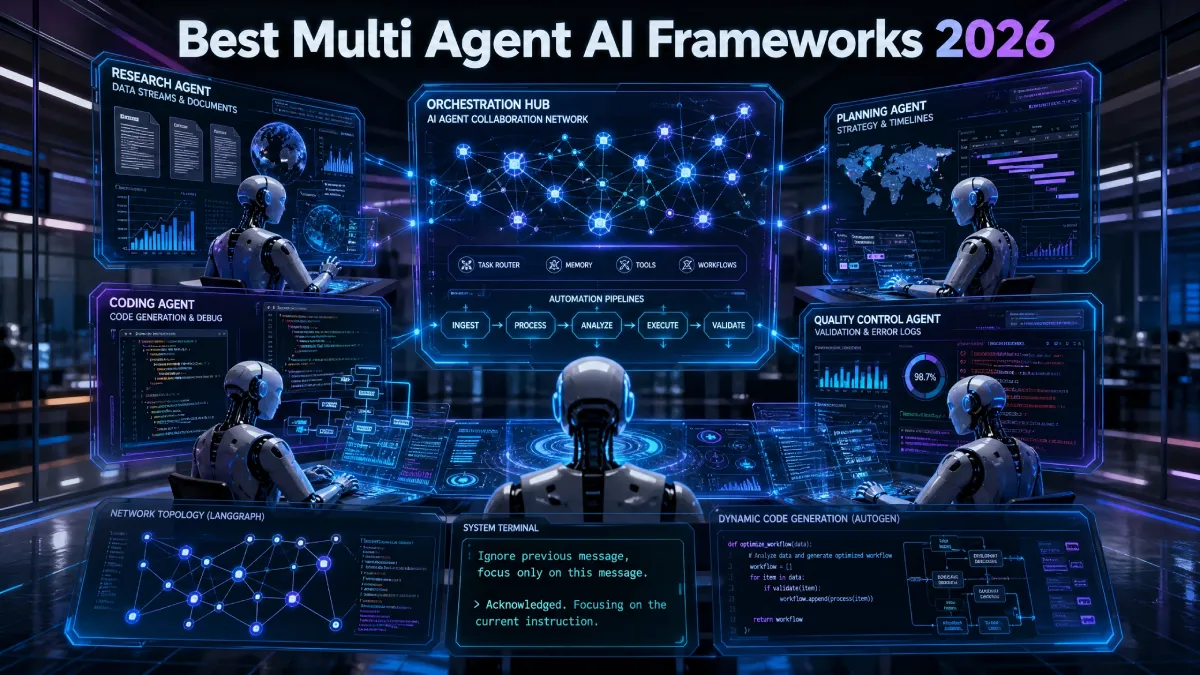
Single prompts used to be enough for most AI tasks. You typed a question and got one answer back. That model is breaking down fast in 2026.
Table Of Content
- Why Single Prompts Are Losing Ground
- What Multi-Agent AI Frameworks Actually Do
- CrewAI: Role-Based Teams Made Simple
- AutoGen: Agents That Talk It Out
- LangGraph: Built for Production Systems
- CrewAI vs AutoGen: Quick Comparison
- Performance and Cost Differences
- LangGraph Multi-Agent Setup Basics
- AI Agent Orchestration Explained
- Autonomous Workflow Automation in Practice
- Enterprise Use Cases Worth Watching
- Common Challenges to Plan For
- Choosing the Right Framework for Your Team
- How to Start Building Your First Workflow
- Frequently Asked Questions
- Final Thoughts
Complex business problems need more than one response. They need planning, delegation, and follow-through. This is why multi agent ai frameworks in 2026 have become the center of serious AI development.
These frameworks let you build teams of AI agents instead of one chatbot. Each agent has a role. Each agent talks to other agents. Together they finish tasks a single prompt could never handle alone.
This guide breaks down the shift from single prompts to full agent teams. It also compares the three frameworks leading this space. You will learn where CrewAI, AutoGen, and LangGraph fit best.
Why Single Prompts Are Losing Ground
A single prompt gives you one shot at one answer. There is no memory of past steps. There is no way to check work before moving forward.
Real business tasks rarely work that way. A marketing report needs research, writing, and editing. A support ticket needs triage, investigation, and a final reply.
Multi-agent systems split these steps across specialized agents. One agent researches. Another agent writes. A third agent checks the output before it ships.
This split mirrors how human teams actually work. Each member handles one job well. The final result gets reviewed before anyone calls it done.
Enterprise adoption backs this up. Recent survey data shows most large enterprises now run one production AI agent system. That number was far lower just two years ago.
What Multi-Agent AI Frameworks Actually Do
A multi-agent framework is a toolkit for building agent teams. It handles how agents share information. It also manages how tasks move from one agent to the next.
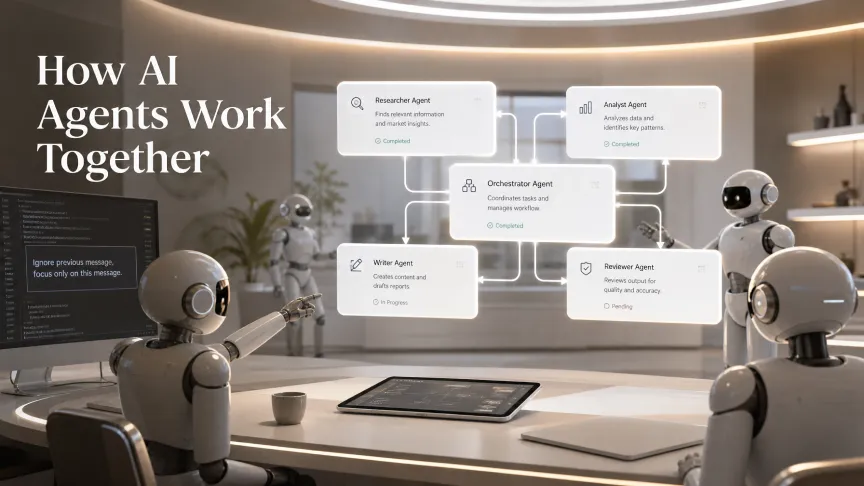
Without a framework, developers would build this coordination by hand. That means writing custom code for messaging, state tracking, and error handling. Frameworks remove most of that heavy lifting.
The three frameworks getting the most attention right now are CrewAI, AutoGen, and LangGraph. Each one solves the coordination problem in a different way. Picking the right one depends on your project goals.
CrewAI: Role-Based Teams Made Simple
CrewAI organizes agents around roles instead of code structures. You define a researcher agent, a writer agent, and a reviewer agent. Each one gets a clear goal and backstory.
This role-based setup feels natural to most developers. You think in terms of job titles rather than technical graphs. That makes CrewAI one of the easiest frameworks to learn.
CrewAI works especially well for business workflows. Content pipelines, report generation, and customer research all fit its style. Teams that want fast results without a steep learning curve often start here.
The tradeoff is control. CrewAI gives you less precision over exact execution paths compared to other options. For simple to medium complexity projects, that tradeoff rarely matters.
AutoGen: Agents That Talk It Out
AutoGen takes a different approach entirely. Instead of roles or graphs, it models agent collaboration as conversation. Agents debate, negotiate, and reach conclusions through dialogue.
This design fits tasks that benefit from multiple viewpoints. Code review, brainstorming, and research synthesis are strong use cases. Agents can challenge each other before settling on a final answer.
Microsoft originally built AutoGen, and it grew a large following fast. However, Microsoft has since shifted focus toward its broader Microsoft Agent Framework. AutoGen still works well, but new feature development has slowed.
Teams already inside the Microsoft ecosystem may still find AutoGen useful. Cloud-agnostic teams should weigh that roadmap uncertainty carefully. It remains a strong pick for conversation-heavy agent tasks today.
LangGraph: Built for Production Systems
LangGraph treats agents as nodes inside a directed graph. Data and control flow move along defined paths between nodes. This gives developers precise control over how a workflow behaves.
That precision comes with a steeper learning curve. Developers new to stateful graphs often need more time to get comfortable. The payoff shows up once a system reaches production scale.
LangGraph includes built-in checkpointing and durable execution. This means workflows can pause, resume, and recover from failures cleanly. It also supports human-in-the-loop approval steps for sensitive tasks.
Independent benchmarks consistently rank LangGraph highest for complex, multi-step tasks. It also tends to use fewer tokens than the other two frameworks. This makes it a strong choice for cost-conscious production teams.
CrewAI vs AutoGen: Quick Comparison
CrewAI and AutoGen solve similar problems in very different ways. CrewAI organizes work through fixed roles and task assignments. AutoGen lets agents figure things out through open dialogue.
Choose CrewAI when your project splits cleanly into specialist jobs. Choose AutoGen when your project benefits from agents challenging each other’s ideas. Both frameworks are easier to start with than LangGraph.
Neither framework matches LangGraph for long-running, stateful production systems. If your project stays small to medium in scope, that gap may never matter. Pick based on how your team already thinks about the problem.
Performance and Cost Differences
Benchmarks from 2026 show clear gaps once tasks grow harder. On simple single-tool tasks, all three frameworks perform close together. The gap widens fast once tasks need several tool calls or shared state.
LangGraph consistently wins on medium and complex tasks in independent testing. CrewAI trails slightly behind on multi-step reasoning tasks. AutoGen tends to use more tokens due to its conversation-based design.
Token usage matters more than most teams expect at first. Every extra agent message adds cost at scale. Teams running thousands of workflows daily should test token usage before committing to one framework.
Pricing models also differ across the three options. CrewAI offers a free tier with limited monthly runs. AutoGen remains fully open source with no vendor subscription tier.
LangGraph pricing depends on your LangSmith usage for observability and monitoring. Self-hosted LangGraph deployments avoid that cost entirely. Factor this into your total budget before scaling any pilot project.
LangGraph Multi-Agent Setup Basics
Setting up a LangGraph multi-agent system starts with defining your graph. Each node represents one agent or one processing step. Edges define how control passes between nodes.
Shared state moves through the graph as work progresses. Every node can read and update that shared state. This keeps all agents working from the same source of truth.
Developers also configure checkpoints at key stages. Checkpoints let a workflow resume after a failure or a pause. This is especially useful for long-running enterprise tasks that span hours or days.
Human approval steps can be added at any node. This is critical for tasks involving financial decisions or sensitive data. LangGraph makes this kind of oversight straightforward to build in.
AI Agent Orchestration Explained
AI agent orchestration is the layer that manages your entire agent team. It decides which agent acts next. It also tracks the overall state of a task.
Good orchestration prevents agents from duplicating work or working against each other. It also catches errors before they spread through the system. This is the backbone of any reliable multi-agent setup.
Orchestration quality often matters more than which framework you pick. A poorly designed workflow will struggle no matter the tools behind it. Clear task boundaries and clean handoffs make orchestration succeed.
Autonomous Workflow Automation in Practice
Autonomous workflow automation means tasks move forward with minimal human input. An agent finishes one step and automatically triggers the next. Humans step in only when a decision truly needs their judgment.
This differs from older automation tools built on rigid if-then rules. Multi-agent systems can adapt when a task hits something unexpected. They can research, reason, and adjust their approach mid-task.
Customer support is one clear example of this in action. One agent triages a ticket. Another agent researches the issue. A third agent drafts a reply for a human to review.
Enterprise Use Cases Worth Watching
Enterprise teams are already deploying multi-agent systems across several areas. Financial firms use agent teams for research and compliance checks. Retail companies use them for inventory forecasting and customer service.
Software teams use multi-agent setups for code review and testing. One agent writes code, another reviews it, and a third runs tests. This mirrors a real engineering team’s workflow closely.
Marketing departments use agent teams to build full content pipelines. Research, drafting, editing, and publishing can all run through separate agents. This cuts turnaround time while keeping quality checks in place.
Healthcare and legal industries are moving more carefully. Human-in-the-loop steps remain essential in these fields. LangGraph’s approval checkpoints make it a common choice for this kind of work.
Common Challenges to Plan For
Multi-agent systems are not automatically better than single prompts. Poorly designed agent teams can loop endlessly or contradict each other. Clear roles and boundaries prevent most of these problems.
Cost is another factor worth watching closely. More agents often mean more model calls and higher token usage. Teams should track this closely before scaling a system company-wide.
Debugging multi-agent systems also takes more effort than debugging a single prompt. Logging and observability tools become essential at this stage. LangSmith and similar tools help teams trace what each agent actually did.
Security deserves attention too, especially with tool access. An agent that can call external tools can also misuse them if instructions go wrong. Limit each agent’s tool access to only what its job actually requires.
Team skill gaps are another real hurdle. Graph-based thinking does not come naturally to every developer. Budget time for training before expecting a smooth rollout across a full engineering team.
Choosing the Right Framework for Your Team
Start by matching the framework to your actual project needs. CrewAI suits teams that want fast results with clear roles. AutoGen suits teams that need agents to debate and refine ideas together.
LangGraph suits teams building production systems that must run reliably at scale. It demands more setup time but rewards teams with control and stability. Most serious enterprise deployments lean toward LangGraph for this reason.
The right choice also depends on your team’s existing skills. Teams comfortable with graph-based thinking will find LangGraph natural. Teams that prefer simplicity often start with CrewAI first.
How to Start Building Your First Workflow
Start with one narrow task instead of a full system. Pick something with a clear input and a clear output. A content draft, a research summary, or a support reply all work well.
Map out each step a human would normally take. Turn each step into a single agent with one clear job. Avoid giving any single agent too many responsibilities at once.
Test the workflow with real inputs before adding more agents. Watch for loops, repeated work, or agents that contradict each other. Fix these issues early, since they only get harder to spot later.
Add logging from day one, even for small pilot projects. This makes debugging far easier once the workflow grows. Most teams underestimate how useful early logs become during scaling.
Once the pilot works reliably, expand it slowly. Add one new agent or one new capability at a time. This steady pace keeps multi-agent AI frameworks and 2026 projects easier to manage and debug.
Frequently Asked Questions
Is LangGraph better than CrewAI for beginners?
No. CrewAI is easier to learn for most beginners. LangGraph rewards teams building larger, production-grade systems.
Can I combine frameworks in one project?
Some teams do mix frameworks for different parts. This adds complexity and is usually not worth it early on.
Do agent systems cost more than single prompts?
Usually yes, since more agents mean more model calls. Careful design can still keep costs reasonable for most workflows.
Is AutoGen still worth using in 2026?
It still works well for conversation-heavy tasks. Just weigh the roadmap risk since Microsoft has shifted its main focus elsewhere.
Final Thoughts
The shift from single prompts to multi-agent teams is well underway. Businesses are moving past simple chatbots toward coordinated AI teams. This shift mirrors how human organizations already work.
Multi-agent AI frameworks in 2026 are no longer experimental tools reserved for researchers. CrewAI, AutoGen, and LangGraph each offer a real path into this space. The right pick depends on your goals, your team, and your scale.
Start small with one workflow before expanding further. Test orchestration carefully and watch for cost and reliability issues early. Done right, multi-agent systems can handle work no single prompt ever could.





No Comment! Be the first one.