





The Rise of Agentic AI: 5 Critical Strategies for Enterprise Automation
Discover how Agentic AI shifts machine learning from passive text generation to autonomous reasoning, transforming enterprise automation through smart frameworks and goal-oriented workflows.
The rise of Agentic AI is fundamentally changing how we interact with technology, moving us toward a future where software doesn’t just wait for commands, but actively solves complex business problems on its own. We are currently witnessing a foundational paradigm shift in machine learning advancements. Artificial intelligence is moving past the phase of simple text generation; today’s systems can perceive context, reason through multi-step challenges, and execute tasks autonomously without constant human intervention.
Table Of Content
- Defining the Shift Toward Autonomous Systems
- Core Components of Intelligent Agents
- The Strategic Impact on Enterprise Automation
- Assessing Your Infrastructure for Agentic Integration
- Selecting the Right Frameworks and Tools
- Designing Goal-Oriented Agent Workflows
- Implementing Safety Protocols and Human-in-the-Loop Oversight
- Monitoring Performance and Iterative Optimization
- Preparing for the Future of Autonomous Computing
- Frequently Asked Questions
This evolution in artificial intelligence applications is redefining enterprise workflows. Organizations deploying these autonomous systems are securing a massive competitive advantage in the digital ecosystem. For forward-thinking leaders, staying ahead requires a deep understanding of these AI innovation insights.
This comprehensive guide breaks down how to implement practical AI development strategies, analyze shifting AI technology trends, and leverage independent digital agents to drive real efficiency in your organization.
Key Takeaways
Beyond Generation: Autonomous frameworks represent a massive technological leap from standard generative models.
Operational Efficiency: Modern enterprises utilize these intelligent workflows to automate multi-layered, strategic operations.
Infrastructure Readiness: Successful deployment relies heavily on robust data engineering and API availability.
Safety First: Integrating structural guardrails and human-in-the-loop oversight is critical to managing autonomous decisions.
Strategic Growth: Long-term success demands a scalable roadmap that aligns agent metrics with core business objectives.
Defining the Shift Toward Autonomous Systems
The tech landscape has officially transitioned from reactive software to goal-oriented, self-directed architecture. Traditional applications rely on strict, hard-coded rules, meaning they can only execute what a developer explicitly programs. Even early AI models required constant prompting for every single step.
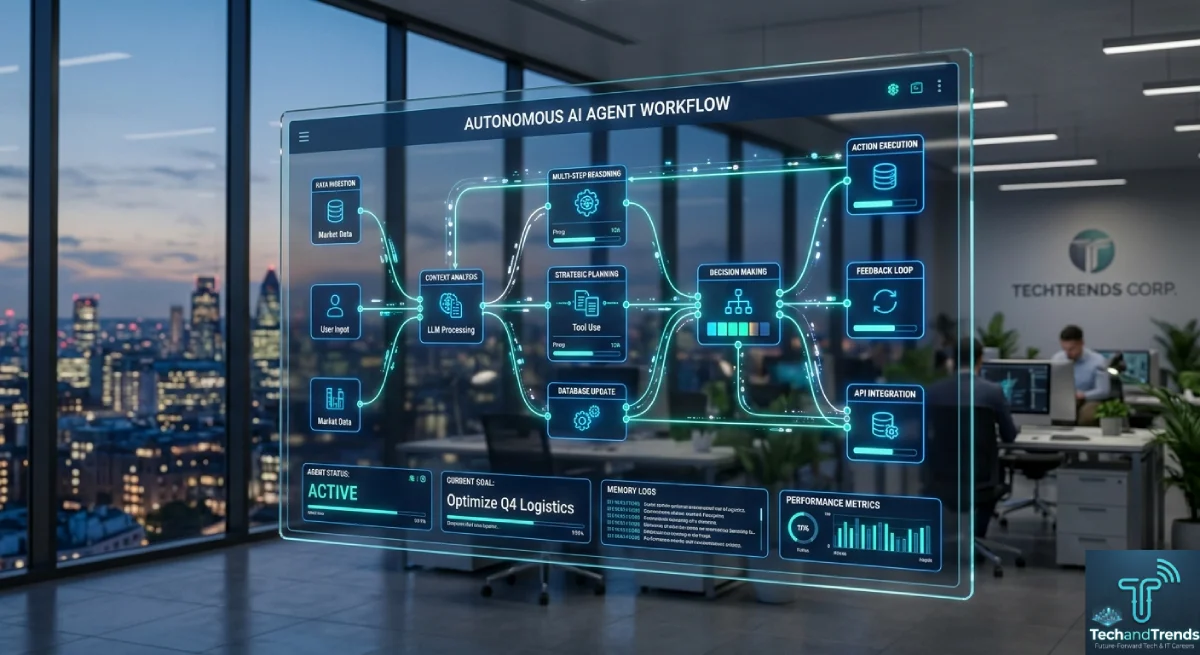
Agentic AI changes this dynamic entirely through autonomy. When given a high-level objective—such as “optimize the Q3 supply chain budget”—the system breaks down the goal, queries the necessary data, evaluates different pathways, and makes informed choices based on real-time data inputs. As enterprises embed these systems into daily operations, we move closer to an ecosystem where machines handle intricate operational logic independently, shifting the role of human workers from execution to high-level strategy.
Distinguishing Between Generative AI and Agentic AI
To build a successful strategy, it is vital to separate the capabilities of standard generative models from true cognitive agents:
Generative AI Models: Systems like standard LLMs excel at creating content, analyzing patterns, and summarizing data based on their training sets. However, they are inherently passive. They require a user to input a prompt, and their journey ends once the response is generated.
Agentic AI Systems: Intelligent agents combine this creative foundational intelligence with advanced cognitive computing, memory retention, and tool access. Instead of just writing an email draft, an agentic system can identify a missing invoice, pull data from an ERP system via APIs, draft the communication, verify it against company policy, and send it out—all autonomously.
Core Components of Intelligent Agents
For an AI agent to mimic human-like decision-making and navigate complex corporate environments, its architecture must rely on three core, interconnected components:
[ Data Understanding (Perception) ] ➔ [ Decision-Making (Reasoning) ] ➔ [ Action Phase (Execution) ]

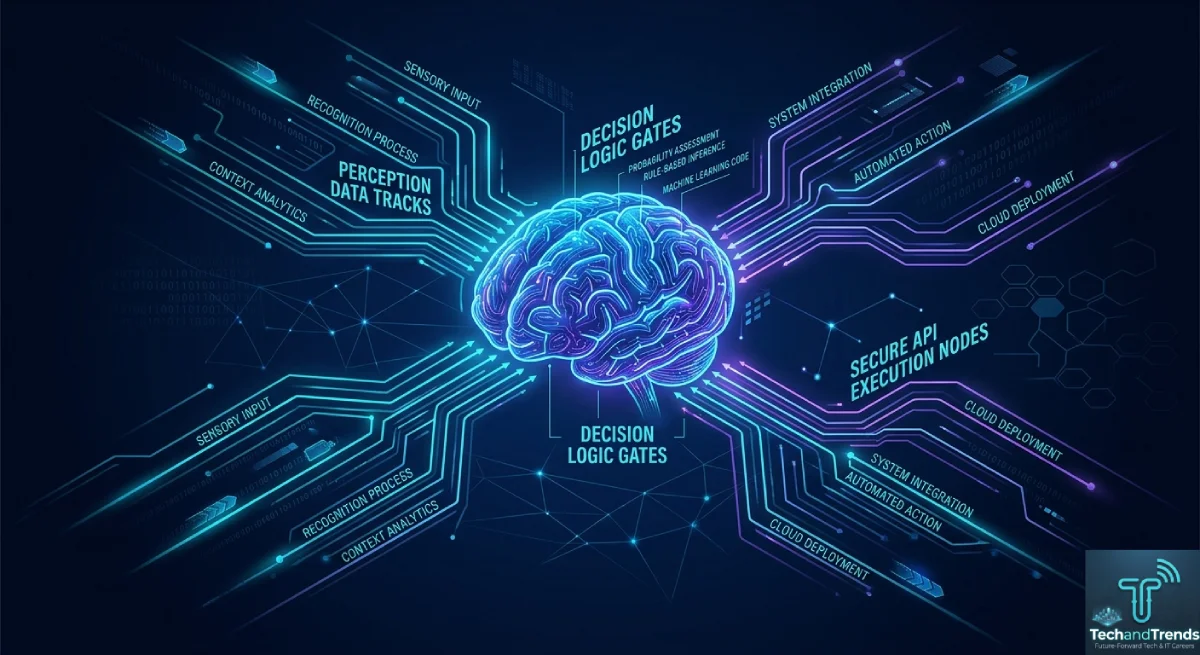
The Data Understanding Component (Perception): This acts as the agent’s senses. It continuously ingests data from its surroundings, including live software environments, system logs, customer databases, and incoming emails.
The Decision-Making Component (Reasoning): This is the cognitive core of the agent. It processes the perceived data, weighs it against pre-set business goals, accesses past memory logs, and plans the most logical next steps to achieve the objective.
The Action Component (Execution): This is where the agent interacts with the physical or digital world. Using secure APIs, it executes the decided plan—whether that involves updating a CRM database, modifying a cloud server setup, or running a code script.
The Strategic Impact on Enterprise Automation
Transitioning from localized scripts to self-driven cognitive infrastructure is unlocking massive value across global industries, creating market opportunities valued in the trillions of dollars.
Impact on Enterprise Automation
Traditional automation tools break when encountering data variants or unpredictable software errors. Agentic AI thrives in these ambiguous environments. By deploying agents capable of dynamic reasoning, enterprises can scale operations without a linear increase in overhead costs. These digital workers manage multi-layered tasks end-to-end, operating smoothly across legacy software and modern cloud ecosystems.
Global enterprises are rapidly integrating autonomous workflows into supply chain logistics, real-time customer experience desks, and predictive financial reporting, making business operations faster and highly scalable.
Evolution from Static Models to Cognitive Agents
Static models process a single data input and deliver a fixed output, requiring manual retraining when market dynamics change. Cognitive agents, conversely, utilize continuous loop feedback to adapt to environmental changes in real time.
| Feature | Static AI Models | Cognitive Agents |
| Decision Making | Rule-based or basic pattern matching | Goal-oriented reasoning & planning |
| Environment Interaction | Passive data processing | Active tool usage, API calls, and environment feedback |
| Workflow Scope | Single-step, isolated tasks | Multi-step, cross-functional processes |
| Adaptability | Requires manual retraining or new datasets | Self-correcting via runtime execution feedback |
Assessing Your Infrastructure for Agentic Integration
A common pitfall for enterprises is rushing into AI development strategies without reviewing their data foundations. A successful deployment requires an ecosystem optimized for high-speed automated interactions.
Evaluating Data Readiness and Pipeline Requirements
An autonomous agent is only as reliable as the data feeding its perception engine. Your internal data pipelines must deliver clean, well-structured, and secure data for intelligent automation to function.
When conducting an infrastructure readiness audit, focus on these primary technical criteria:
Data Latency: Are your data pipelines fast enough to supply real-time information for immediate agent action?
Data Integrity: Do you have automated validation scripts running to prevent corrupt data from misguiding the agent’s reasoning engine?
API Accessibility: Is your internal software ecosystem fully accessible through safe, authenticated, and well-documented APIs?
Identifying High-Value Use Cases for Autonomy
To mitigate initial risks, avoid assigning highly sensitive or fully open-ended tasks to an agent. Focus on high-frequency, data-heavy processes that currently experience operational bottlenecks due to manual human transfers. Look for workflows requiring cross-functional data retrieval, and gradually expand the agent’s scope as its performance stabilizes.
Selecting the Right Frameworks and Tools
Building a reliable autonomous system requires selecting an orchestration stack that aligns perfectly with your scaling goals and security protocols.
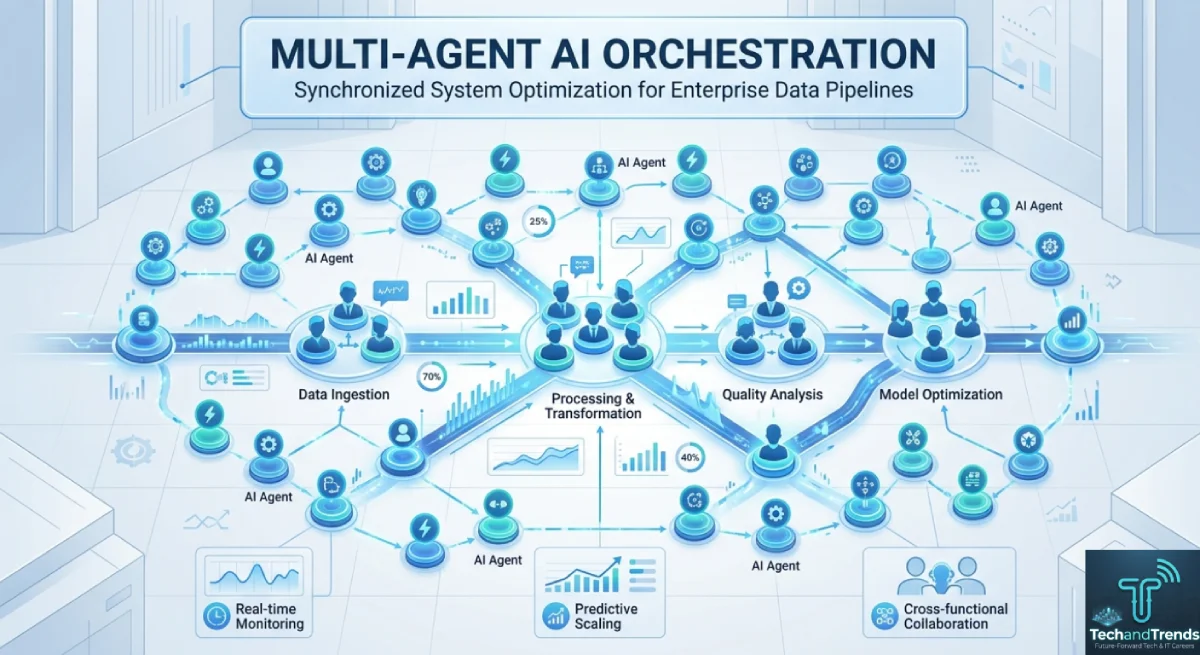
Comparing Popular Agent Development Platforms
The AI ecosystem offers several robust frameworks designed to manage agent logic, contextual memory, and software execution loops:
| Framework | Primary Strength | Best Use Case |
| LangChain | Modular Orchestration & Memory Control | Complex Data Pipelines & Advanced Retrieval |
| CrewAI | Multi-Agent Coordination & Role Playing | Collaborative Task Solving & Team Workflows |
| AutoGPT | Autonomous Goal Execution & Web Research | Open-ended Research, Analysis, and Discovery |
Integrating Large Language Models with External APIs
To transform a language model into an active enterprise asset, it must connect securely to external systems. When linking machine learning engines to business software via APIs, developers must implement strict API gateways. This involves setting granular access permissions, enforcing strict rate-limiting protocols to avoid server crashes, and structuring rigorous data-schema validations to ensure smooth communication between the agent and host software.
Designing Goal-Oriented Agent Workflows
Structuring a cognitive workflow requires a careful balance between operational flexibility and strict programmatic boundaries. The objective is to give the agent room to solve problems without allowing unpredictable execution paths.
Defining Clear Objectives and Constraints
Every agent deployment must start with a distinct, mathematically verifiable success metric. Alongside this objective, developers must program strict programmatic guardrails. Guardrails dictate exactly what resources, folders, or actions are completely off-limits, keeping the system aligned with compliance standards.
Structuring Multi-Step Reasoning Chains
Complex business problems cannot be solved in a single processing step. Workflows should be structured into sequential reasoning chains—similar to how human analysts break down projects.
[Identify Problem] ➔ [Gather Context Data] ➔ [Draft Solutions] ➔ [Validate Against Constraints] ➔ [Execute]
Structuring the reasoning architecture modularly makes it significantly easier to audit logs, isolate logical errors, and optimize performance over time.
Implementing Recursive Task Decomposition
When an agent faces an expansive, multi-layered objective, it uses recursive task decomposition to break the macro-goal into isolated sub-tasks. The system executes each micro-task sequentially, verifies the correctness of individual outputs, and synthesizes them into a unified final resolution. This method allows agents to stay focused on the broader goal while managing complex details.
Implementing Safety Protocols and Human-in-the-Loop Oversight
As autonomous code execution spreads across enterprise tech stacks, system reliability and digital safety become primary priorities. Organizations must build resilient safety layers to manage unexpected edge cases safely.
Establishing Guardrails for Autonomous Decision Making
Guardrails serve as an unbreachable perimeter around the agent’s logic engine. These programmatic barriers prevent illegal system operations, enforce ethical compliance, and ensure that the agent’s actions stay fully within authorized operational boundaries.
Managing Error Handling and Fallback Mechanisms
Even the most advanced cognitive systems require built-in exception strategies. If an API call fails or an unexpected data shape is received, the agent must not enter an infinite loop. Instead, comprehensive fallback mechanisms should automatically route the task to an internal exception log or gracefully scale back operations.
Best Practices for Human Intervention Points
For high-impact corporate milestones—such as transferring funds, altering master databases, or launching public communications—human intervention points are essential. Integrating structured decision gateways allows companies to maximize automated processing speeds while retaining critical human oversight.
| Safety Strategy | Primary Benefit | Implementation Level |
| Hard Constraints | Prevents unauthorized software actions | System & Network Architecture |
| Anomaly Detection | Flags erratic reasoning patterns instantly | Real-time Execution Monitoring |
| Human Review | Ensures policy and compliance alignment | Post-Reasoning / Pre-Action Gateways |
| Fail-Safe Mode | Prevents cascading system crashes | Global Emergency Protocol |
Monitoring Performance and Iterative Optimization
Maintaining an autonomous system requires continuous monitoring. Monitoring infrastructure should be viewed as an essential operational component to ensure long-term reliability and high output quality.
Tracking Key Performance Indicators for Agents
Engineering teams must track specific, actionable metrics that map directly to business performance:
Task Success Rate: The percentage of assigned objectives resolved correctly without needing manual fallback overrides.
Token & Execution Latency: The processing time required for an agent to move from initial perception to final action.
Cost Per Task: The precise financial expenditure (API tokens, compute costs) required to execute a specific workflow.
Refining Agent Behavior Through Feedback Loops
Continuous optimization relies heavily on structured feedback loops. By establishing system pathways where human operators can rate, tag, or modify agent decisions, developers generate clean, contextual fine-tuning data. This continuous learning capability ensures the agent adapts to evolving company preferences over time.
Analyzing Logs for Continuous Improvement
Deep system logs act as the ledger of an agent’s internal thought process. By regularly auditing these logs, software engineers can pinpoint exact moments where reasoning drifted, uncover API bottlenecks, and optimize execution prompts to keep the system robust and efficient.
Preparing for the Future of Autonomous Computing
We are entering a new architectural era where modern enterprises will be heavily supported by persistent, always-on digital workforces. Moving forward, the organizations that lead their sectors will not just be those using artificial intelligence, but those that orchestrate it with clear logic, sound governance, and structural agility.
Preparing for this future requires close collaboration between enterprise leaders, operational teams, and software engineers. By mapping out high-value use cases, building clean data pipelines, and implementing strict safety parameters today, you can position your organization to thrive in a highly automated, agentic digital landscape.
Frequently Asked Questions
What distinguishes the rise of agentic AI from traditional artificial intelligence applications?
Traditional AI applications, such as basic search systems or first-generation chatbots, are purely reactive; they process a direct input and return a single static output. Agentic AI is proactive. It is designed with continuous reasoning loops that allow it to analyze an environment, map out multi-step execution plans, use external APIs, and adjust its actions dynamically to hit a pre-set goal without constant manual steering.
How do current machine learning advancements contribute to the future of AI technology?
Recent shifts in machine learning focus heavily on reasoning frameworks, long-term contextual memory, and tool usage rather than just predicting the next word in a sentence. These advancements enable foundational models to act as central decision-making engines, allowing systems to self-correct logical errors, run complex code scripts, and interact smoothly with external software ecosystems.
What are the most critical AI development strategies for implementing intelligent automation?
The most critical strategies include establishing structured, low-latency data engineering pipelines, wrapping all host software in secure, accessible APIs, and implementing strict behavioral guardrails. Furthermore, developers must design robust human-in-the-loop validation checkpoints for all high-risk execution stages.
What is the projected agentic AI impact on the modern enterprise?
Industry-leading analysts project that agentic AI workflows will unlock trillions of dollars in global productivity. By automating complex, cross-functional knowledge work that older software suites couldn’t touch, autonomous agents allow enterprises to scale their operational capacity exponentially while keeping operational overhead lean.
Why is cognitive computing essential for the evolution of intelligent agents?
Cognitive computing principles allow an agent to navigate real-world business ambiguity. Instead of failing immediately when encountering an unexpected error or incomplete dataset, a cognitive agent can weigh alternative pathways, query supplementary data sources, and reason through unpredictable scenarios to complete its objective successfully.





No Comment! Be the first one.