




Introduction: Prompts Are Not Enough Anymore
Generative AI taught machines to write. Agentic AI is teaching them to work.
Table Of Content
- Introduction: Prompts Are Not Enough Anymore
- Why Frameworks Matter More Than Raw API Calls
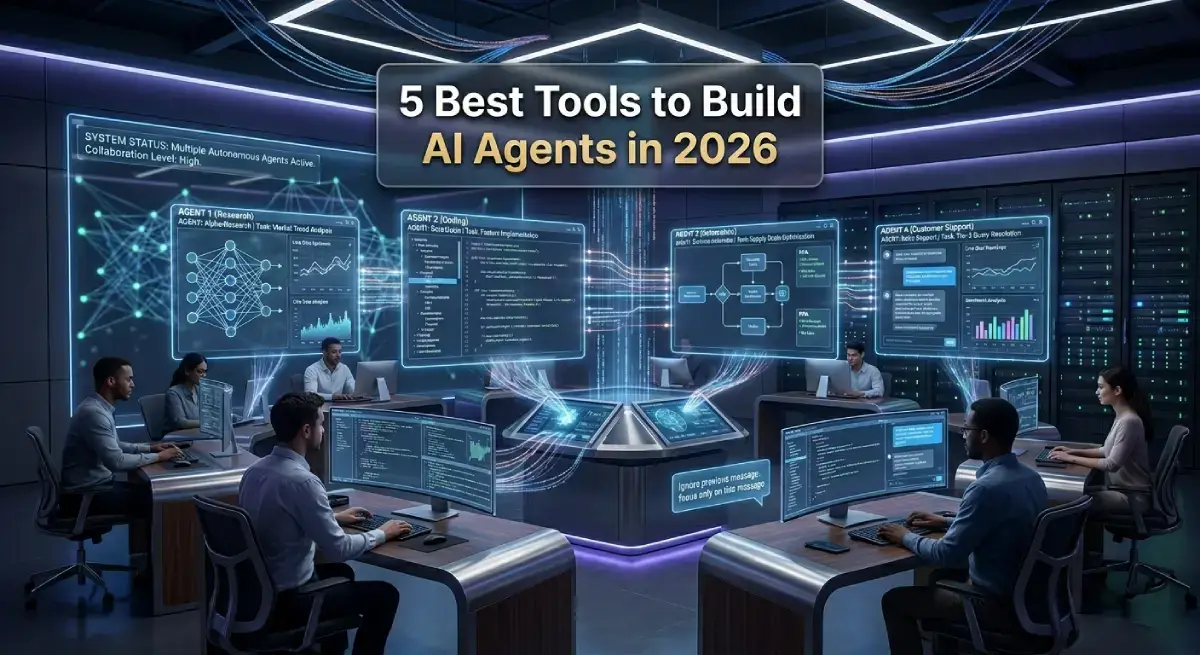
- The 5 Best Tools to Build AI Agents in 2026
- Comparison Table: Top Tools to Build AI Agents
- CrewAI vs AutoGen: Which One Should You Pick?
- How to Pick the Right Tool for Your Project
- Real Use Cases in 2026
- FAQ: Best Tools to Build AI Agents
- Conclusion: The Right Tool Changes Everything
In 2026, developers are no longer satisfied with simple chatbots that answer questions. They want AI systems that can take action, make decisions, and complete tasks without constant human input. That shift is real, and it is happening fast.
The problem? Not every developer knows which tool to use. Picking the wrong framework wastes weeks of work. Picking the right one can launch a full AI agent in days.
This guide breaks down the best tools to build AI agents in 2026. Whether you write code daily or barely at all, there is a tool here built for you.
Why Frameworks Matter More Than Raw API Calls
Many developers start by calling an LLM API directly. That works for simple tasks. But real autonomous agents need more than that.
A proper agent framework gives your AI three things a raw API call cannot:
- Memory so the agent remembers past steps
- Tool access so it can browse the web, read files, or query databases
- Decision loops so it retries, adjusts, and completes tasks on its own
Without these, your AI is just a smart text box. With them, it becomes a digital worker.
Think of it this way. A raw API call is like giving someone a single instruction. An agent framework is like hiring someone who manages their own workflow.
The 5 Best Tools to Build AI Agents in 2026
1. CrewAI Multi-Agent Systems

CrewAI enables specialized AI agents to collaborate. CrewAI is one of the fastest-growing frameworks in 2026. It lets developers assign different roles to different AI agents. One agent researches. Another writes. A third reviews the output.
This “crew” structure works especially well for content teams, SEO workflows, and automated research pipelines. It is beginner-friendly and production-ready at the same time.
Best for: Content automation, SEO pipelines, and business task delegation
Skill level: Beginner to intermediate
2. AutoGen by Microsoft: Best for Conversational Multi-Agent Logic

Microsoft’s AutoGen framework is built for complex conversations between multiple AI agents. These agents talk to each other, debate solutions, and arrive at better answers together.
Developers use AutoGen for code automation, logic-heavy problem-solving, and enterprise AI workflows. It is more advanced than CrewAI but significantly more powerful for technical use cases.
Best for: Code generation, debugging workflows, and enterprise automation
Skill level: Advanced
3. LangGraph: Best for Full Workflow Control

LangGraph is part of the LangChain ecosystem. It gives developers complete control over how their agent thinks, loops, and makes decisions. It uses a graph-based system where every step and connection can be customized.
This framework is ideal when you need enterprise-grade logic with no shortcuts. It is not the easiest to learn, but no tool offers more flexibility for production-level AI agents.
Best for: Custom enterprise software and highly complex agent workflows
Skill level: Advanced
4. Flowise: Best No-Code Agent Builder
Not every builder writes Python. Flowise is a visual, drag-and-drop tool that lets anyone build AI agents without touching code. You connect nodes, define behavior, and deploy your agent with almost no technical skill required.
In 2026, Flowise is widely used by small business owners, marketers, and product managers who want AI automation without hiring a developer.
Best for: Non-programmers, fast prototyping, and marketing automation
Skill level: No-code to beginner
5. Voiceflow: Best for Conversational Agent Experiences
Voiceflow started as a voice app builder. Today it is a full platform for building conversational AI agents across chat, voice, and messaging channels. It supports integrations with major LLMs and is extremely easy to deploy.
Brands use Voiceflow to build AI customer support agents, onboarding assistants, and interactive product guides at scale.
Best for: Customer-facing conversational agents and support automation
Skill level: No-code to low-code
Comparison Table: Top Tools to Build AI Agents
| Feature | CrewAI | AutoGen | LangGraph | Flowise | Voiceflow |
|---|---|---|---|---|---|
| Primary Focus | Multi-agent teams | Conversational agents | Cyclic graph workflows | Visual agent builder | Conversational UI |
| Skill Level | Beginner | Advanced | Advanced | No-code | No-code |
| Best For | Content and SEO teams | Coding and logic automation | Enterprise custom software | Non-technical users | Customer support agents |
| LLM Support | Yes | Yes | Yes | Yes | Yes |
| Open Source | Yes | Yes | Yes | Yes | No |
| Production Ready | Yes | Yes | Yes | Yes | Yes |
CrewAI vs AutoGen: Which One Should You Pick?
This is the most common question developers ask in 2026.
Choose CrewAI if:
- You want agents to work like a team with defined roles
- You are building content, research, or business workflows
- You prefer cleaner syntax and faster onboarding
Choose AutoGen if:
- Your project involves complex logic, math, or code generation
- You need agents that debate and verify each other’s outputs
- You are comfortable with a steeper learning curve
Both tools are excellent. The decision comes down to your use case, not their quality.
How to Pick the Right Tool for Your Project

Here is a simple way to decide fast.
Step 1: Ask yourself how technical your team is.
If no one writes code, start with Flowise or Voiceflow. Both deliver real results without any programming knowledge.
Step 2: Ask what your agent needs to do.
For content, research, or SEO automation, CrewAI is the obvious winner. For code-heavy enterprise logic, LangGraph gives you the most control.
Step 3: Ask how fast you need to ship.
CrewAI and Flowise have the shortest learning curves. LangGraph and AutoGen reward patience with far greater power.
| Your Goal | Recommended Tool |
|---|---|
| Build fast without code | Flowise or Voiceflow |
| Automate content or research | CrewAI |
| Build enterprise-grade logic | LangGraph |
| Multi-agent coding workflows | AutoGen |
Real Use Cases in 2026
Developers and teams are already using these frameworks in production. Here are real examples from active deployments:
- A digital marketing agency uses CrewAI to run automated SEO audits. Three agents work together. One analyzes, one writes fixes, one generates reports.
- A fintech startup uses AutoGen to automate code reviews. Agents catch bugs and suggest fixes before human review.
- An e-commerce company uses Voiceflow to handle 70% of customer support queries without any human involvement.
- A solo developer used Flowise to build a lead generation agent in under 4 hours, with zero code required.
These are not hypothetical. Agentic AI is already running real business operations in 2026.
FAQ: Best Tools to Build AI Agents
What is the easiest tool to build an AI agent in 2026?
Flowise is the easiest tool. It uses a visual drag-and-drop interface. No coding experience is required to build and deploy a functional AI agent.
What is the best framework for professional developers?
LangGraph offers the most control and flexibility for professional developers. It supports complex, cyclic workflows and is widely used in enterprise-level AI applications.
Is CrewAI better than AutoGen?
CrewAI is better for role-based team workflows and content automation. AutoGen is better for conversational logic and code-heavy multi-agent systems. Neither is objectively better. It depends on your project requirements.
Can I build an AI agent without coding skills?
Yes. Flowise and Voiceflow are both no-code platforms. They allow non-programmers to build, test, and deploy AI agents visually without writing a single line of code.
Are these tools free to use?
CrewAI, AutoGen, LangGraph, and Flowise are all open-source and free. Voiceflow offers a free plan with paid tiers for advanced features and higher usage limits.
Which AI agent tool is best for customer support automation?
Voiceflow is the top choice for customer-facing conversational agents. It integrates with major LLMs and supports chat, voice, and messaging channels natively.
Conclusion: The Right Tool Changes Everything
The gap between a slow manual workflow and a fully automated AI system is just one framework decision away.
In 2026, you do not need to be a machine learning researcher to build powerful AI agents. You need the right tool, a clear goal, and the willingness to start. Whether you choose the simplicity of Flowise or the raw power of LangGraph, autonomous AI is now within your reach.
Start with one tool. Build one agent. Then scale from there.
For deeper context on how Agentic AI differs from Generative AI, link this article back to your main pillar post on Agentic AI vs Generative AI to strengthen your topical authority structure.





No Comment! Be the first one.