





How to Build and Manage Your AI Chatbot Conversations Archive in 2026
A clear 2026 guide to building and managing your AI chatbot conversations archive, with privacy tips and platform comparisons.

Most people chat with AI tools every single day. Yet very few think about where those conversations actually go. An AI chatbot conversations archive is the system that stores every message you send. Understanding how it works can protect your privacy and boost how much value you get.
Table Of Content
- What Is an AI Chatbot Conversations Archive
- Why Your Chat Archive Matters More Than You Think
- How Archive and Delete Actually Differ
- How the Major AI Platforms Handle Archiving
- Building a Personal Archive System That Actually Works
- Data Retention and Privacy Considerations
- Chatbot Archive Features Compared
- Common Mistakes People Make With Their Archive
- Practical Tips For Managing Your Archive
- Frequently Asked Questions
- Conclusion
What Is an AI Chatbot Conversations Archive
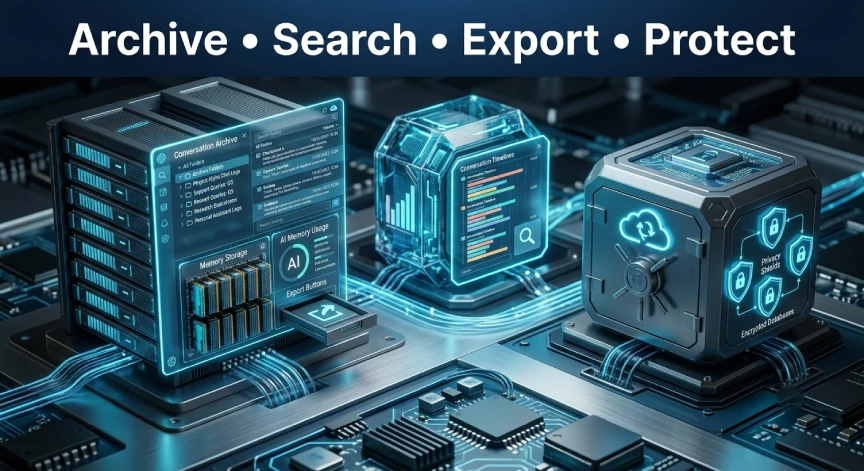
An AI chatbot conversations archive is a structured record of your chat history. It holds full message threads, timestamps, and any files you shared. Think of it as a digital filing cabinet for everything you have asked an AI assistant.

Most major platforms now build this feature directly into their interface. ChatGPT, Claude, and Gemini all keep a running log of your sessions. Some tools archive chats automatically, while others require you to save them yourself.
Why Your Chat Archive Matters More Than You Think
A well-kept archive turns scattered conversations into a real knowledge base. You can revisit old prompts and reuse strong answers. You can also track how your thinking on a project changed over time. This is useful for writers, marketers, developers, and students who rely on AI daily.
Archives also support accountability inside businesses. Companies that use chatbots for customer service depend on saved transcripts to review support quality. Teams can spot common questions and measure response accuracy. They can also train new staff using real examples pulled from past chats.
There is a privacy side too. Every stored conversation is also a data record. Knowing what gets saved and where it lives matters. This knowledge helps you decide what to share with any AI tool.
How Archive and Delete Actually Differ
Many users assume archiving a chat removes it completely. That is not correct on most platforms. Archiving simply hides a conversation from your main sidebar without deleting the data underneath.
Deletion works as a separate action entirely. When you delete a chat, most platforms remove it from your active view right away. Backend copies may still exist for a limited window. This usually happens due to legal or safety requirements.
If privacy matters to you, always check both settings carefully. Archive a chat to declutter your workspace. Delete a chat only when you genuinely want that content gone for good.
How the Major AI Platforms Handle Archiving
ChatGPT offers a simple archive option through its settings menu. You can hide any conversation from the sidebar while keeping full access later. A dedicated archived chats section stores everything in one place for quick retrieval.
Claude keeps conversation history tied to your account. You can search across past sessions right from the app. Recent memory updates let the assistant recall useful context from earlier chats. You choose whether to turn this feature on.
Gemini ties its history to your broader Google account activity. You can review, pause, or clear conversation history from your account dashboard. Google also lets you delete activity within a chosen date range. This gives you more control than deleting everything at once.
Each platform updates these features often, so settings menus can shift. It helps to check your data controls page every few months. This way you always know exactly what your archive contains.
Third-party browser extensions have also entered this space recently. Some tools let you archive many conversations at once using bulk selection. Native platform tools rarely offer this kind of speed for heavy users.
Building a Personal Archive System That Actually Works
Relying only on a platform’s built-in tools has real limits. Native search functions can miss context. Long chat lists become hard to scan after a few hundred entries. A personal system built around consistent habits solves this problem.

Start by renaming valuable conversations the moment they become useful. A chat named exactly what it covers is far easier to find later. Waiting until you have hundreds of generic titles almost guarantees you will never clean them up.
Group related chats using folders or project features where available. Many platforms now let you cluster conversations by topic or client. This turns a messy sidebar into a searchable resource you can actually rely on.
Consider exporting important conversations outside the platform itself. Tools like Notion, Obsidian, or a simple document folder give you a permanent copy. This protects your work even if a platform changes a feature or shuts one down.
A consistent naming pattern makes the biggest long-term difference. Include the date, topic, and purpose in every title you save. Future searches become fast instead of frustrating once this habit sticks.
Data Retention and Privacy Considerations
Every platform sets its own rules for how long data stays stored. Free and paid tiers often store active conversations indefinitely until you delete them. Deleted content typically enters a shorter retention window on backend systems first.

Model training policies also vary widely between providers. Some platforms use conversation data to improve their systems by default. Others require clear opt-in permission before any user data touches training.
Enterprise plans usually offer stronger control over these settings. Business accounts can often set custom retention windows for their data. They can also opt out of model training entirely in many cases.
If you handle sensitive information, always review a platform’s policy first. Data rules change often as regulations evolve around the world. A quick policy check today can prevent a privacy headache later.
Chatbot Archive Features Compared
ChatGPT Archive lets you hide chats from the sidebar without deleting them. Claude Archive keeps history searchable and pairs it with optional memory recall. Gemini Archive links to your Google account and offers date range deletion.
ChatGPT Export works through account settings as a downloadable data file. Claude Export currently allows conversation copying rather than full account export. Gemini Export connects through Google Takeout for a broader account-level download.
ChatGPT Memory now carries context across separate conversations for paid users. Claude Memory can recall useful details across sessions when you enable it. Gemini Memory works through a personal intelligence layer tied to your account.
No single platform wins every category outright. Your best choice depends on whether you value memory, export flexibility, or simple organization. Many professionals end up using more than one tool for different tasks.
Common Mistakes People Make With Their Archive
Letting conversations pile up without any naming system causes the biggest headache. Hundreds of chats titled with generic first messages become impossible to search later. A small naming habit prevents this problem before it ever starts.
Assuming archived chats are automatically deleted is another common mistake. This false sense of security can lead to oversharing sensitive information. Always remember that archiving only hides a conversation from view.
Ignoring memory settings is a third mistake worth fixing today. Many users never check whether a platform is storing personal details long-term. A quick settings review can prevent unwanted context from following you across sessions.
Skipping regular backups leaves valuable work vulnerable to sudden loss. Account issues, platform outages, or accidental deletion can erase months of insights. A simple monthly export routine protects hours of work in just minutes.
Practical Tips For Managing Your Archive
Review your archive every few months instead of letting it grow unchecked. A quick cleanup session helps you spot outdated information you no longer need. This keeps your workspace fast and easy to navigate every time you search.
Use clear, consistent naming from the very first message you send. Include the topic, client name, or project phase directly in the title. This single habit saves enormous time during future searches.
Back up conversations tied to important decisions or ongoing projects. A short export routine protects your work from accidental deletion or account issues. Treat valuable AI conversations the same way you treat any business document.
Turn off memory features for sensitive topics if privacy is a concern. Most platforms let you toggle memory on a per-conversation basis. This gives you control without forcing you to avoid useful AI features.
Set a recurring reminder to check your data settings each quarter. Providers update privacy controls often, sometimes without a clear announcement. Staying on top of these changes keeps your archive both useful and safe.
Frequently Asked Questions
What is an AI chatbot conversation archive used for?
It stores your past AI conversations so you can search and reuse them. It also supports quality checks for businesses using chatbots in customer service.
Does archiving a chat permanently delete it?
No, archiving only hides a conversation from your main view. The data remains stored until you choose to delete it separately.
Can I export my chatbot conversation history?
Most major platforms allow some form of export or download today. Check your account settings under data controls for available options.
Is my chat history used to train AI models?
This depends entirely on the platform and your account settings. Many tools offer an opt-out option if you prefer your data stays private.
How long do platforms keep deleted conversations?
Retention windows vary widely between providers and account tiers. Many use a short backend period after deletion for security reasons.
Conclusion
Your AI chatbot conversations archive is more valuable than most people realize. It holds ideas, decisions, and problem-solving history you can reuse. Taking a few minutes to organize it properly pays off quickly.
Start small by renaming your next few conversations as you go. Review your settings to understand what gets stored and for how long. A little structure today turns your archive into a truly useful tool.
The habits you build now will save real time later. Every organized conversation becomes a resource instead of forgotten clutter. Your archive can grow into one of your most reliable work tools.






No Comment! Be the first one.