




What AI Employee Monitoring Laws for Small Business Owners Mean After Maine and California’s 2026 Changes
Maine’s new surveillance law and California’s AI emotion-tracking ban reshaped the rules in 2026. Here is what small employers must disclose, which tools to avoid, and how to write a simple...
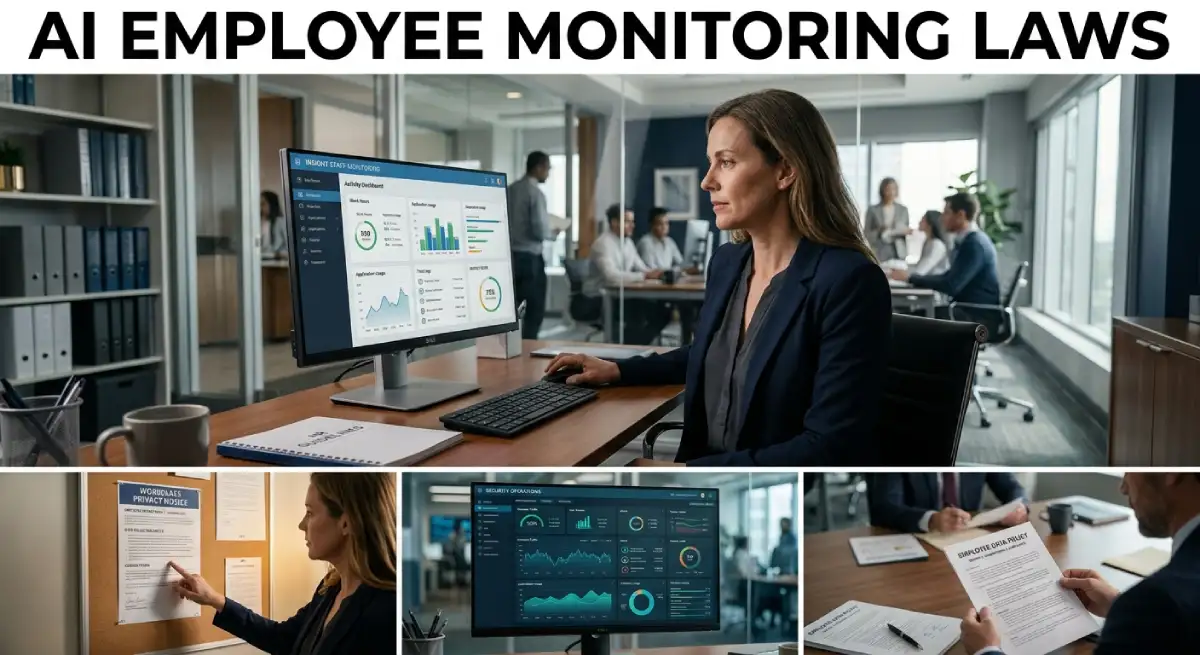
Can you legally watch your team with AI software? Usually yes, if the tools run on company equipment, serve a business purpose, and staff knows. But AI employee monitoring laws for small business shifted fast in 2026. Maine’s surveillance law took effect in July, and California just banned AI emotion tracking.
Table Of Content
- AI Employee Monitoring Laws for Small Business: The Federal Baseline
- The Four States With Dedicated Notice Laws
- What California Just Banned
- Four Risky Mistakes Small Businesses Make
- A Quick Word on AI Hiring Tools
- What a Violation Really Costs
- A Practical Monitoring Policy for Small Teams
- Frequently Asked Questions
- Before You Switch On the Next Monitoring Tool
Notice rules matter more than ever, and a vague handbook line may not satisfy them. This guide covers who requires what, which AI features are off limits, and what mistakes cost. Think of it as a short checklist for owners without an HR department. It isn’t legal advice, so have an employment attorney review your final policy.
AI Employee Monitoring Laws for Small Business: The Federal Baseline
Start with the good news about AI employee monitoring laws for small business. Federal rules, mainly the Electronic Communications Privacy Act, give employers wide room. You need a legitimate business reason, such as security, compliance, or quality control. Most state laws build on that foundation rather than replace it.
Trouble starts once you step beyond company equipment. Personal phones, private accounts, and home environments get stricter treatment. Recording audio adds its own consent rules. We’ll take each of those in turn.
AI adds a twist. Older tools mostly logged what happened. Newer ones score productivity, flag sentiment, or guess at mood. Lawmakers care far more about that second kind.
States weighed 155 workplace AI bills in the 2026 session, according to MultiState. Many died in committee. One legal tracker adds that a surveillance bill many guides called effective in January never passed. Check the statute number and date before trusting any summary.
The Four States With Dedicated Notice Laws
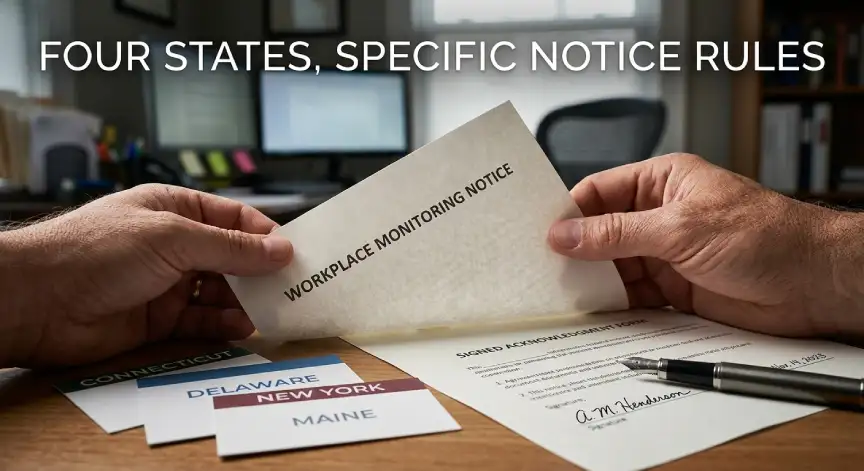
Four states now have stand-alone monitoring notice laws, per recent legal summaries. Connecticut, Delaware, and New York came first. Maine joined in July 2026 with Maine’s LD 61 law, which goes further. Notice is the common thread, not consent.
| State | What you must do | Worth knowing |
|---|---|---|
| Connecticut | Post a workplace notice about electronic monitoring | Notice, not consent |
| Delaware | Give a daily notice, or a one-time written notice the employee acknowledges | Two routes to compliance |
| New York | Written notice at hiring, a signed or electronic acknowledgment, and a posted notice | Three separate steps, all required |
| Maine | Notice before using any tool, disclosure in interviews, and written notice every year | Fines of 100 to 500 dollars per violation |
Maine deserves a closer look because it’s the newest. Employers can’t require staff to install tracking apps on personal devices. Home, car, or personal-property video and audio monitoring is off limits unless the job requires it. The Maine Department of Labor enforces the law.
Security cameras and employer-owned safety devices are carved out, according to the same summary. Even so, the definition is broad enough that AI-driven tools may fall inside it. Audit what you run before assuming you’re exempt.
Running a team across state lines? Don’t build four separate policies. Write one policy that meets the strictest rules, then add state notices where needed. That’s cheaper than managing exceptions.
What California Just Banned
California’s AB 1883, signed on September 30, bans a specific kind of AI surveillance. It targets tools that collect neural data or infer an employee’s emotional state. That can include video, audio, time-tracking, and location tools when they use AI that way. Penalties reach 500 dollars per violation.
Safety uses survive. The law doesn’t bar tools that serve safety and avoid the prohibited features. Governor Newsom asked lawmakers to clarify the scope, so expect revisions. Confirm the effective date with counsel before you act.
Why does this matter outside California? Other states are watching. Vendors may change a feature for every customer instead of one state. Don’t count on that, though.
Here’s the practical test. Ask every vendor whether the product reads facial expressions, tone of voice, or stress signals. If the answer is yes and you have California staff, pause the rollout. Employees working from California likely count too.
Four Risky Mistakes Small Businesses Make
1. Recording audio without checking consent rules
AI meeting notetakers and call recorders are everywhere now. Some states require every person on a call to agree to being recorded. A tool that quietly joins a client call can create exposure you never planned for. Our roundup of the best AI meeting notetaker apps shows what these tools actually capture.
2. Pushing tracking onto personal devices
A company laptop is fair game with proper notice. A personal phone is murkier. Maine now lets employees refuse tracking apps on personal devices. Buying work phones for key staff may cost less than the arguments.
3. Collecting biometrics without a plan
Face scans, fingerprints, and voice analysis count as biometrics in many states. One legal summary calls Illinois the highest-risk state for them. Monitoring tools sometimes add face or voice analysis in a quiet product update. Read the release notes and switch off features you didn’t choose.
4. Watching conversations about pay or working conditions
Monitoring tied to security or performance is one thing. Reading chats where staff discuss pay or conditions is another. Federal labor law can protect employees who talk about those topics together. Keep your monitoring focused on business purposes, not on what people say about their jobs.
A Quick Word on AI Hiring Tools
Hiring tools follow a different set of rules. Illinois amended its Human Rights Act, effective January 1, 2026, to cover AI that could discriminate. New York City requires bias audits for automated hiring tools. If you screen applicants with AI, check those rules too.
What a Violation Really Costs
The fines look small. Maine’s range is 100 to 500 dollars per violation, and California’s tops out at 500. But “per violation” can multiply fast when one missing notice touches every employee. How regulators count them is still unsettled, so don’t bank on the low end.
Try a made-up example. Say a 12-person company skips Maine’s annual notice, and each employee counts as one violation. At 500 dollars each, that’s 6,000 dollars before any legal fees. Real penalties depend on how the labor department counts, so treat this as a thought exercise.
Fines aren’t the real hit, though. A tool you later switch off wastes the subscription. So does software that staff install on their own. Our guide to shadow AI risks for small businesses explains why.
Heavy-handed monitoring has a people cost too. Good employees notice when they’re watched closely. Some will quietly start looking elsewhere.
A Practical Monitoring Policy for Small Teams
Complying with AI employee monitoring laws for small businesses doesn’t take a 30-page document. You need a plain-English policy that says what you monitor, why, and who sees the data. Give it to every new hire, remind staff in writing yearly, and collect signed acknowledgments. That habit covers most notice rules and costs very little.
Next, list every tool that touches employee data, including ones staff adopted on their own. Many remote teams run several productivity apps at once. Each one may collect more than you expect. Our roundup of the best AI productivity apps for remote work is a handy starting list.
Before buying any AI monitoring product, ask the vendor:
- Does it use facial, voice, or emotion analysis, even as an optional feature?
- Can we switch off individual data-collection features?
- Where is employee data stored, and for how long?
- Can we export and delete all employee data on request?
- Does it support the notice steps our states require?
Finally, train the people who use the data. A manager who screenshots a worker’s screen and shares it around creates risk fast. Our piece on cybersecurity training for employees covers the awareness side. Treat monitoring data like payroll data, and limit who can see it.
One more opinion: measure output when you can. Results, deadlines, and customer feedback are easier to defend than logged keystrokes. They’re also easier to explain to your team. Less surveillance means fewer legal questions.
Frequently Asked Questions
What do AI employee monitoring laws for small businesses require?
Mostly a business reason, company-owned equipment, and notice. Four states add specific notice duties, and California bans certain AI features.
Do I need employee consent to monitor them?
Most states require notice, not consent. A signed acknowledgment is still the safest proof that you gave notice. Audio recording is the exception, since some states need everyone’s agreement.
Can I track employees’ personal phones?
It’s risky. Maine now lets employees decline tracking apps on personal devices. Issue company devices for anything you need to monitor. That keeps the line between work and private life clean.
Do these laws apply to remote employees?
Often yes. Laws tend to follow where the employee works. A remote hire in Maine or California can pull you into those rules. Ask an attorney if your team spans several states.
Are AI emotion detection tools legal for employers?
In California, no, if the tool uses AI to infer emotional state. Other states haven’t matched that ban, as far as published summaries show. Choosing tools without that feature avoids the question.
Before You Switch On the Next Monitoring Tool
AI employee monitoring laws for small business boil down to three habits. Tell people, keep monitoring tied to work, and skip the tools lawmakers just banned. Do that, and you cover most of the risk. Skip it, and a cheap subscription gets expensive.
Laws will keep moving, so review your policy every year. Tie that review to your software renewal date. It takes an hour, not a project.
Our Business Tech section has more explainers for owners who want to stay ahead. Next up: whether your small business should hire IT staff or outsource the job.




No Comment! Be the first one.