





The Matter Smart Home Standard Explained: Why 2026 Is the Year It Finally Works
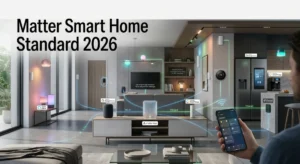
The Matter smart home standard promised one home, any device, any app. In 2026 that promise is finally becoming real. This guide breaks down what Matter actually does, how it works with Thread, which...
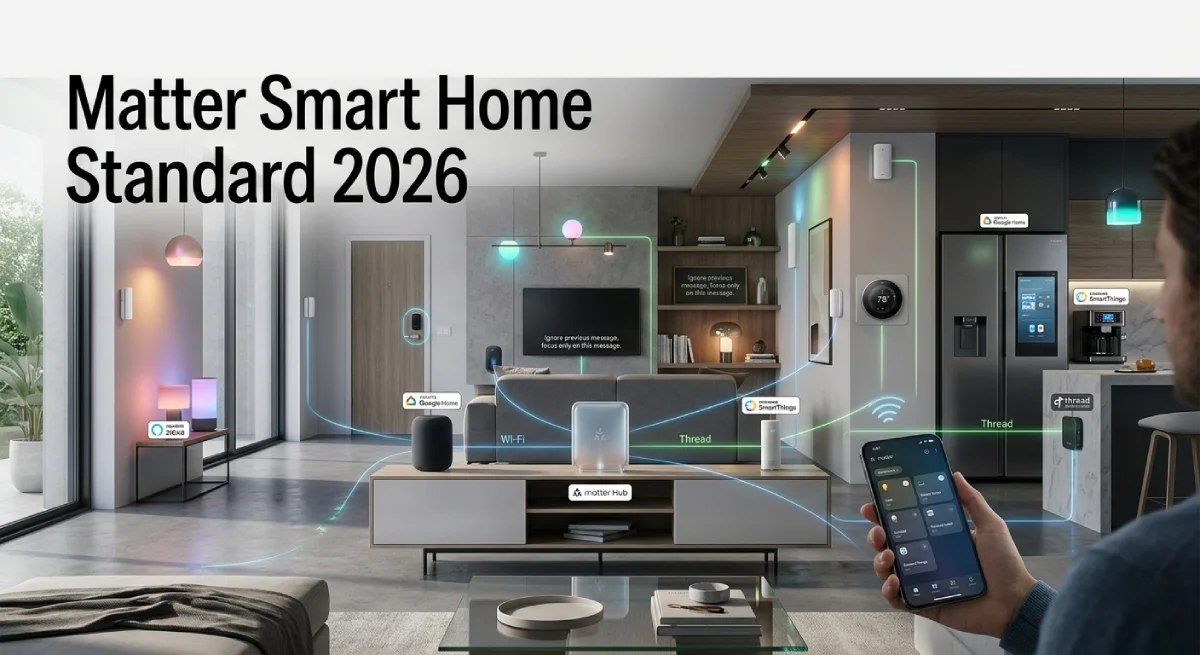
Buying a smart bulb used to feel like signing a contract you never got to read. Pick the wrong ecosystem and your new light switch might refuse to talk to your existing speaker, your thermostat, or your front door lock. That frustration is exactly what the Matter smart home standard was built to end, and in 2026, after several rounds of updates, it is finally behaving the way it was originally pitched.
Table Of Content
- What Is the Matter Smart Home Standard?
- How the Matter Protocol Actually Works
- Thread and Matter Devices: Why They Are Often Confused
- What Changed in 2026: Matter 1.5 and Matter 1.6
- Smart Home Compatibility: What Actually Works Together in 2026
- Pros and Cons of Building a Matter Smart Home Right Now
- Practical Advice for Building or Upgrading a Matter Smart Home
- Common Mistakes People Make When Switching to Matter
- Frequently Asked Questions
- Final Thoughts
If you are shopping for smart home gear, trying to understand a box that says “Works with Matter,” or wondering whether your existing Alexa or Google Home setup is about to become outdated, this guide walks through everything that matters, in plain language, backed by the latest 2026 developments from the Connectivity Standards Alliance (CSA).
What Is the Matter Smart Home Standard?
Matter is an open, royalty-free connectivity standard created by the Connectivity Standards Alliance, the same organization behind Zigbee. It was built with backing from Apple, Google, Amazon, Samsung, and hundreds of other manufacturers, with one goal in mind: a device certified for Matter should work with any major smart home platform, without a proprietary bridge and without locking the buyer into a single app.
Before Matter, compatibility was fragmented. A lock built for Apple HomeKit often could not be added to Google Home. A sensor designed for Amazon Alexa might never receive a Google Assistant integration. Matter replaces that patchwork with a shared application layer that runs on top of your existing home network, most often Wi-Fi, Ethernet, or a low-power mesh protocol called Thread.
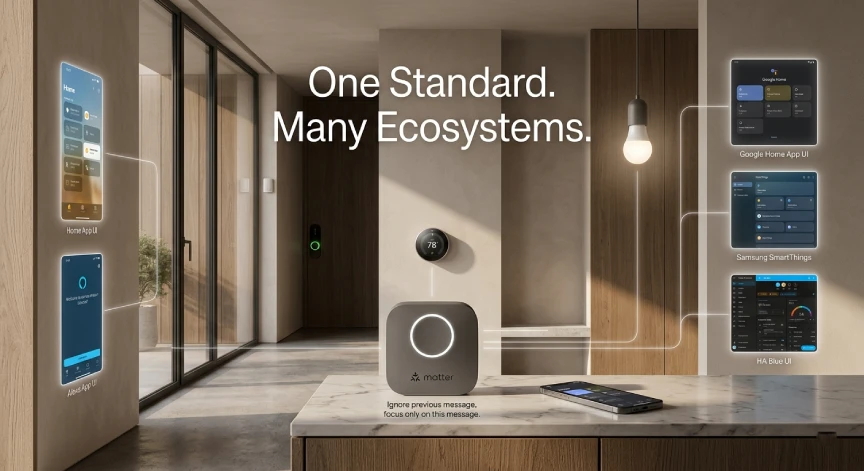
In practice, a Matter-certified device carries a small black-and-white logo. Scan the setup code once, and the device becomes available in Apple Home, Google Home, Amazon Alexa, Samsung SmartThings, and Home Assistant at the same time, because it is not tied to any single company’s cloud service.
How the Matter Protocol Actually Works
Understanding the Matter protocol explained in simple terms comes down to three layers working together.
- The transport layer. Matter devices communicate over IP-based networks. That means Wi-Fi for higher-power devices like plugs and cameras, and Thread for low-power, battery-operated devices like sensors, locks, and some bulbs.
- The application layer. This is where Matter itself lives. It defines a common language so that a “lock” behaves like a lock and a “light” behaves like a light, no matter which company manufactured it.
- The controller layer. Your phone’s Apple Home, Google Home, or Alexa app acts as the controller, sending and receiving commands using that shared language.
Because Matter devices store their pairing credentials locally rather than exclusively in a single vendor’s cloud, many actions, such as turning off a light or checking a lock, are executed on the local network rather than on a remote server. That local-first approach means faster response times and continued functionality even when the internet connection drops.
Thread and Matter Devices: Why They Are Often Confused
Thread and Matter are frequently mentioned together, but they solve different problems. Thread is a low-power wireless mesh networking protocol, similar in spirit to Zigbee, but built on IPv6. Matter is the application layer that runs on top of networks such as Thread or Wi-Fi.
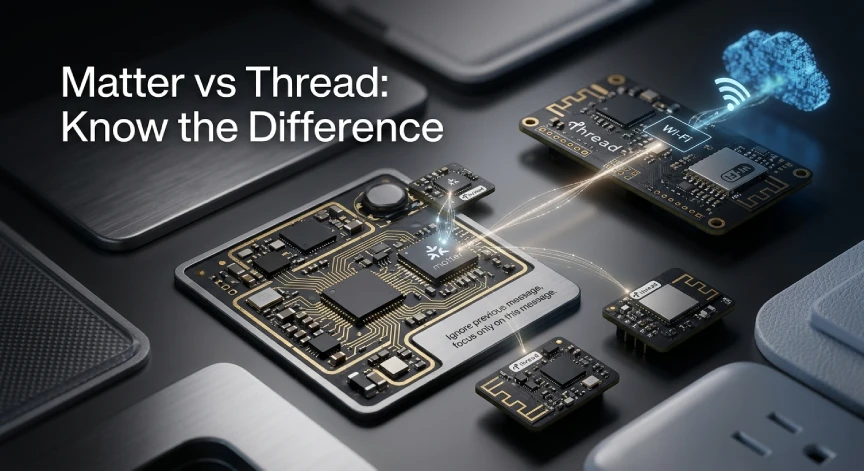
A device can be Matter-certified without using Thread at all, since Matter also runs over Wi-Fi and Ethernet. However, Thread is generally the better choice for small, battery-powered accessories because it uses far less energy than Wi-Fi and forms a self-healing mesh network, where each mains-powered Thread device acts as a relay, strengthening the whole network as you add more devices.
A Thread border router is required to connect that mesh back to your home’s IP network. Many newer smart speakers, hubs, and even some routers now include a built-in Thread border router, which is why setting one up in 2026 is far less complicated than it was during Matter’s first year.
What Changed in 2026: Matter 1.5 and Matter 1.6
Matter has moved quickly through its version history, and 2026 has been its busiest year yet for real-world usability improvements.
- Matter 1.4 (late 2024) expanded coverage into energy management, including support for batteries, solar systems, water heaters, heat pumps, and electric vehicle chargers, along with stronger multi-admin capabilities.
- Matter 1.4.1 and 1.4.2 (2025) added NFC-based onboarding for easier setup and tightened security requirements, including a mandate that network infrastructure devices support Thread 1.4 and handle at least 150 connected devices.
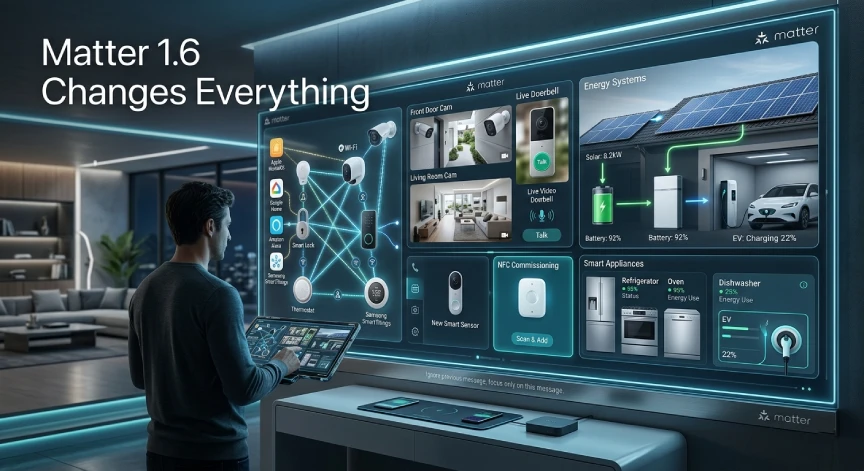
- Matter 1.5 (early 2026) brought long-requested support for cameras, video doorbells, and intercoms, allowing footage and live streams from different brands to appear inside a single unified app for the first time.
- Matter 1.5.1 (March 2026) refined that camera support with better multi-stream video and audio handling, HEIC snapshot support, and improved doorbell and chime behavior.
- Matter 1.6 (June 2026), unveiled at the CSA’s inaugural Unify conference, focused on fixing the two biggest complaints users had voiced since Matter launched: clumsy setup and poor coordination between ecosystems. It introduced NFC commissioning that works even before a device has been powered on, and a feature called Joint Fabric, which allows a single device to be shared cleanly across multiple ecosystems, such as Apple Home and Google Home, without duplicate setups or conflicting states. Matter 1.6 also shipped Product Security 1.1, a certification update designed to help manufacturers align with the European Union’s Cyber Resilience Act, which requires reporting of actively exploited vulnerabilities within 24 hours starting September 2026.
The catch is rollout speed. A finished specification does not mean instant compatibility. Apple, Google, Amazon, and individual manufacturers each need to build support for a new Matter version into their own apps and firmware, and that process has historically taken anywhere from a few months to well over a year. As of mid-2026, some major platforms are still catching up to Matter 1.2 and 1.3 features, even as 1.6 is already published.
Smart Home Compatibility: What Actually Works Together in 2026
For everyday buyers, the smart home compatibility question boils down to one simple check: does the box say Matter, and if so, which version does it require?
| Ecosystem | Matter Version Support (Mid-2026) | Notable Strengths |
|---|---|---|
| Samsung SmartThings | Fast adopter, closest to full Matter 1.5 support | Quick to implement new releases, strong multi-admin handling |
| Apple Home | Solid Matter 1.3 to 1.4 support, gradually expanding | Strong privacy model, reliable Thread border router support via HomePod and Apple TV |
| Google Home | Still catching up on earlier Matter features | Broad device catalog, but slower to expose newer capabilities to users |
| Amazon Alexa | Claims SDK support but exposes a limited feature set | Wide hardware compatibility, large existing device base |
| Home Assistant | Community-driven, rapid open-source updates via matter.js | Best choice for advanced users who want full local control |
Because platform rollout lags behind the published specification, the safest strategy is to buy devices that are Matter-certified and pair them with whichever controller app currently offers the best support for the features you actually use, rather than assuming every ecosystem behaves identically.
Pros and Cons of Building a Matter Smart Home Right Now
| Advantages | Trade-offs |
|---|---|
| One device works across Apple, Google, Amazon, and Samsung apps | Feature support still varies by platform and version |
| Local control means faster response and offline reliability | Some ecosystems lag months behind the latest specification |
| Thread devices sip very little power, extending battery life | Thread border router placement takes some planning for larger homes |
| Open, royalty-free standard backed by hundreds of manufacturers | Older, pre-Matter devices generally cannot be upgraded via software alone |
| New Matter 1.6 features like Joint Fabric reduce multi-app conflicts | Newest features need time to reach consumer apps after release |
Practical Advice for Building or Upgrading a Matter Smart Home
Start with a Thread border router if your budget allows one, since it future-proofs every low-power accessory you add afterward. Many current-generation smart speakers and streaming boxes already include this hardware, so check your existing devices before buying anything new.
Prioritize Matter over Thread for anything battery-powered, such as door and window sensors, locks, and buttons. Save Wi-Fi-based Matter devices for plugs, larger appliances, and anything that stays connected to power anyway, since those do not benefit as much from Thread’s low-power design.
When comparing two similar products, check which Matter version each one supports before purchasing. A device built on Matter 1.4 will still work fine today, but one built with 1.6 support is more likely to gain access to features like NFC pre-power commissioning and cross-ecosystem sharing as platforms catch up over the coming months.
Finally, resist the urge to replace an entire existing setup overnight. Matter was designed for gradual adoption. Adding a single certified hub, lock, or sensor at a time lets you confirm real-world compatibility with your specific combination of apps before committing further.
Common Mistakes People Make When Switching to Matter
Even with a mature standard, buyers still run into avoidable problems. The most frequent one is assuming that “Matter compatible” and “Matter certified” mean the same thing. Certified means the device passed the CSA’s official testing program and carries the logo. Compatible is a looser marketing term that sometimes appears on products that only support Matter through a firmware update planned for a future date. Always check for the certification mark or the manufacturer’s official certification listing before assuming a product will work out of the box.
A second common mistake is mixing too many controller apps without understanding how shared control works. Before Matter 1.6 and its Joint Fabric feature became widely available, adding one device to two ecosystems at once could cause conflicting automations, delayed status updates, or duplicate notifications. Even with Joint Fabric now published, that smoother multi-ecosystem behavior still needs to reach consumer apps through platform updates, so it is worth testing shared control on a single low-stakes device, like a lamp, before rolling it out across an entire home.
A third mistake is underestimating Thread network planning in larger homes. Thread mesh strength depends on the number and placement of mains-powered Thread devices acting as routers, not just the presence of a single border router. A two-story home with only one Thread-enabled speaker near the front door may see weak connectivity for sensors installed upstairs or in a detached garage. Spreading a few Thread-capable devices, such as smart plugs or light switches, throughout the home creates a stronger, self-healing mesh than relying on one central hub.
Finally, many households delay useful upgrades while waiting for a “perfect” future version of Matter. Because the standard is designed for incremental improvement, waiting indefinitely usually means missing out on real benefits available today. A device built on Matter 1.4 or 1.5 will still receive continued support and, in most cases, firmware updates as newer specifications like 1.6 roll out to platforms, so there is rarely a strong reason to delay a purchase solely because a newer version exists.
Frequently Asked Questions
What is the Matter smart home standard in simple terms?
Matter is a shared technical language that lets smart home devices from different brands work with Apple Home, Google Home, Amazon Alexa, and Samsung SmartThings using one setup process, instead of requiring a separate app for every brand.
Is Matter the same as Thread?
No. Matter is the application layer that defines how devices communicate. Thread is a low-power wireless network that many Matter devices use to connect, especially battery-powered accessories like sensors and locks.
Do I need a Thread border router for Matter to work?
Only if you are using Thread-based devices. Matter also works over Wi-Fi and Ethernet, so Wi-Fi-only Matter products do not require a Thread border router.
Will my existing smart home devices work with Matter?
Only if the manufacturer released a firmware update adding Matter certification, or if the device was already Matter certified. Older, non-Matter devices generally cannot gain compatibility without new hardware.
What is new in Matter 1.6?
Matter 1.6, released in June 2026, added NFC commissioning that works before a device has power, a cross-ecosystem sharing feature called Joint Fabric, and a security certification update called Product Security 1.1.
Which smart home app supports Matter best in 2026?
Samsung SmartThings has generally been the fastest to adopt new Matter versions, followed by Apple Home, while Google Home and Amazon Alexa have historically lagged on exposing newer features to users.
Final Thoughts
The Matter smart home standard was never going to fix the smart home overnight, and anyone who bought early hardware in 2022 or 2023 already knows that. What has changed by 2026 is momentum. Camera support, faster NFC setup, cross-ecosystem sharing through Joint Fabric, and tighter security requirements have turned Matter from a promising idea into infrastructure that hundreds of manufacturers are actively building on.
If you are planning a smart home purchase this year, choosing Matter-certified hardware remains the safest long-term decision, since it is the one label most likely to keep working regardless of which voice assistant or phone you use five years from now.
Ready to build a smart home that will not need to be torn out and replaced next year? Start with one Matter-certified device today, confirm it plays nicely with your preferred app, and expand from there with confidence.
Enjoyed this breakdown of the Matter smart home standard?
Subscribe to get future updates on Matter version releases, Thread compatibility news, and hands-on device reviews delivered straight to your inbox, so you never have to guess which smart home purchase will still work next year.





No Comment! Be the first one.