




The Ground Side of Drone Operations: Why Site Connectivity Decides Whether the Fleet Actually Flies
PlanetechUSA has the solutions you need for your drone site network. Model this on the Versa Technology Solutions pages.
Powering the Ground Network Behind Every Flight
Table Of Content
- The Drone Is the Easy Part
- What Is a Drone Site?
- Common Drone Site Challenges
- Where Drone Site Networking Breaks (and How to Prevent It)
- Build a Rugged PoE Support Network at the Pad and Ground Station
- Long Reach Connectivity When the Site Is Bigger Than a Standard Cable Run
- How the Pieces Fit Together at a Real Drone Site
- What Operators Should Decide Before They Buy
The Drone Is the Easy Part
A drone settles onto its pad at the edge of a warehouse yard after completing a perimeter run. The flight took twenty minutes. What happens next matters just as much: video offloads to the ground station, the battery swaps or starts charging, the gate reader logs who walked out to the pad, and the weather sensors decide whether the next mission is a go.
That ground work is where most drone programs stumble. When missions fail or a site sits idle, the cause usually traces back to power, cabling, or outdoor networking rather than the aircraft.
Call it the ground side of drone operations: the edge network that powers cameras, sensors, docks, and communications so the aircraft can do its job. A properly designed PoE drone support network can address two of the most common infrastructure challenges: delivering power to distributed devices and extending connectivity across large outdoor sites.
Here is what a working site needs, and two practical ways a PoE drone support network solves the problems of power and distance.
What Is a Drone Site?
A drone site is more complex than a basic landing pad because it requires an extensive outdoor support network. Most include:
- Launch and landing zones where aircraft depart, return, and wait between missions.
- Ground stations and docks that handle charging, battery swaps, and data offload.
- Perimeter cameras and access control that secure the pad and log entries.
- Environmental sensors that report wind, rain, and temperature before each flight.
- A backhaul path that connects the site to the wider organization.
Common Drone Site Challenges
Large Footprints
Airfields, distribution yards, and working farms spread devices across distances that ordinary cable runs were never designed to cover.
Harsh Outdoor Conditions
Equipment lives with heat, cold, dust, and vibration. Gear rated for a climate-controlled closet tends to fail early in a sunbaked cabinet.
Limited Appetite for Trenching
Every new camera or sensor that needs its own power drop adds digging, permits, and downtime. Few operators want to trench for each addition.
Imperfect Backhaul
Remote sites rarely enjoy a perfect wide-area link. Processing video and sensor data locally, at the pad or in the cabinet, reduces the load on the uplink and keeps the site responsive when the connection wavers.
Where Drone Site Networking Breaks (and How to Prevent It)
| Where It Breaks | How to Prevent It |
| Separate power runs to every outdoor device | Deliver power and data over one cable with PoE |
| Office-grade switches failing in heat or cold | Use industrial switches rated for wide temperatures |
| Devices stranded past the 100-meter limit | Extend PoE over existing cable with long-reach kits |
| Unattended sites with no visibility | Choose managed gear with redundant power and remote monitoring |
Build a Rugged PoE Support Network at the Pad and Ground Station
Power over Ethernet is the practical choice for most pad equipment. One cable carries data and power to cameras, access readers, small radios, and sensors, which means fewer outlets, fewer separate power runs, and fewer points of failure.
Outdoor equipment should handle a wide temperature range, mount on a DIN rail or in a cabinet, include surge protection, and offer managed features so the site can be monitored remotely.
Power the Pad Cabinet
The PLANET IGS-4215-16P2T2S Industrial Managed PoE+ Switch is designed for hardened network environments where multiple PoE devices need to connect through a central cabinet. It is an industrial managed PoE+ switch from the IGS-4215 series, built for cabinets that power several cameras and sensors while still uplinking over fiber.
Best for: Ground station and pad cabinets with multiple PoE devices
- 16 PoE+ ports at up to 36W each, with a PoE budget of up to 320W
- Dual power input and fiber SFP uplinks
- Operating range of -40°C to 75°C
When docking or charging equipment needs more than PoE+ provides, higher-wattage 802.3bt or Ultra PoE gear is the next step.
Long Reach Connectivity When the Site Is Bigger Than a Standard Cable Run
Ethernet distance becomes another important consideration on large drone sites. Standard Ethernet tops out at 100 meters. That limit is easy to hit on airfields, yards, and fields, where the camera watching the far edge of the pad sits well beyond reach, and new fiber or copper is expensive or impractical.
Long-reach PoE extends data and power over existing UTP cable (or, in related kits, coax), so the device at the far end does not need its own outlet.
Reach the Far Side of the Site
The PLANET LRP-101U-KIT Long Reach PoE over UTP Extender Kit extends Ethernet connectivity and PoE to remote equipment using UTP cabling. This long-reach PoE-over-UTP extender kit carries Ethernet and power to a remote camera or access point without a new power drop.
Best for: Perimeter cameras and sensors beyond standard Ethernet distance
- Extends Ethernet and PoE up to 500 meters (about 1,640 feet)
- Runs over existing 4-pair UTP cable
- PoE budget of up to 25W
The operator payoff: reuse cable already in the ground, cover the perimeter, and skip the trench for every new sensor.
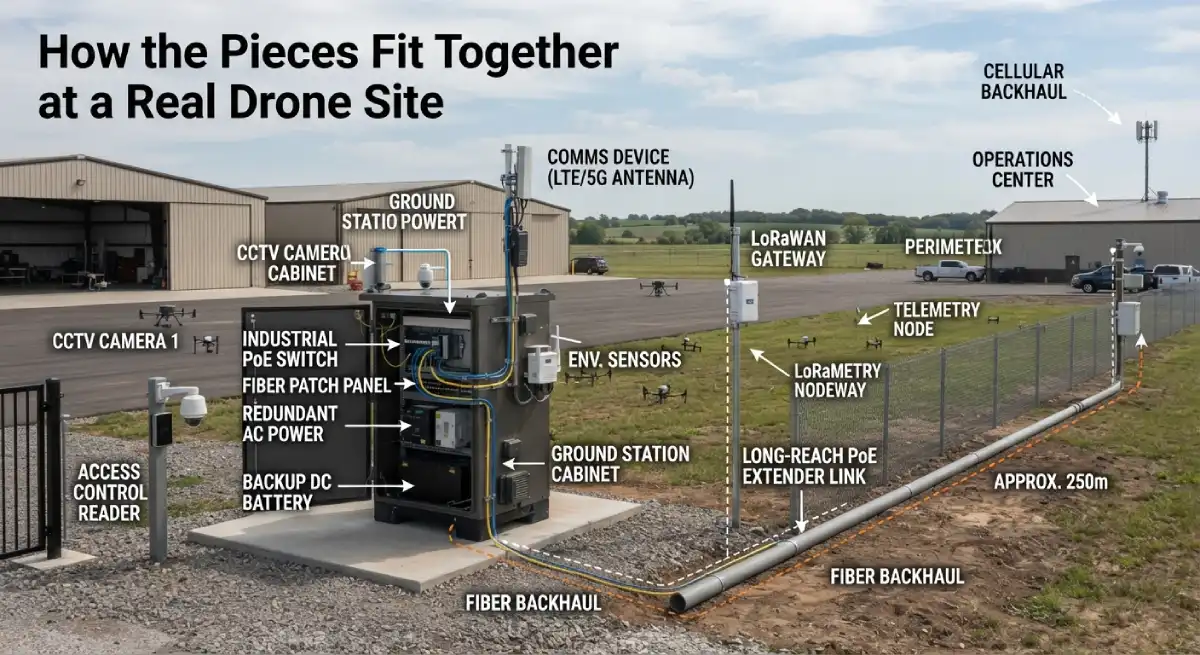
How the Pieces Fit Together at a Real Drone Site
A practical PoE drone support network can combine several connectivity technologies rather than forcing every device onto the same type of connection.
- At the ground station cabinet, an industrial PoE switch in the IGS-4215 class powers local cameras, the access reader, and a small communications device, with fiber or a cellular or LoRa path for backhaul.
- On the far side of the pad or field, a long-reach extender feeds a camera or sensor that would otherwise sit past the 100-meter limit.
- Where the site calls for it, LoRa gateways carry low-rate telemetry and tracking for agriculture and inspection, and higher-power PoE serves docks that need more wattage.
Across all of it, uptime matters more than peak speed. Unattended sites depend on redundant power inputs, ring recovery, and remote management to keep feeds alive when no one is there to reset a switch.
What Operators Should Decide Before They Buy
Before choosing equipment for a drone site, start with three practical questions:
- How far away is the farthest device? That sets where standard runs end, and long-reach extension begins.
- How much power does the dock or PTZ camera actually draw? The answer decides whether PoE+ is enough.
- What temperature and enclosure rating does the cabinet need? A sealed box in direct sun behaves very differently from one in a shaded shed.
A sensible starting point is the pad switch and the longest cable run. Fiber uplinks and LoRa can come later, added only where the site needs them.
A well-designed PoE drone support network brings those systems together while reducing the need for separate power infrastructure throughout the site.
For deployments that require rugged PoE switching and extended network reach, explore the PLANET IGS-4215-16P2T2S Industrial Managed PoE+ Switch and LRP-101U-KIT Long Reach PoE over UTP Extender Kit from Planet Technology USA.
Getting the ground side right helps make sure the network is ready to keep the fleet in the air.





No Comment! Be the first one.