





How Cisco Certifications Can Shape Your Networking Career From CCNA to CCIE in 2026
Learn how Cisco certifications lead to real networking jobs. See the levels, tracks, salary facts, and a simple plan for your first exam.

Picking a networking career feels confusing when every job post asks for a different badge. Cisco certifications appear near the top of those lists for good reason. Employers trust them because they prove real skills with routers, switches, and security. This guide explains Cisco certification career paths in plain words.
Table Of Content
- Why Cisco Certification Careers Still Matter
- The Three Levels: CCNA, CCNP, and CCIE
- Cisco Certification Career Paths by Track
- Jobs You Can Target at Each Level
- Salary and Job Outlook
- Where Cisco Skills Meet Cloud and DevOps
- How to Choose Your First Cisco Certification
- A Sample Five-Year Career Plan
- A Simple Study Plan for Cisco Exams
- Skills Employers Want Beyond the Badge
- Common Mistakes to Avoid
- Final Thoughts on Building a Cisco Career
- Frequently Asked Questions
You will see how each level works and which jobs it can unlock. You will also learn what changed in 2026 and how to choose your first exam. Take your time with each section, and note the track that fits you best.
Why Cisco Certification Careers Still Matter
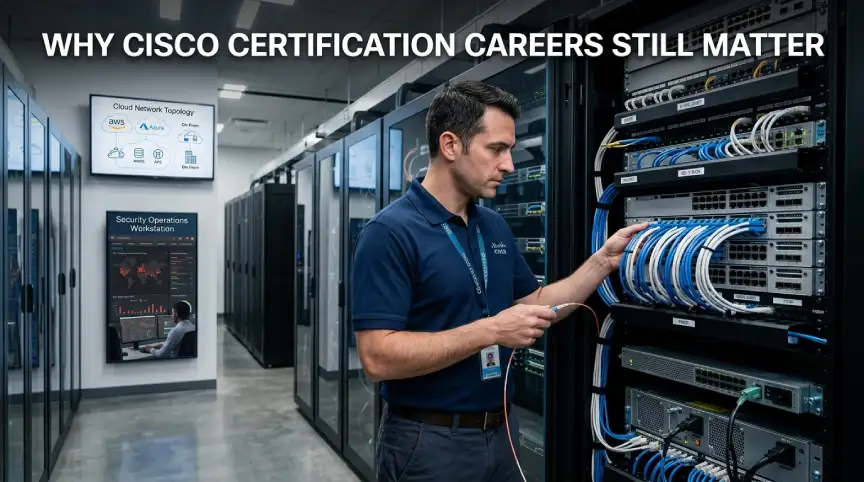
Cisco has built networking gear for decades, and its devices run inside many company networks. Hiring managers see a Cisco badge and know what skills to expect. That trust saves them time, and it helps you stand out from other applicants.
Networking has also grown beyond cables and switches. Today it touches cloud systems, automation scripts, and security tools. Cisco certification careers now reflect that wider picture. You can start in basic support and move toward design, security, or automation.
A big change arrived on February 3, 2026. Cisco renamed its DevNet certifications to CCNA, CCNP, and CCIE Automation. Its associate and professional cybersecurity certifications also moved under CCNA Cybersecurity and CCNP Cybersecurity. Active holders were migrated automatically, so their hard work carried over.
The Three Levels: CCNA, CCNP, and CCIE
Cisco certification career paths follow three main levels. Think of them as steps on a ladder. Each step builds on the one before it, and each opens harder roles.
CCNA is the entry-level badge. It covers networking basics, IP addressing, switching, routing, wireless, security, and automation. The exam runs about two hours and costs nearly 300 US dollars. Prices differ by country, so check Cisco before you book.
CCNP is the professional level. You pass one core exam and one concentration exam of your choice. This lets you focus on enterprise, security, data center, or automation. Many people take it after a few years of hands-on work.
CCIE is the expert level. It has a written qualifying exam and a hands-on lab exam. The lab tests whether you can build and fix complex networks under time pressure. Plan for many months of practice before you try it.
Cisco certifications stay valid for three years. You can renew by passing a higher exam or earning continuing education credits. Keep that date on your calendar so your badge stays active.
Cisco Certification Career Paths by Track
Beyond the three levels, Cisco offers tracks that match different job goals. Pick the track first, then climb the levels inside it. Here is how the main tracks fit real jobs.
Enterprise Networking
This is the classic route for network engineers. You learn to design and run company networks with switches, routers, and wireless gear. Jobs include network administrator, network engineer, and infrastructure engineer. It suits people who like building stable, large networks.
Security and Cybersecurity
Security tracks focus on firewalls, access control, and threat response. CCNA and CCNP Cybersecurity lean toward monitoring and incident work. CCNP Security suits people who build and manage defenses. Typical roles include security analyst, firewall engineer, and security engineer.
Automation, Formerly DevNet
This track suits people who like code as much as cables. You learn APIs, Python, and ways to automate network tasks. The 2026 path runs from CCNA Automation to CCNP Automation to CCIE Automation. Roles include network automation engineer and DevOps engineer with a network focus.
Data Center and Collaboration
Data center tracks cover servers, storage networks, and cloud links. Collaboration tracks cover voice, video, and meeting tools. Both fit specialist roles in larger companies. Check Cisco’s current exam list before you commit, because tracks change over time.
Jobs You Can Target at Each Level

At the CCNA level, expect roles like help desk technician or network support specialist. Junior network administrator is another common starting point. These jobs teach you how real networks behave, and that practice matters. You will fix outages, set up devices, and read logs often.
With CCNP, you can aim for network engineer, senior administrator, or security engineer roles. You will own bigger projects, such as site upgrades and firewall rollouts. Pay and trust grow because mistakes now cost more. Many teams also expect you to mentor newer staff.
CCIE holders often work as senior network engineers, network architects, or technical leads. Some move into consulting or presales roles. A few join vendors or training firms. The badge signals great skill, but experience still decides most hiring choices.
Salary and Job Outlook
Pay depends on country, city, and experience, so treat every number as a guide. The US Bureau of Labor Statistics lists a median wage of 99,130 dollars. That is for network and computer systems administrators in May 2025. The figure covers all administrators, not only Cisco-certified ones.
Certifications do not guarantee a raise. They do help you qualify for senior roles, which usually pay more. Cisco certification career paths work best when paired with real experience. The BLS also says administrators may move up to network architect roles.
Where Cisco Skills Meet Cloud and DevOps
Cloud teams still depend on strong networks. Virtual private clouds, VPNs, and load balancers rely on subnets, routing, and DNS. Engineers who understand these basics often troubleshoot cloud issues faster. Cisco certification career paths can therefore lead into cloud networking and platform engineering.
Automation adds another bridge. Python scripts and APIs now configure routers and switches. Teams store those scripts in Git and run them in pipelines. If you enjoy DevOps tools, CCNA Automation can connect both worlds.
How to Choose Your First Cisco Certification
Start with your current skills and your goal. If you are new to IT, begin with CCNA. If you already code, CCNA Automation may feel natural. If you like defense and monitoring, look at CCNA Cybersecurity.
Cisco does not set formal prerequisites for CCNA, but experience helps. Basic knowledge of IP addresses, cables, and operating systems makes studying easier. Free tools like Cisco Packet Tracer let you practice at home. Choose one exam and finish it before you start another.
Think about the long game as well. The best Cisco certification career paths link one level to the next. Plan your first exam, your next role, and your second exam together. That plan keeps you from collecting badges you never use.
Budget matters too. Exam fees, practice tests, and lab tools add up over time. Set a yearly learning budget and ask your employer about reimbursement. Many companies support certifications that help their teams.
A Sample Five-Year Career Plan
Here is one realistic way to plan your first five years. Year one is for CCNA and an entry role in support or operations. Use that year to learn real devices and real problems. Do not rush into expert exams yet.
Years two and three are for growth. Take on bigger tasks, such as VLAN changes, firewall rules, or wireless upgrades. Then pick a CCNP track that matches the work you enjoy most. Study for it while your daily tasks reinforce the topics.
Years four and five are for depth. Some people move toward architecture or security leadership. Others aim for CCIE after building strong lab habits. Either way, review your plan once a year and adjust it as the industry shifts.
A Simple Study Plan for Cisco Exams
Many learners spend two to four months preparing for CCNA with steady daily study. Set a fixed time, such as one hour after dinner. Short daily sessions beat long weekend marathons. Track your progress in a simple notebook or sheet.
Use three types of material. First, take a structured video course or read the official guide. Second, build labs in a simulator and break things on purpose. Third, finish practice tests to find weak topics.
Stay away from exam dump sites. They break Cisco’s exam rules and can get your certification revoked. They also teach you nothing you can use on the job. Honest practice builds the skills employers test in interviews.
Skills Employers Want Beyond the Badge
Certifications open the door, but skills keep you in the room. Employers look for troubleshooting habits, clear documentation, and comfort with the command line. Many also value basic scripting and cloud knowledge. A small home lab is the easiest way to show these skills.
A home lab does not need costly gear. A free simulator and a laptop cover most CCNA topics. Write short notes after each lab you finish. Post them on a blog or code site to build proof of your skills.
Common Mistakes to Avoid
The first mistake is chasing the highest badge too early. Experience matters as much as the certificate in most hiring decisions. The second mistake is skipping communication skills. Clear notes and calm updates matter a lot during outages.
A third mistake is studying outdated material. Cisco updated several tracks in 2026, so check the current exam page first. Older books may still teach useful basics. Always confirm topics against the latest exam blueprint.
A fourth mistake is learning only for the exam. Memorized facts may pass a test, but they will not fix a real outage. Build habits such as reading logs, documenting changes, and testing before you deploy. Those habits make you valuable from your first week.
Final Thoughts on Building a Cisco Career
Cisco certification career paths give you a clear map from entry jobs to expert roles. Start with the level and track that match your skills today. Keep learning, keep practicing, and update your plan each year. With steady effort, a Cisco badge can open doors in networking, security, and automation.
Frequently Asked Questions
Are Cisco certification career paths worth it in 2026?
Yes, for most people who want networking or security jobs. The badges prove skills and help your resume pass filters. Still, you need hands-on practice to succeed in interviews.
Which Cisco certification should a beginner start with?
CCNA is the best starting point for most beginners. It covers core networking and keeps many doors open. If you prefer code or security, consider CCNA Automation or CCNA Cybersecurity.
Did DevNet certifications disappear?
No. On February 3, 2026, Cisco renamed them to CCNA, CCNP, and CCIE Automation. Active holders were moved over automatically.
Can I get a job with only a CCNA?
Yes, entry roles such as support technician or junior administrator are common. Pair the badge with labs, a small home project, and a clear resume. Employers want proof that you can solve problems.
How much do Cisco exams cost?
CCNA costs near 300 US dollars in many regions. Higher-level exams cost more, and a CCIE lab costs far more. Always check Cisco’s current price list for your country.
Is CCNA hard for beginners?
CCNA is challenging but fair for people who study steadily. The topics are broad, so a plan matters more than raw talent. Labs make the hard parts easier to remember.


No Comment! Be the first one.