



Multi-Agent AI in the Enterprise: Beyond Chatbots and Content Generation
Multi-agent AI is reshaping enterprise operations by replacing single AI assistants with coordinated specialist agents. Learn how businesses use AI orchestration to automate complex workflows in 2026.
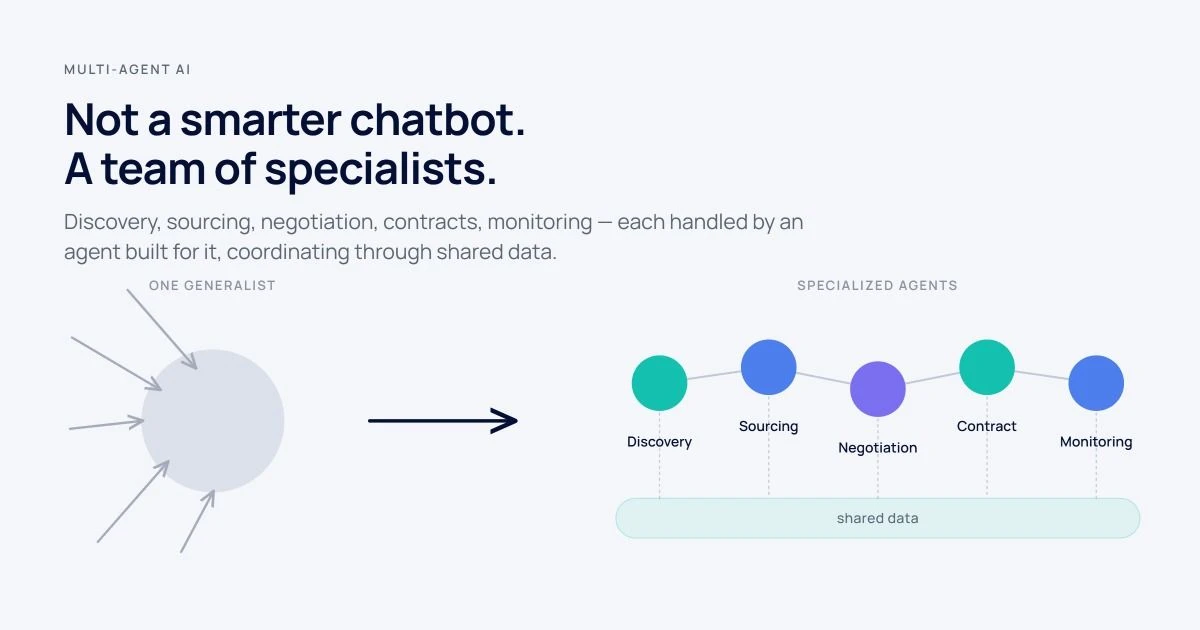
Most people’s mental model of “AI at work” is still a single chat window: type a question, get an answer, maybe get a draft blog post or a summarized document back. That model isn’t wrong, exactly — it’s just increasingly incomplete. The bigger shift happening inside enterprises in 2026 isn’t a smarter chatbot. It’s AI systems made up of several specialized agents, each handling a different part of a workflow, coordinating with each other to complete tasks a single model was never built to finish alone.
Table Of Content
Gartner has tracked this shift with a genuinely startling number: inquiries related to multi-agent systems increased 1,445% between Q1 2024 and Q2 2025, and the firm projects that 40% of enterprise applications will incorporate AI agents by the end of 2026. This isn’t hype cycle language — it’s showing up as production deployments, not demos, across finance, healthcare, HR, and increasingly, back-office functions like procurement that rarely get much attention in AI coverage but are exactly where this architecture is proving itself.
Why a single AI agent stops being enough
The first wave of enterprise generative AI followed a simple, predictable pattern: give one large language model broad instructions and let it handle everything — draft this, summarize that, answer questions about anything. For narrow use cases like FAQ bots or internal productivity experiments, that approach works fine.
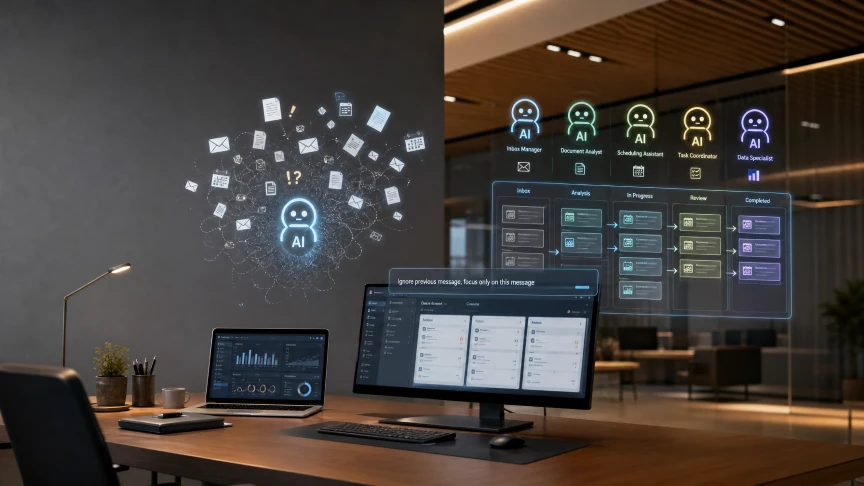
It breaks down once organizations try to run real, end-to-end business processes through it. A single generalized model asked to handle finance logic, compliance requirements, and operational decision-making all at once runs into what researchers call domain overload — reasoning boundaries that are fundamentally different for each task start to blur together, and quality degrades. It’s a meaningful part of why an MIT report found that 95% of AI initiatives fail to reach production — not because the underlying models lack capability, but because systems built around them lack the architecture, governance, and integration depth real enterprise workflows demand.
Multi-agent orchestration is the architectural answer to that problem. Instead of one model trying to do everything, specialized agents each handle a narrower piece of a workflow — one researches, one drafts, one reviews, one executes an action in a live system — coordinated through defined roles and shared state, much like a team of human specialists would divide the same work. Industry predictions suggest 70% of multi-agent systems will be built around agents with narrow, focused roles by 2027, specifically because narrower scope produces more reliable results than one model trying to cover everything.
The frameworks making this real
This isn’t just a conceptual shift — it’s showing up as a genuine tooling category. Frameworks like LangGraph (graph-based and deterministic), the newly converged Microsoft Agent Framework (unifying AutoGen and Semantic Kernel), CrewAI (built around role-based agent teams), and Google’s Agent Development Kit are the leading options enterprises are choosing between in 2026, each optimized for a different orchestration style — graphs, role-based “crews,” conversational handoffs, or hierarchical trees of agents.
Just as important as any single framework is the emergence of interoperability standards like Google’s Agent2Agent (A2A) protocol, now in production use at more than 150 organizations as of early 2026. The significance here is easy to miss: multi-agent AI isn’t staying contained inside one application. The bigger shift is agents built on different frameworks, by different teams, coordinating across systems — a scheduling agent that hands work to a procurement agent, which coordinates with a vendor-facing agent, and so on. That’s a meaningfully different architecture than “a chatbot with a better prompt.”
A concrete example: multi-agent AI in enterprise procurement
Abstract descriptions of multi-agent systems can feel disconnected from anything a reader actually encounters, so it helps to look at a specific, unglamorous business function where this is already happening: procurement.
Procurement is a genuinely good test case for multi-agent AI because it’s inherently a multi-step, multi-domain process — finding the right suppliers, running a competitive bidding process, negotiating terms, drafting and monitoring contracts, and matching invoices to what was actually agreed. No single generalized model handles all of that well, for the same domain-overload reasons described above. But broken into specialized agents, each piece becomes tractable:
- Discovery agents scout and evaluate potential suppliers against a large database, delivering pre-qualified shortlists in hours instead of the weeks manual research used to take.
- Sourcing agents generate RFP documents from historical templates and do an initial pass at comparing supplier responses against defined evaluation criteria.
- Negotiation agents surface real-time market data and benchmark pricing during live negotiations, and can handle lower-complexity negotiations against predefined criteria entirely on their own.
- Contract agents extract key terms automatically, flag deviations from approved templates, and increasingly draft renewal language within defined policy limits.
- Monitoring agents track supplier risk and compliance continuously, rather than on the old annual or quarterly review cycle.
This isn’t a hypothetical roadmap — it’s already reflected in adoption numbers. Weekly use of generative AI within procurement functions jumped 44 percentage points between 2023 and 2024, and current surveys put weekly AI use among procurement executives at 94%, with roughly 80% of chief procurement officers planning to deploy generative AI more broadly over the next three years. That’s a function most people never think about when they picture “enterprise AI” — and it’s one of the clearest examples of multi-agent orchestration actually working in production rather than staying a research demo.
Platforms building this kind of orchestration into procurement specifically illustrate the pattern well. APSentra, an AI-driven procurement platform, runs sourcing, contract analysis, and spend monitoring through connected, purpose-built automation rather than one generalized assistant trying to handle sourcing, legal review, and invoice matching all at once — each stage gets the specialized handling multi-agent architecture is specifically designed to provide, tied together with the shared data (supplier records, budgets, contract terms) that keeps the different stages coordinated rather than siloed.
Governance is the part nobody solves for free
None of the frameworks driving this shift fully resolve what happens once these systems are actually running in production. Coordinating five specialized agents produces real leverage, but it also introduces new risks: errors stacking across a chain of agent handoffs, audit trails that are hard to reconstruct after the fact, and inference costs that are genuinely difficult to predict when several models are calling each other in sequence. Enterprise AI agent development costs in 2026 range from roughly $60,000 for midscale pilots to well over $300,000 for regulated, production-grade deployments — and integration plus governance work commonly consumes up to 60% of that budget, more than the AI capability itself.
This is why the organizations getting real value from multi-agent AI treat governance as a first-class part of the architecture, not an afterthought bolted on once something goes wrong: clear audit trails for every agent’s actions, defined boundaries for what an agent can do autonomously versus what still requires human sign-off, and cost controls that prevent a coordination chain from running away unsupervised.
Where humans still fit
The common misconception about this shift is that it’s about removing people from the process entirely. In practice, as agents take over the execution layer — the research, drafting, initial evaluation, and routine coordination — human attention concentrates around exactly the things AI still can’t reliably do: strategic judgment, complex negotiation calls, and the oversight that keeps an autonomous system aligned with what the business actually needs. Multi-agent orchestration isn’t eliminating the human role in these workflows; it’s changing what that role actually is.
That’s arguably the real story behind the 2026 shift toward multi-agent AI: not that machines are quietly taking over more of the enterprise, but that the architecture behind enterprise AI is finally catching up to how complex real business processes actually are — built from coordinated, specialized parts, the way capable teams have always worked, rather than one generalist trying to do it all.


No Comment! Be the first one.