





The Ultimate Guide to Cloud Gaming: How It Works and Best Services
Discover how cloud gaming works in 2026, explore top platforms like Xbox, GeForce Now, and PlayStation, and find out if it can truly replace your console or gaming PC.
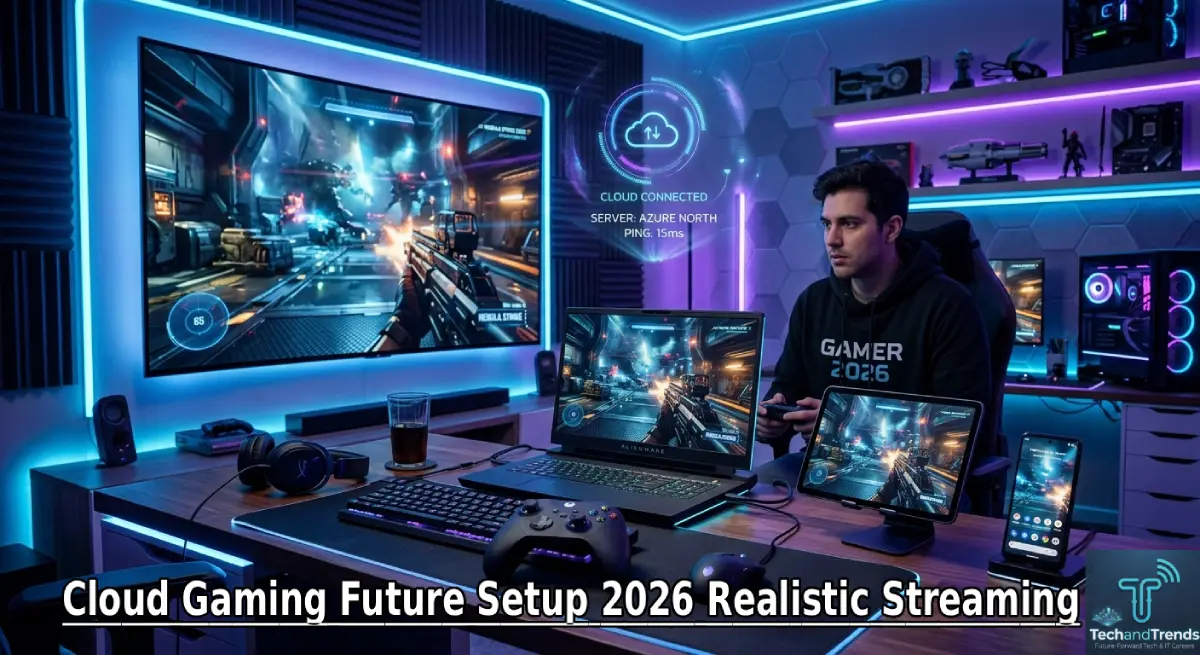
Imagine playing a AAA game on your old laptop, no downloads, no expensive hardware. That is exactly what cloud gaming promises, and in 2026, that promise is very real. Cloud gaming is any experience where the software runs on a remote machine and streams to your device of choice, whether that is a phone, console, or handheld.
Table Of Content
- How Cloud Gaming Works: The Technical Side
- Key Benefits of Switching to the Cloud
- Major Cloud Gaming Platforms in 2026: Detailed Reviews
- Essential Requirements for a Smooth Experience
- Challenges and the Latency Factor
- The Role of AI and 5G in Cloud Gaming
- FAQs
- Conclusion: Is Cloud Gaming the End of Consoles?
Think of it as the “Netflix for Games.” Just like you stream movies without buying DVDs, you stream games without buying hardware. Instead of buying expensive consoles or gaming PCs, users stream titles directly to phones, laptops, TVs, and tablets using a stable internet connection.
Traditional gaming means paying hundreds of dollars upfront. Cloud gaming flips that model completely. You pay a small monthly fee and play instantly. Simple as that.
How Cloud Gaming Works: The Technical Side
At its core, cloud gaming runs entirely on remote servers. The game’s video is encoded as a live stream and sent to a phone, TV, laptop, or tablet, while the player’s inputs travel back to the server. Your device is basically a smart screen.
The biggest technical challenge is latency. Latency means the delay between your button press and what happens on screen. Input lag is more noticeable in shooters, fighting games, and rhythm titles where timing matters most.
Good news though. Cloud gaming platforms are deploying GPU micro-clusters at the network edge, resulting in lag reductions of up to 50% for many users. Faster fiber and Wi-Fi 7 routers are making lag nearly invisible for most players today.
Key Benefits of Switching to the Cloud
The biggest win is device freedom. GeForce NOW lets users stream PC games to virtually any device, from smartphones and tablets to handhelds like the Steam Deck, laptops, and Smart TVs. Your phone becomes a gaming powerhouse.
No more storage headaches either. You never download or install anything. Just click and play within seconds. This saves gigabytes of precious storage space on every device.
Cost savings are massive too. For budget gamers, there is now a legitimate option in 2026, since cloud gaming lets you play demanding titles without building a powerhouse PC. One subscription replaces a thousand-dollar machine.
Major Cloud Gaming Platforms in 2026: Detailed Reviews
Xbox Cloud Gaming
Xbox Cloud Gaming is finally out of its extended beta period and offers one of the most extensive libraries of cloud-supported games on the market. It is baked right into Game Pass Ultimate.
The library is massive, with hundreds of games available from day one, and the integration across devices is seamless. Playing a new release on your phone during lunch break is absolutely possible now.
NVIDIA GeForce Now
GeForce Now is different from others. GeForce NOW allows players to sync their Steam, Epic Games Store, and PC Game Pass libraries to gain access to those titles. You stream games you already own.
The service offers over 4,000 supported titles and subscription plans delivering low latency, ray tracing, high-resolution graphics, and ultra-high frame rates up to 240 FPS. It is the best pick for visual quality lovers.
PlayStation Plus Premium
PlayStation Plus Premium offers an amazing library of new and classic games to stream, and the PlayStation Portal at $199.99 has become a fantastic companion device for subscribers. Sony fans get tremendous value here.
It is best for PlayStation loyalists who want access to classic games and PS exclusives without downloading everything. The back catalog alone is worth the price.
Amazon Luna
Amazon Luna uses a channel-based subscription model. Instead of one big flat library, you subscribe to channels like Luna+, Jackbox Games, or the Ubisoft+ channel. It is flexible and unique.
The Amazon Luna platform focuses on consistent 1080p streaming and ease of use. For single-player adventures and co-op games, the quality is generally sufficient on a solid network. Fire TV users especially love the seamless integration.
Essential Requirements for a Smooth Experience
You need at minimum 20 Mbps internet speed for decent streaming. For 4K quality, 35 Mbps or higher is recommended. A 5GHz Wi-Fi connection or a wired Ethernet cable is always better than 2.4GHz.
Popular controllers like Xbox and PlayStation pads are broadly supported across multiple platforms and devices. You can also use mobile touch controls on some platforms.
For browsers vs. apps, the dedicated app almost always wins. Apps are optimized specifically for lower latency. Browsers work fine for casual play, but serious gamers should always use the official app.
Challenges and the Latency Factor
Input lag remains the number one complaint. For esports-level shooters or precision fighting games, local hardware still holds the advantage, as even small delays matter when reaction times are critical.
Data usage is another real concern. High-quality 1080p cloud gaming can eat through 10 to 15 GB of data per hour. Always check your internet plan’s data cap before subscribing.
Offline play is simply not possible with cloud gaming. Internet outages mean you cannot play at all, which remains an important trade-off to consider for your specific situation.
The Role of AI and 5G in Cloud Gaming
This is where things get seriously exciting in 2026. Multi-Access Edge Computing combined with 5G is enabling input-to-display times that approach local consoles, making competitive gameplay viable on cloud.
NVIDIA’s DLSS 4 technology is a game changer for low-bandwidth users. Technologies like DLSS 4 significantly boost game performance through intelligent upscaling and additional frame generation. You get sharp visuals even on slower connections.
Cloud gaming revenue is projected to reach $14 billion by 2027, with the market expanding at 44% annually through 2030. The investment in better AI and edge servers will only accelerate from here.
FAQs
Q1. What is cloud gaming and how does it work?
Cloud gaming streams games from powerful remote servers directly to your device. Your inputs go to the server, and video comes back to your screen in real time.
Q2. What internet speed do I need for cloud gaming?
You need at least 20 Mbps for smooth 1080p gaming. For higher quality, 35 Mbps or more is recommended. A wired Ethernet or 5GHz Wi-Fi connection works best.
Q3. Is cloud gaming free or does it require a subscription?
Most platforms offer a free tier with limits. Full access requires a monthly subscription. Xbox Game Pass Ultimate, GeForce Now, and PS Plus Premium all have paid plans.
Q4. Can I play cloud games on my mobile phone?
Yes. Most major platforms fully support Android and iOS devices. You can use a Bluetooth controller or touch controls depending on the game and platform.
Q5. Is cloud gaming better than buying a console or gaming PC?
For casual gamers, cloud gaming saves money and offers great flexibility. For competitive or pro gamers, local hardware still delivers lower latency and better control.
Q6. Which is the best cloud gaming service in 2026?
Xbox Cloud Gaming is best for large game libraries. GeForce Now leads in visual quality. PlayStation Plus Premium is ideal for Sony fans. Your best choice depends on your needs.
Q7. Does cloud gaming work without a fast internet connection?
No. Cloud gaming fully depends on a stable, fast internet connection. Slow or unstable internet causes lag, blurry visuals, and disconnections during gameplay.
Conclusion: Is Cloud Gaming the End of Consoles?
For casual gamers, cloud gaming is already a perfect fit. Casual multiplayer games, racing, sports, and co-op titles are often very playable on today’s modern cloud connections. The experience is genuinely great.
For pro and competitive gamers, local hardware still wins for now. But that gap is closing fast every single year with new AI and edge computing breakthroughs.
Our final verdict? Cloud gaming is not the future anymore. It is the present, and it is actually good now. If you have reliable internet, a subscription is absolutely worth trying. Start with a free trial and judge for yourself.

No Comment! Be the first one.